Week 12 brings us to the end of the first module, GAM710. I know this is oxymoronic, but it really has been a long 12 weeks that have passed in the blink of an eye. GAM710 has been very challenging (partly due to the breadth of study, and partly due to setting the bar high for myself), but I have enjoyed it and learned a lot. Some of the SMART goals that I set along the way have already been achieved, while others are still a work in progress. Some I intend to have completed before the next module begins, but I have intentionally included some longer term goals and aspirations that will continue to progress throughout the rest of my MA studies, and beyond. These include:
Flutter Development
I am now in a position to begin building a functional prototype for my “Quick Cook Challenge” app. I am confident that I made the right choice of development strategy and I’m looking forward to investing more time in honing my skills in this area to move along the learning curve in pursuit of mastery. Now that the intense period of reflection has come to an end, I can take a lesson from Adriel Wallick in her video talk “Game a Week: How to Succeed, Fail and Learn”. I need to put in the development hours to make the progress that I’m looking for.
I set a SMART goal to investigate prototyping tools for designing screen mock-ups, but now that I have had the opportunity to gain some familiarity with Flutter, I have concluded that best strategy here is to use rough pencil and paper sketches and then jump straight into Flutter, rather than involve an intermediary tool for high fidelity images.
I do intend to spend some time learning more about source control before the next module commences, but I’m now not overly concerned about reaching any particular level of expertise. As long as I can get a handle on the basic elements, I can learn on the go, on an as and when required basis.
Agile
Agile is a new concept for me, but I feel that, during this module, I have grasped a solid theoretical understanding of the general mechanics involved. I am looking forward to immersing myself in a situation to experience the practical application of the project management methodologies.
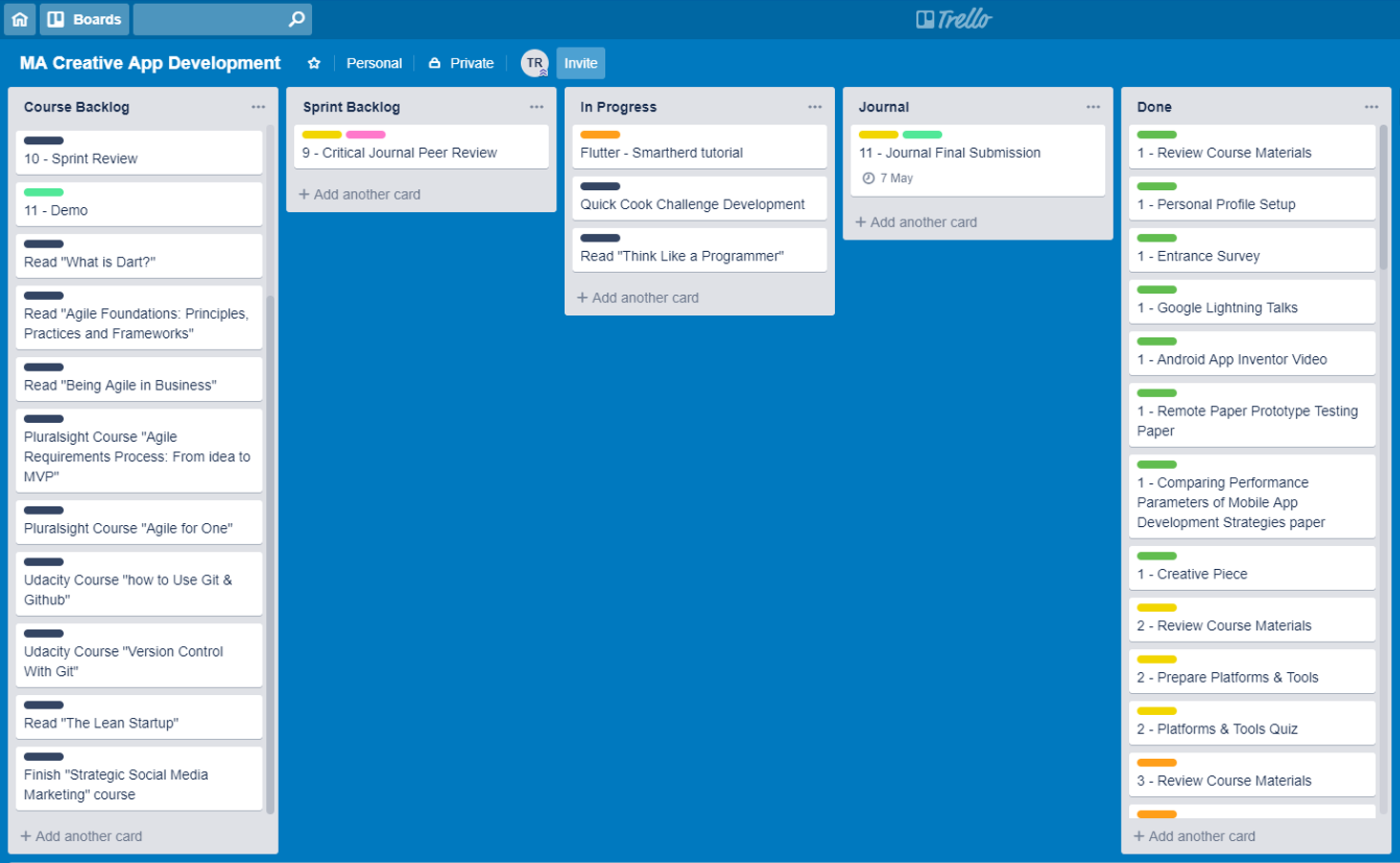
Through some trial and error, I feel that I now have a better handle on the effective use of a Trello board to organise my work schedule, and I intend to take a more disciplined approach to sprint planning and review, going forward.
Commerce
New practices, tools and techniques have emerged since I first set out on my corporate career path, and while I have some level of familiarity with them, this module has persuaded me to delve deeper into the likes of Lean Startup Methodologies, Business Model Canvas and Strategic Digital Marketing over the duration of the remainder of my MA studies, so that I can embrace them for the benefit of my intended startup venture.
Emerging Technologies
Data science – big data, machine learning and predictive analytics hold particular interest for me. I have a lot of data analysis experience and enjoy unleashing the power that good data holds. I am aware that these are huge areas of study, but I intend to take my analytical talents to the next level by exploring these areas in more detail, with the purpose of creatively integrating these technologies into the app product that I eventually build for my intended startup venture. This will dramatically improve the value offered by my business model.
I am looking forward to getting stuck in to some practical development work in GAM730, and it will be great to gain some practical experience of working on a collaborative project managed with Agile principles and techniques. But, before that happens, I’m really looking forward to enjoying some downtime to overcome the ‘extreme reflection fatigue’ that I’m currently battling!
My experience with Github is minimal. I’ve used it intuitively, and tentatively, but my ignorance has delivered more problems than benefits. I am now pushing projects to Github directly from Android Studio, but I’m still yet to fully understand or apply the range of available features. Whilst my shortcomings with the facility hasn’t been too much of an obstacle to the quality of my work to date, I anticipate growth in its importance as the complexity of my code progresses.
By 3rd June, I intend to be comfortable with the terminology, and have at least a basic understanding of how to use Github through Android Studio.
The benefits of being fully conversant with Github will rise correlatively as the complexity of my projects develops. Particularly so when working collaboratively. As well as providing access-from-anywhere backup, Github facilitates tracking changes across versions, managing collaborative development projects, and seeking coding assistance from the Flutter community within Github. These benefits will all contribute to my progress as an efficient and effective App Developer.
I will start by familiarising myself with the terminology (push, pull, commit, fork, clone, merge etc.) to better understand the range of possibilities. I’ll use online tutorial resources to learn and integrate source control into my development process, starting with 2 Udacity courses, and then reassess my needs.
Primarily a solo project, I will seek assistance from the study group if/when necessary.
Specific
I will be able to explain each term in the Github glossary and apply the main features through Android Studio
Measurable
I will consider each of the 29 terms achieved when I can explain it in my own words and practically apply the concept, where appropriate.
Achievable
Time is my constraint, so I’ll use my Trello board (8) to incorporate a commitment to understanding 7-8 glossary terms per sprint.
Relevant
Proficiency with source control will be increasingly beneficial, if not essential, for upcoming modules, and beyond.
Time-Bound
This will be achieved by 3rd June. I will ring fence 4 hours per week, over the next 4 sprints to achieve this.
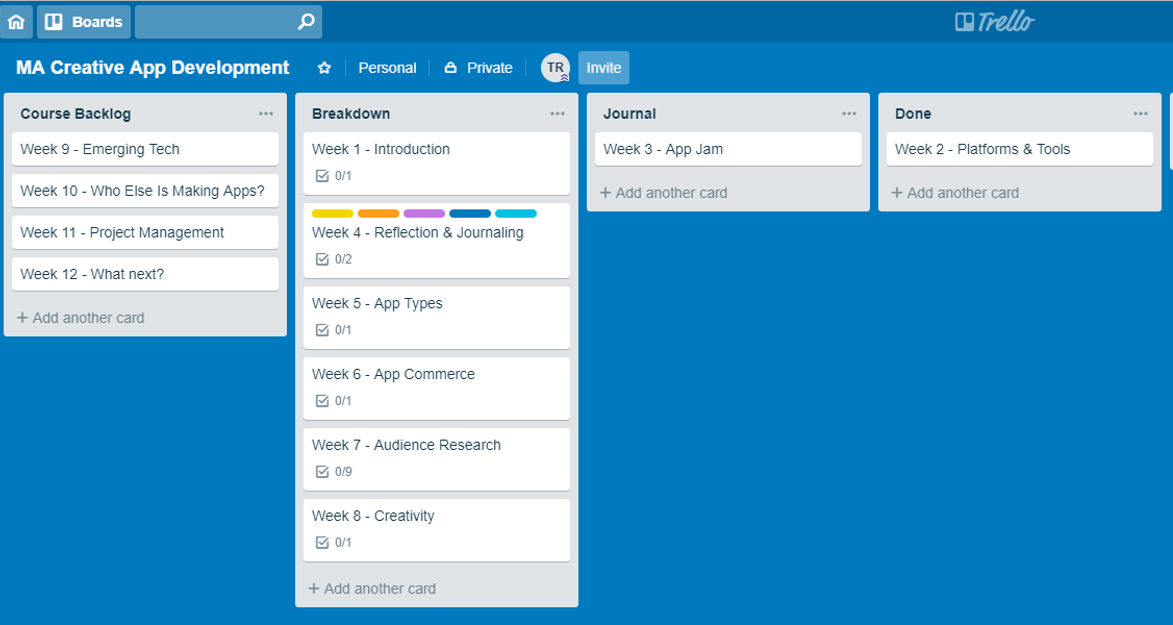
Now that I have visibility of each task (rather than at a weekly topic level) I can see exactly where I am.
I can now use this board to properly plan and review my weekly sprints, and organise myself more efficiently, and so I consider my SMART goal from week 9 to be achieved.
It’s also quite nice to be able to slide each card to the right, as it helps to garner a satisfying feeling of accomplishment.
In all honesty, I’ve struggled with reflective practice. I’m more comfortable facing questions requiring convergent thinking, with a definitive correct answer to strive for, than those requiring divergent thinking to reach an outcome judged with subjectivity. I’m somewhat uncomfortable with the uncertainty of whether I’m meeting expectations, and, being an analytical thinker, I find it difficult to know when to stop. I do proactively seek frequent feedback, which helps.
Until very recently, I’ve
viewed reflective practice as an inconvenience – a distraction to my learning
progress. This attitude, along with my focus on developing my Flutter
capability, is largely responsible for my falling behind with my critical reflection
journal. While I’ve recognised the value
in understanding what went well (and should be applied again) and what didn’t
(so do something different) in a given context, I’ve been puzzled by the apparent
heavy emphasis for this module.
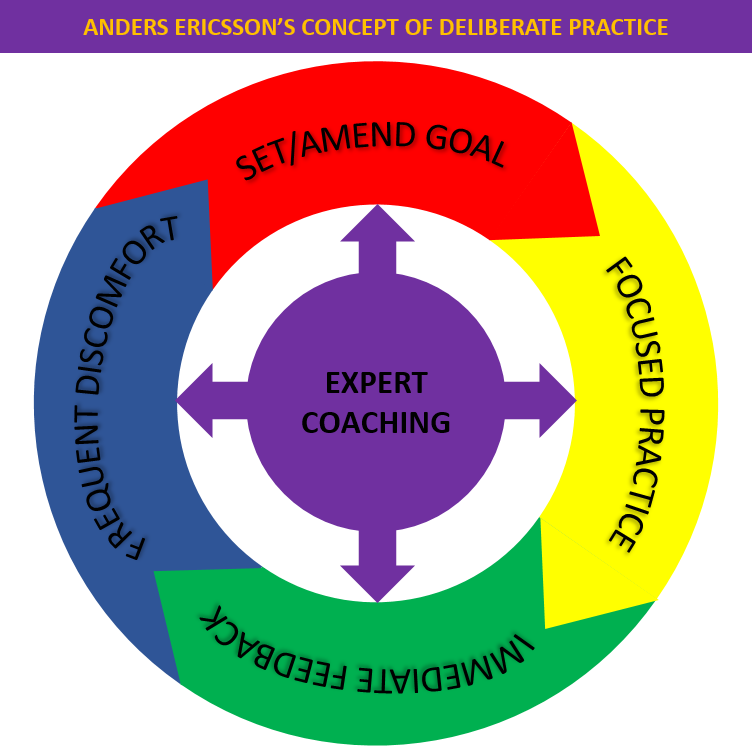
However, I’ve recently engaged with Anders Ericsson’s work on Deliberate Practice. It provoked a turning point for my perception. Building the following representation of Ericson’s cyclical process for incremental development of expertise helped me to see that the structured proactive approach to reflection stimulates creative insight and mental adaptation. This encourages elaboration, and the formation of associations between known and new concepts, to form alternative representations, and view situations from different perspectives to expedite learning.
I’m beginning to recognise
that I should embrace reflective practice, as it could actually be my passport
to app development mastery.
My Critical Reflective Journal
will be brought up to date by 29th April
Deliberate practice expedites learning. Active retrieval provides a self-assessment of my comprehension, which is fundamental in identifying improvement opportunity, enabling me to effectively plan future activity for efficient progress.
I have 3 weeks to post blog entries for weeks 5 to 11. Using my notes, I will dedicate 6-8 hours per week to achieving this.
Regular requests for Tutor/study
group feedback, will help me continue to achieve incremental quality improvement.
Specific
I will post journal entries reflecting on the work that I have covered in weeks 5 to 11.
Measurable
I will use my Trello board to plan and implement weekly sprints, to include journal entries covering 2-3 weeks coursework, and chart my progress.
Achievable
Time is my key constraint, but I can afford to allocate 6-8 hours per week to achieve this. I’ve kept notes on everything that I’ve worked on.
Relevant
This module requires submission of a complete journal, and it’s a skill that I will use to assess and drive the progress of my continuing professional development.
Time-Bound
This will be done by 29th April. I will complete entries covering 2 weeks coursework, each week, over the next 3 weeks
My proposed business venture requires an app with reach to the majority of the market, so my preferred development strategy is to use Google’s open source Flutter framework to create mobile apps for both Android and iOS platforms. Flutter uses Dart, a strongly typed object orientated language, to build a single code base that is compiled to native code for both platforms, eliminating the need for separate code sources. Ahead-of-Time compilation removes the need for a bridge, so Flutter apps achieve faster and superior performance over those from alternative hybrid development frameworks, like React Native and Xamarin.
Bringing a very limited amount
of Java coding experience to the course, and only managing to gain a brief
introduction to Flutter at that time, restricted my deliverables to for the app
jam to just a paper prototype for my “Quick Cook Challenge” concept. However, my Java work provided some familiarity
with object orientated programming principles, which facilitated my shift to
Dart, and I’ve found the language to be considerably easier to learn. I’ve since built several basic apps under the
instruction of tutorial courses (1 Dart and 3 Flutter) that I’ve now (almost) completed. I’m becoming increasingly comfortable working
with the Flutter framework, and rapidly gaining confidence in building basic screen
layouts with step-by-step instruction.
I’m also beginning to apply and deepen my comprehension by anticipating
small code snippets within tutorials, ahead of the implementation. Engagement
with the community through social media, particularly Facebook groups, Twitter
and Medium, is also helping me to explore the potential that Flutter offers.
Once I’ve completed my third Flutter
course, I will build my own layouts for the “Quick Cook Challenge” app from the
jam.
While Flutter development will be an ongoing process for me, this SMART goal focuses on the short-term progress that I intend to make, in preparation for the next module. The following diagram illustrates my long-term vision for my route to mastery of the Flutter framework. The curve is inspired by Charles Handy’s concept of “Life Cycle Thinking” , and Whitney Johnson’s application of his S-curve (or Sigmoid Curve) concept to illustrate the development of competence in a new domain of expertise. I further developed this concept to reflect the anticipated evolution of the Flutter Framework, and the continued learning opportunity this will present during the “Mastery” phase. The red arrow indicates my perceived current progress along the curve:
Over the long-term, I
anticipate 4 phases of development:
BEGINNER:
Learning to use Flutter to the point where I am capable of building a complete functional
low-complexity multi-screen app, with effective screen transitions and logic that
makes the app useful.
RAPID
PROGRESS: Exploring more advanced Flutter widgets and features, incorporating
them into higher-complexity apps
PLATEAU:
A period of consolidation and experimentation, using widgets and plugin combinations
in concert to develop more creative and original apps
MASTERY:
An infinitely ongoing phase for me to really test and push the limits of
possibility within the framework, and expand the possibilities by developing my
own plugins.
By 3rd June I will
have built a complete functional prototype for my “Quick Cook Challenge” app (from
the jam) to reach the end of my ‘Beginner’ phase.
Proficiency in developing Flutter
apps is the key core capability I want to gain from this course. I’d considered the alternative strategy of
partnering with an established Developer in order to launch my startup, but for
various reasons (primarily financial and control), I opted to upskill myself
instead. If I don’t achieve app
development competency over the duration of the course, I will consider myself
to have underachieved.
Tutorial courses work, and I will continue with them, but I need to incorporate alternative methods to help take my understanding and familiarity to a deeper level. I will use Google’s Flutter Widget Catalogue as a guide, and build my own representations of standard widgets (the building blocks of Flutter). I’m a visual learner, so building models that are meaningful to me provide opportunity for elaboration and active retrieval, which, according to Anders Ericsson’s Deliberate Practice theory, are proven strategies for strengthening comprehension.
I will prioritise the widgets with a Pareto (or, “law of the vital few”) approach, assuming 20% of the standard widgets will deliver 80% of the results I need. Joseph Juran suggested the principle after recognising that economist Vilfredo Pareto’s observed 80/20 relationship between land ownership and population, held validity as a general rule of thumb for much wider application. A relevant example: Microsoft reports that fixing the top 20% of reported bugs eliminates 80% of errors and system crashes. After addressing 20% of the widgets, I’ll add to my catalogue as I use new ones.
This milestone is predominantly a solo project, but support is available within the study group and the wider Flutter community. The SMART goal is:
Specific
I will build a functional prototype for my “Quick Cook Challenge” app.
Measurable
I will construct a Trello board to chart progress, and manage my schedule effectively, implementing weekly sprints to achieve the complete app.
Achievable
Time and technical capability are my constraints. The Trello board will help schedule my time effectively, and I’ll use tutorials and Stack Overflow to assist with any challenging aspects.
Relevant
This is the foundation milestone for my future Flutter progression, which is a key factor for success for my intended startup. It will also enable my contribution to collaborative coding projects during upcoming modules.
Time-Bound
This will be achieved by 3rd June. I will dedicate 18 hours per week to achieving this.
My week 8 SMART goal was to read “Hooked: How to Build Habit Forming Products” by Nir Eyal. And what a fascinating read it was!
Hooks and stickiness were raised in the course materials in week 8 and I thought it would be an interesting and valuable area for further research, and I wasn’t wrong.
Nir Eyal is a Behavioural Psychologist with a particular interest in consumer behaviour within a technology context. His book, “Hooked” sets out to explore why some apps capture the attention of the market, while others just don’t.
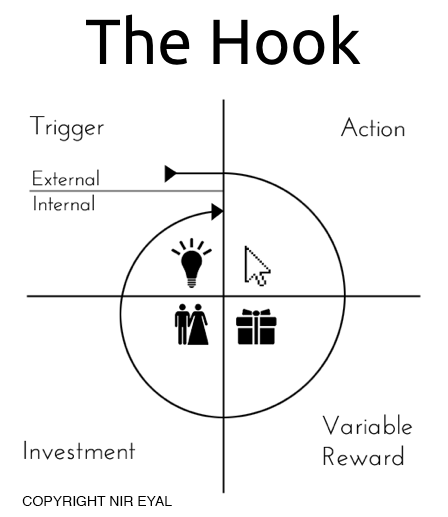
Based on years of research, Eyal has identified the four elements that must be integrated into a product’s design in order to attract users, maintain engagement, create a desire within the user to use the app repeatedly, and even establish this behaviour as a habit. The book discusses the application of the Hook Model that he developed:
The Hook Model represents a 4 stage process that an app designer should lead their user through in order to create a stickiness and elicit habitual engagement. The 4 stages are:
1. Trigger
A trigger is something that prompts the user to take action of some kind. Initially, external triggers must be provided (for example, a notification with button to be clicked) in order to guide the user into your app. Eventually, this should cultivate an association between visiting your app and the rewards that this action brings for the user, and so internal triggers will take over as the impetus. Internal triggers are (mostly negative) emotional cues, such as boredom or hunger, that your user learns to satisfy by using your app. Internal triggers are critical to habit formation.
My “Quick Cook Challenge” app concept could provide an external trigger in the form of a strategically timed (maybe 3pm as it tends to be a low point in the day and people start to think about what they will have for dinner) notification which, when clicked, provides a randomly selected recipe. Hopefully, over time, the user will build an association between their feelings of hunger and the rewards (recipes) that the app provides, and so this internal trigger will be the foundation upon which a new habit will develop for them.
2. Action
The action is a simple behaviour that is carried out by the user with the expectation of a resultant reward. For example, entering keywords and clicking the search button in Google with the expectation of receiving answers to questions.
My “Quick Cook Challenge” app concept will provide lists of recipes to choose from, prompting the user to scroll to see what is available, and what’s new.
3. Reward
The reward is the reason for visiting the app. It is the value that the user receives from the app. The nucleus accumbens is the area of the brain that is activated by desires and cravings, and it is most active when a reward is anticipated. The brain is fascinated by the unknown, and so the nucleus accumbens can be further stimulated with the added suspense of an unknown or unexpected reward (for example, the content is different each time a user logs into Facebook). This is the reason why apps that provide variable rewards tend to become habitual far more quickly than those offering a predictable reward, with the habit lasting longer before the user begins to lose interest.
There are 3 categories of reward:
Rewards of the tribe
Value derived from other people that makes the user feel good, for example, replies and likes on Facebook or retweets on Twitter.
Rewards of the hunt
Value derived from the user’s own efforts, for example finding interesting articles from scrolling through Pinterest.
Rewards of the self
An intrinsic pleasure, with an element of variability, such as a feeling of accomplishment, achievement or completion, for example, levelling up on Candy Crush.
The more types of reward that an app offers, the better the chances of establishing a user habit.
My “Quick Cook Challenge” app concept will provide rewards of the tribe in the form of feedback and ratings on their own posted recipes and culinary attempts. Rewards of the hunt will be provided when they find recipes from other people that interest them, and reading feedback that has been left for other people’s recipes and results (which can be entertaining). Rewards of the self should be realised when the user has followed a recipe, enjoyed a meal, and satisfied their hunger because of it. if sponsorship could be secured, physical rewards and prizes could also be earned for the best and worst rated recipes and results, which would further encourage usage of the app.
4. Investment
The investment phase is where the user is encouraged to provide value to the app, for the purpose of increasing the likelihood of their next pass through the Hook Model process. This investment could be monetary (for example purchasing extra lives in a game) but other examples might include increasing their reputation through contributing to group discussion, gaining followers or generating and sharing content. All of these investments build to create a barrier to exit for the user, which might be a considerable factor in retaining their loyalty, should the user ever be faced with the decision to stick with your app or ditch it in favour of direct competitor.
My “Quick Cook Challenge” app concept provides many opportunities for user investment. They can upload their own recipes, provide feedback and ratings for recipes that other users have uploaded, share the results of their culinary efforts in anticipation of comments and ratings, and provide comments and ratings for the culinary results of other users.
While my “Quick Cook Challenge” app concept already incorporated many of the elements of Nir Eyal’s Hook Model, this was more by accident than by intentional design. I think the Hooked Model is an incredibly valuable find, and I fully intend to purposely incorporate what I’ve learned from this book in all future app designs.
I have used the Trello tutorial to set up a board (essentially a Kanban board) for my coursework, but it isn’t currently working for me. I see the benefits of using a board, but I’ve structured it in a way that doesn’t provide clear visibility of the tasks. I used a card for each week of the course, with tasks listed within it, making it difficult for me to see task-level detail. Consequently I haven’t used or updated the board since.
By 14th April I will have a restructured Trello board, using a card per task, and grouping them into relevant weeks, and categories with a colour key, to give full task-level visibility.
A well-structured Trello board will help me plan and implement weekly sprints to manage my progress more effectively. Moving cards to the right will also provide an element of motivation for me.
I will add a card for each of the tasks from the entire module and assign a colour to categorise it, to group tasks according to the course week, or goal that it relates to. I will then prioritise the tasks and move each card to the appropriate status lane. I will then continue to use the board on an ongoing basis to chart my progress. Tutor/study group feedback might also prove helpful. So, I will commit to the following SMART goal:
Specific
I will improve my project and time management by restructuring my Trello board, using a card for each task, categorised with a colour key.
Measurable
The success of the restructure will be measured by how effectively it serves me going forward. Further adaptation will occur as part of the ongoing board management process.
Achievable
Time is the only constraining factor, but the restructure should only take me around 2 hours.
Relevant
A well-structured Trello board will help me to better manage my progress throughout the course, and beyond.
Creativity is the topic of conversation for this week. The word creativity sparks an immediate connection with artistic talents for me, but taking a step back from that and looking at creativity in a broader sense, it is a set of thought processes that are engaged, in order to resolve a problem or situation in a unique and innovative way.
The provided video discussed how clever creative app design can incorporate hooks and stickiness to increase user appeal and promote increased engagement. I hadn’t given much consideration to this previously, but the video triggered a desire in me to learn more.
I would like to gain a better understanding of the techniques that I can use in the design of an app that will help to attract and retain users, as well as encourage increased frequency of interaction with my apps.
So I’ve put together a SMART goal:
Specific:
I will gain a better understanding of how I can incorporate hooks and stickiness into my app design by reading the book “Hooked: How to Build Habit Forming Products” by Nir Eyal.
Measurable:
I will use what I learn from the book to identify features that I can build into my “Quick Cook challenge” app to act as hooks and improve stickiness.
Achievable:
I have ordered a copy of the book. The only other constraining factor is time, and reviews indicate that this is a relatively quick and easy read.
Relevant:
Hooks and stickiness are important elements in app design as they play a significant role in attracting and retaining users and also influence the frequency with which the user engages with your app.
Time-bound:
I will attempt to read this book over the next 2 weeks. There are only 9 chapters (including Introduction) and so I will aim to read 1 chapter each evening.
The Lean Startup Methodology is an approach to developing products and businesses that minimises risk and increases the efficiency of the development process. This is an iterative process of testing hypothesis to validate the viability of the product for the intended market, and releasing incrementally improved versions of the product based on validated learning.
The Lean Startup approach works in conjunction with the Business Model Canvas, along with Lean, value Proposition and Mission Model Canvases. From the little knowledge that I currently have, it appears to incorporate Agile principles in developing a startup business and/or product that the market will help to develop, and consequently increase the likelihood of acceptance.
Gaining a better understanding of Lean Startup Methodologies, and further reading on the Business Model Canvas, should serve me well when it comes to developing my own startup, and so I will set myself a SMART goal:
Specific
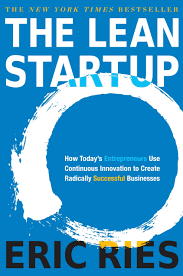
I will improve my understanding of the Lean Startup methodology by reading the book “The Lean Startup: How Constant Innovation Creates Radically Successful Businesses” by Eric Ries
Measurable
The course will improve my approach to building a digital startup, to reduce risk and increase the probability of launching a successful business.
Achievable
I have purchased a copy of the book and so the only other constraint that I have to consider is scheduling the time to read and understand it. As my current priority is to achieve proficiency with Flutter, I will delay this goal to run alongside the next module.
Relevant
My ultimate goal is to develop a startup digital business, and so the Lean Startup Methodology should prove highly valuable once I begin to work on this.
Time-Bound
I will have read the book by the 26th August 2019. With 16 chapters (including Introduction) I will commit to reading 1-2 chapters per week over the 12 week period of GAM730.
I have a commercial background, but I’m on the MA Creative App Development course because I want to be well equipped to create my own startup venture, with a mobile app sitting at the core of the business and I want to feel confident that I can launch and grow that business into a success story. So, I’m using the course to develop the full range of skills and competencies that I need to become a developer of great mobile apps.
Skills & Competencies
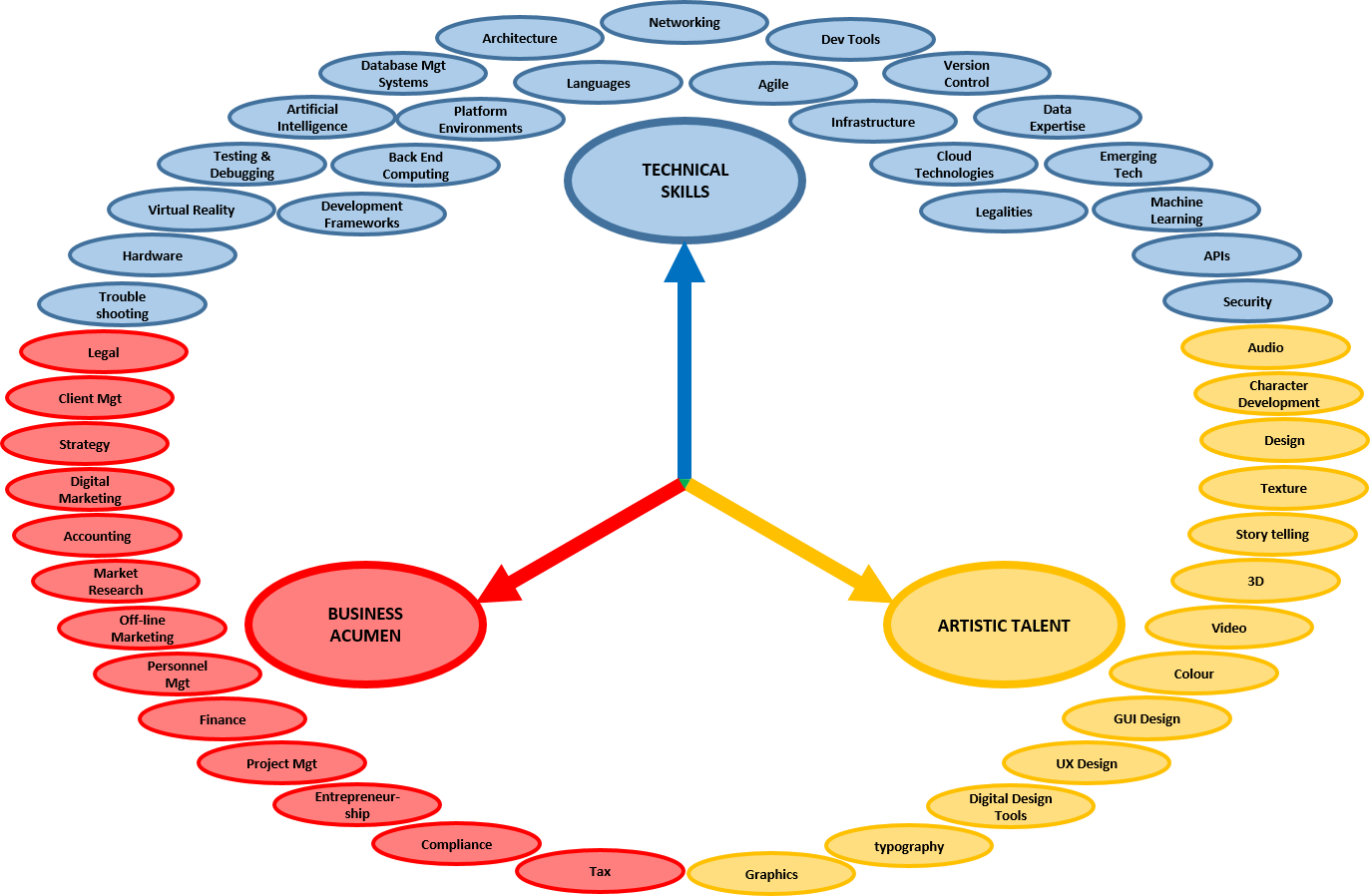
I started by looking at the key skills and competencies that
a great app developer needs, and through brainstorming, with some internet
research, I found myself developing a model to help me to see where I need to
be. This is how I see it:
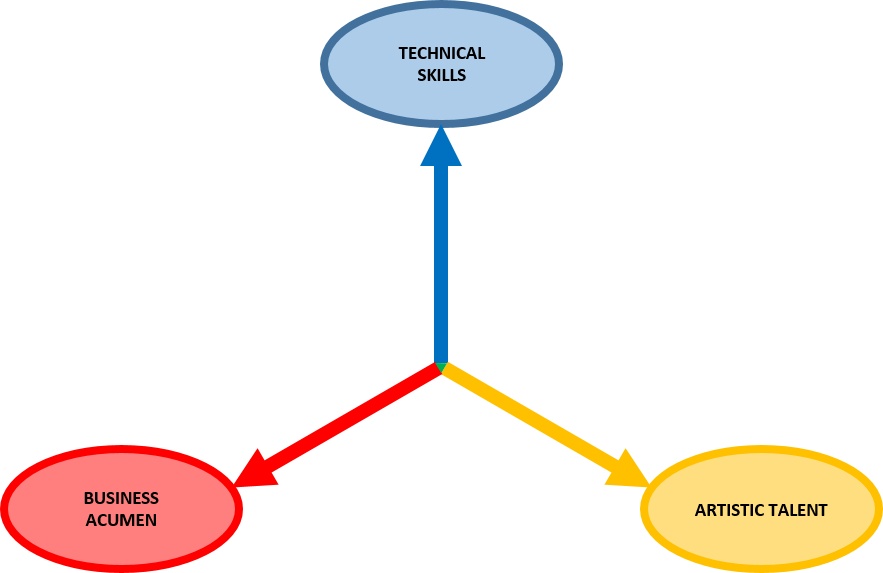
The skills, group nicely into a trinity of families:
Technical skills – so that I can create and build an excellent product
Business acumen – so that I can identify market needs and create a business model that successfully delivers a financially viable solution.
And artistic talent – so that I can deliver a user experience that supports the brand, creates another competitive selling point, and nurtures adoption and loyalty.
And I rank them in that order of importance for me.
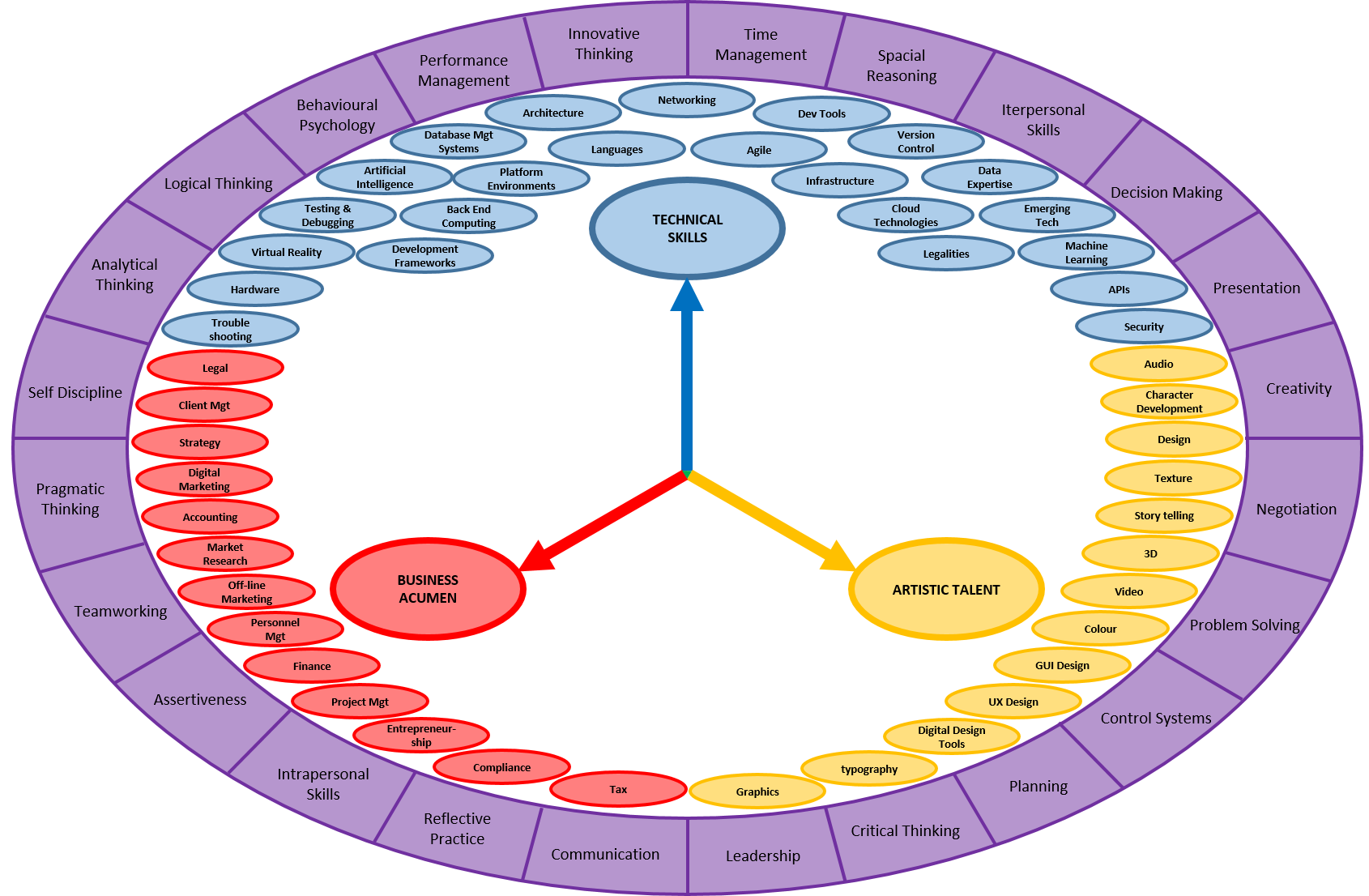
Each of the skills families is an umbrella for an array of hard skills, each with its own level of relevance and priority in terms of how it impacts my own short, medium and long-term objectives.
And all of this is supported by a range of soft skills.
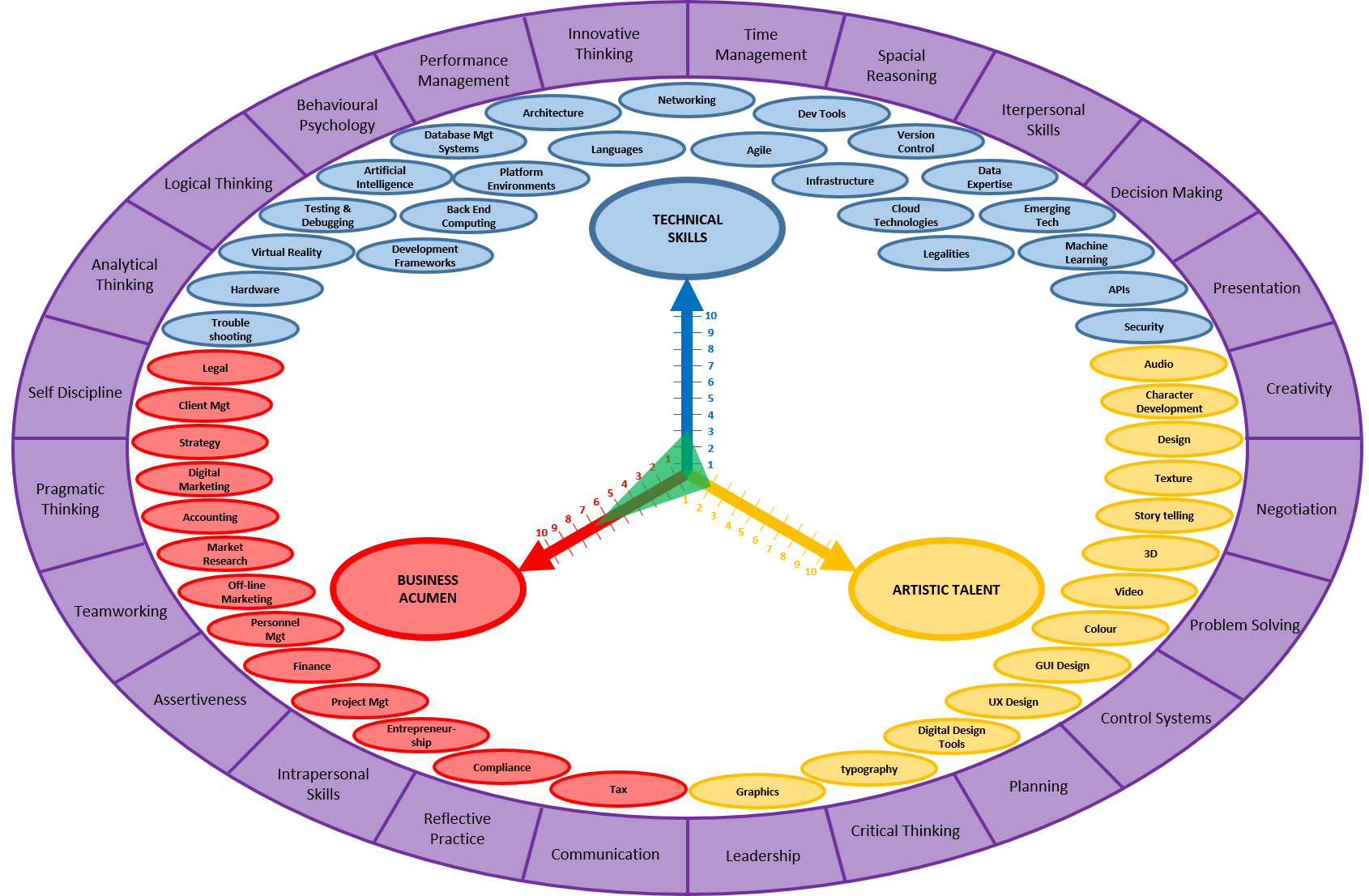
I conducted a subjective self-assessment of my starting
point, based on my achievement to date and peer comparison, and the green
triangle represents my perceived current capability as an app developer.
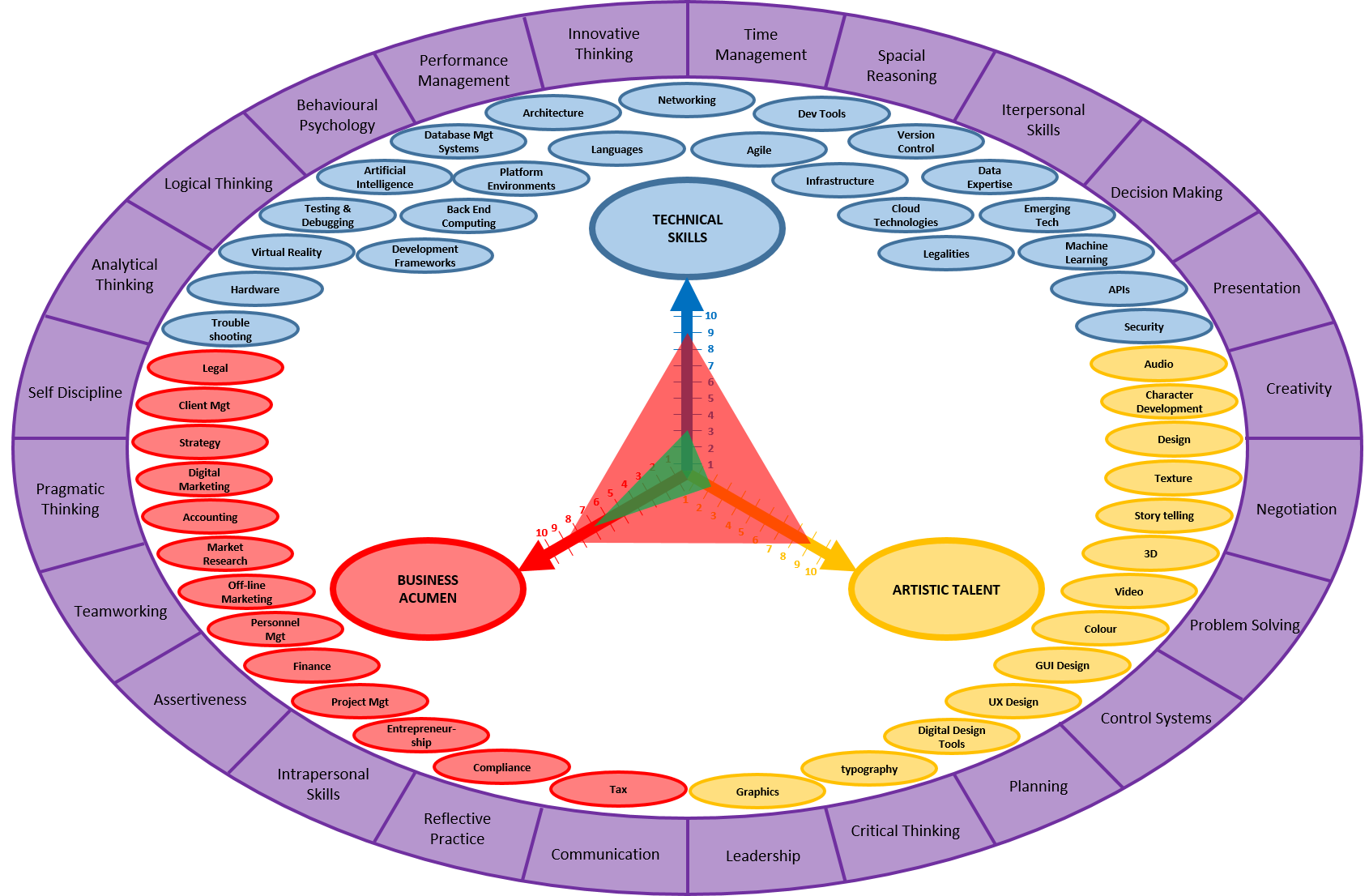
I intend to get my business venture off the ground on my own,
initially, and gradually build my team of specialists around me, as and when
necessary, and so I need to spend the next 2 years bringing my score for each
of the skills families to at least a 9.
The red area represents my currently perceived skills gap.
The arrows at the end of each scale, point toward infinity, representing
my appreciation for endless learning opportunity, in order to exploit new
technologies, rapid adaptation of developing industry trends, and satisfy
ever-changing consumer demands.
My priorities for the course lie with the development of my technical
skills. It’s imperative that I bring
those up to speed as quickly as possible, so that I have a solid foundation for
the rest of the course.
I may not have an IT background, but I do bring some solid
transferrable skills. I’m very
analytical and pragmatic, with a good balance of both logical and creative thinking
for problem solving. However, building this
model brought a realisation that I hadn’t fully appreciated the enormity of the
task ahead, and just how much of it is completely new to me. I’m viewing this as a stretching, but
achievable challenge that I’m fully committed to, but, at times, I’ve felt a
little overwhelmed by the size of the skills gap, and there is a degree of
imposter syndrome that I’m currently wrestling with.
I just need to keep a calm head, eat this
elephant one bite at a time, and trust in the support network and resources that
the course provides, to help get me there.
The App Jam
The week 3 app jam was an end-to-end development exercise, with a theme based on the words “guide”, “opponent” and “restricted”, which were generated using VNA cards. This was an opportunity for me to draw on everything I’d learned, and assess my strengths and weaknesses within that context. I knew from the outset that the jam had come far too early in the process for me, as I lacked the necessary technical skills. Although, I hadn’t discounted the possibility at that point, I knew that building a fully working app wasn’t a realistic goal for me. So, I primarily focused on what I could learn from the process of the jam, with the aim of creating a paper prototype and then building a fully working app if I could improve my skills sufficiently in time, but this became a secondary concern for me.
As expected, I didn’t get to build the app. But I did get a good experience of the
process, taking away some key lessons:
The right tools for the job
I need experience with the best tools for the job.
Flutter
I tried to get some Flutter experience before starting the jam. I’m now content that Flutter is the best development strategy for me, as it allows me to develop for both Android and iOS platforms with a single code base, and it’s reported to be relatively straightforward to learn. However, it’s completely new to me and there just wasn’t enough time to get to grips with it in any real depth.
Dart
Flutter uses the Dart language, and so a solid general understanding of that will also be highly beneficial for me.
Process flow tool
During the creative piece from week 1, I had identified a need to find a more appropriate tool than PowerPoint to draw up process flow diagrams, but I hadn’t managed to do this in time
Wireframing tool
and it’s a similar situation with wireframing. I did look at InVision as a possible tool, to help planning screen layouts, but learning how to use it was time that I couldn’t afford if I wanted to achieve anything else before the deadline. So I reverted to PowerPoint. It does deliver aesthetically pleasing results, but it’s time consuming and becomes fiddly when working with small detail. Maybe I should have settled for hand drawn sketches? I’ll explore this further.
Time estimation
I based my plan for the jam on what I’d learnt from the week
1 creative piece. While the structure was, on the whole, fairly sound, my time
estimations for each phase weren’t always very accurate. I compensated for slippage by adjusting and
capping subsequent tasks to stay on track.
Experience will help with this, but I’ll also look to adopt some Agile
principles to improve my project management skills.
Select projects that inspire me
I generated a list of theme ideas, and decided to pursue my “Quick
Cook Challenge” app idea, as it was something that I thought I might use
myself, and some rudimentary research identified that there might be an
opportunity in the market for it. But,
after working on this for a few days, I noticed myself beginning to
procrastinate, which told me that I wasn’t as invested in the concept as I’d first
thought, and I had to be quite disciplined to make progress with it. I might have avoided this by generating a
theme that I could really get excited about, had I afforded more time for the
theme generation phase, and applied a more strategic concept assessment and selection
criteria.
Subconscious thinking is valuable
Many of my better creative ideas happened while I was doing
something completely unrelated, with thoughts just popping into my head from
nowhere. I need to capitalise on this
and build purposeful breaks into my plan at the appropriate times, to allow for
this subconscious ideation to happen.
Taking all of this into account, my main objectives for the
remainder of the module are:
Objectives for the rest of module 1
Programming
Before the next Module starts, I will use Flutter to build a working prototype for the “Quick Cook Challenge” app, from the jam. I will apply the principles learned as I go through 6 Flutter and Dart tutorial courses, to create a fully working prototype. I will dedicate 18 hours per week to this, as it is essential that I can comfortably build an app of a decent standard, for the rest of the course. To further improve my capability, I will also read “Think Like a Programmer”, and engage with the Flutter community, by connecting with relevant individuals and groups on social media platforms, as well as sharing ideas with others within the study group who also have an interest in Flutter.
2. Version Control
By 26/04/19 I will be comfortable using Git and GitHub for version control, both from the command prompt, and through Android Studio, so that I am well prepared to work on collaborative projects. I will spend 2-3 hours per week taking 2 video tutorial courses.
3. Development tools
Before the next Module starts, I will select and learn how to use:
A process flow diagramming tool to draw process flow diagrams more easily
A wireframing tool to create medium fidelity screen plans more quickly
I will assess 2 or 3 of each type, analysing the benefits over using pencil and paper, and select the ones that I feel most comfortable with, if any. These tools could prove very useful during future app development projects.
4. Better time management
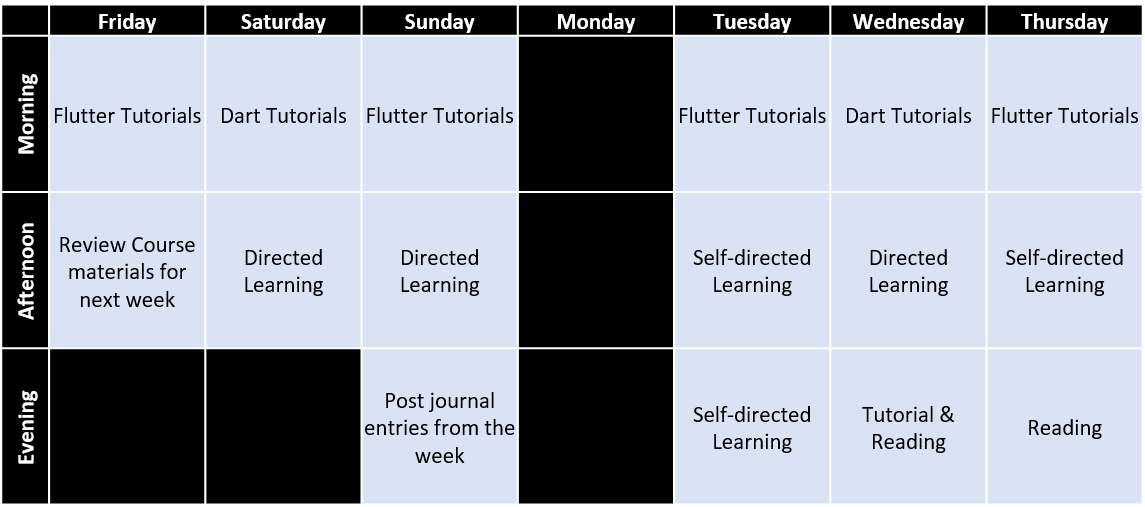
Feedback has, so far, been largely positive, and encouraging, but I’m finding myself falling behind the pace of the course, a little. I need to adopt a more structured, but flexible, approach to managing my week, to help me to achieve a good balance of technical skills and coursework. I’ll spend the next 2 weeks catching up, and then work to keep pace going forward, using this weekly plan, of 3 hour periods:
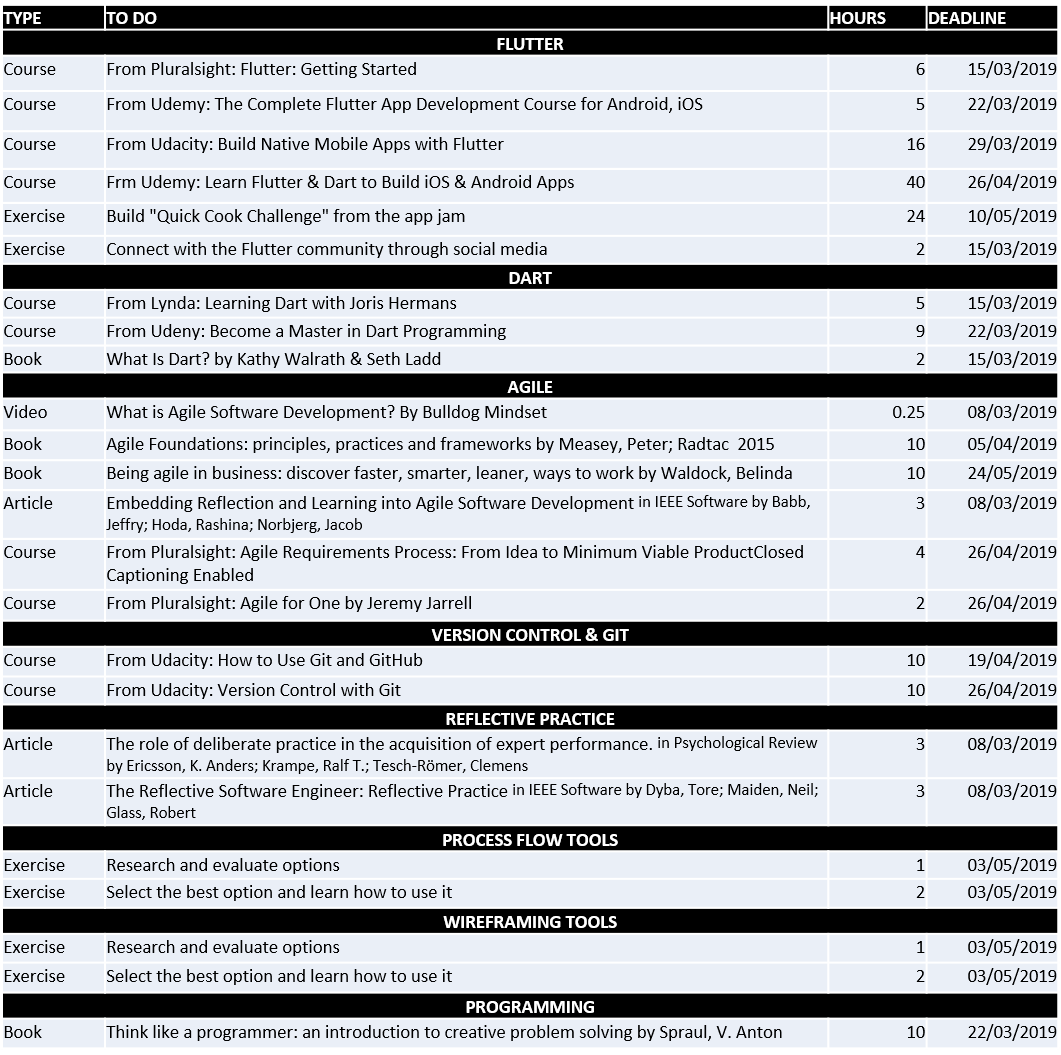
And this is how it all fits into my plan for the rest of the
module.






 My Journey to App Success