Audience Research

This week we’re taking a closer look at audience research. As I have touched on qualitative and quantitative data collection techniques in my post on market research, I will concentrate on persona (or avatar) marketing for this one.

I completed my Chartered Institute of Marketing Diploma in 1995. Avatar, or persona marketing was encouraged as an approach to targeting your market segment. This technique involves constructing a profile for a fictional person that represents your target market. If your target market can be segmented, you should construct a different persona to represent each.

While this approach might help the marketer to ‘speak’ to the target market as if they were a person that is known to them, I have always viewed this approach as risky. Perhaps even dangerous.

The thing is, people don’t necessarily fit perfectly into boxes. While some products or services might attract a certain, clearly defined, type of buyer, most won’t. The more detailed the profile that you build for your persona, the greater the chance you have of failing to recognise, or even alienating, a proportion of the true market for your product. This technique does encourage you to examine a broad array of the demographic characteristics and lifestyle factors for your fictional being: age, gender, educational achievements, job, which newspaper they read, family structure, location, what they drive, how they spend their weekends, which political party they vote for etc etc etc. You end up with a tightly defined profile for a person, which forms a pigeonhole. Then an integrated (and quite possibly myopic) marketing campaign is built, targeting people that fit that pigeonhole. When you think about it, how sensible is it to spend money trying to sell your product to someone that doesn’t actually exist?

That said, up until quite recently, I had been unaware of a better approach, and so I would advocate proceeding with caution, and being conscious to avoid over-profiling.

However, aware that it was over 20 years since I gained my marking diploma, and the emergence of the digital age in that time had provoked a paradigm shift in marketing (as well as all other areas of commerce), I decided to embark on a Strategic Social Media Marketing course from Boston University about 6 months ago. Things certainly have moved on in marketing in that time, and I was introduced to the concept of community (or network) marketing (personally, I prefer community marketing, as, back in the day, network marketing used to mean pyramid selling schemes that tended to have a negative reputation).

Community marketing involves the infiltration of existing online communities that are relevant to your product, industry or market. These communities serve the purpose of bringing people with a common interest together to discuss that topic and provide and receive value to/from that community. By finding relevant communities, you can more clearly identify the diversity of profiles that might be interested in your product. By just observing conversations, and the questions and answers exchanged, you can build up a good understanding of the the problems that these people want solved, and the pains that they want easing, helping you to develop your key value proposition.

Communities can be found in many forms, for example as Facebook groups (particularly good for understanding user profiles), Twitter hashtags, independent chat rooms and forums, as well as blogs, Medium articles and Quora Q&As.

Without realising it at the time, this is how I had formulated the business model for my intended app based startup. This course just formalised the approach for me.

This case study illustrates my point nicely: About 3 years ago, I did some work with a small business (who have asked to remain anonymous) that turn domestic lofts into easily accessible storage space by installing insulation, floor boarding, lighting, shelving and ladders. They wanted to grow the business from being a local sole trader, into a national company, using a franchise model. They initially took a persona approach to selling franchises, and built a couple of avatars, which seemed perfectly logically sound: One avatar was a trades person with aspirations of running their own business, while the other was a person leaving the military services with some relevant skills (Defence cuts were driving large numbers in this segment at the time). Both seemed to be fairly sound assumptions, but focusing marketing efforts on these two profiles wasn’t generating as much interest as was hoped for. Many things changed with the business over time, but one of the key differences that made all the difference was a shift to more of a community approach to marketing. By engaging with a more general franchise community, they found an enormous uplift in enquiries from potential new franchisees. They were attracting interest from people looking for an attractive franchise proposition, and what’s really interesting is that, while some of their franchisees are from a trade background (as was expected), a good proportion of them are from the commercial sector, escaping the rat race of middle and senior management – a sector that was completely unexpected, and would never have been considered with a persona approach. The business is now on a roll, and currently have 16 fully fledged franchisees (including accountants, an ex Finance Director an ex Managing Director and other professionals) and a pipeline of new franchisees growing faster than they can process them – a nice problem to have. The business has also been shortlisted for the British Franchise Association’s “Emerging Franchisor of The Year 2019” award, and will know whether they’ve won in June.

I hope this last example will be viewed as constructive criticism…

I believe that the marketing for the MA Creative App Course has fallen into the persona marketing trap. I initially dismissed the course as it didn’t appear to be serving my needs. The overview provided was speaking to gamers and creative types, and I definitely don’t fit either of those personas. However, buried deep in the “Who Is This Course For?” section, there was just one line that suggested that this course might be what I was looking for: “Someone who has an idea of an app they wish to create”. It was this line alone that eventually persuaded me to investigate further. It was only an in-depth discussion with Alcwyn Parker that properly demonstrated that the course was right for me. Marketing materials need to spell out the value proposition for the reader, making the connection between the product features and the readers needs (i.e. the product-market fit) blatantly obvious. I suspect that it is my marketing experience that helped me to recognise that I needed to proactively seek out the value that the course holds for me. I wonder how many others haven’t bothered to put in the effort to find the value for them? I would recommend some A/B testing as it would be interesting to see how a community marketing approach impacts the level of interest shown for the course.

I am still yet to complete the Strategic Social Media Marketing course from Boston University. I only got half way through before the MA Creative App Development course commenced (I had intended to run the two in parallel for 3 weeks, but this module was more full on than I had anticipated). The course has provided plenty of very useful and relevant information so far, and so I will set a SMART goal to finish the course over the time of the next module:

Specific

I will improve my understanding of strategic digital marketing by completing the Strategic Social Media Marketing course from Boston University.

Measurable

The course will give me a good insight into how digital products are marketed online and introduce me to tools that I can use to help with market research.

Achievable

There are approximately 24 hours of study remaining to complete the course, which I can schedule across the 12 week period of GAM730. The course is perfectly pitched at my level of capability.

Relevant

Familiarity with digital marketing techniques and tools is very important for app marketing and continuing market research throughout the product lifecycle.

Time-Bound

I will have completed the course by the 26th August. With 24 hours of study left, I will dedicate 2 hours per week for 12 weeks over the course of GAM730.

Market Research

The Chartered Institute of Marketing defines market research as: “The process of making investigations into the characteristics of given markets, e.g. location, size, growth potential and observed attitudes. “

Market research is often approached as a one-off standalone exercise to satisfy an immediate need. However, taking a more strategic approach enables you to continually shape and develop your market intelligence across the entire span of your product lifecycle, from concept to grave. As the old cliche goes, ‘knowledge is power”, and having an intimate understanding of your market enables early identification of opportunities and threats, and an agile response to changes in market forces, which could prove to be the competitive advantage that rescues your product from a potentially damaging situation, and turns it into a success.

Your strategic market research plan should be a subsection of your strategic marketing plan, supporting the integrated marketing strategy for your product. Just as your strategic marketing plan should be a subsection of your organisational strategy (if appropriate) contributing to the pursuit of the organisation’s objectives.

The starting point for market research should be a clearly defined set of objectives, perhaps to test your hypothesis and assumptions relating to the product and the market. Of course, the objectives will vary considerably, depending on many factors, but particularly where the product currently sits on the Technology Adoption Lifecycle Curve (from “Crossing The Chasm” by Geoffrey A. Moore).

For example, market research at the conceptual stage (not shown on the curve above, but comes before innovators) will be focused on finding and identifying potential users, and finding your unique selling point (USP) to distinguish your app from similar competitive offerings. In contrast, market research conducted at a point of maturity along the curve might be more concerned with which features the user base likes, which it doesn’t, what new features are wanted, and why. A well executed strategic marketing plan can have a significant positive impact on the length of the lifecycle of a product.

All too often, it is taken that user research = market research. While all user research is market research, not all market research is user research – it is just one element. There is so much more to be considered. Market research should be used to gain an understanding of the whole competitive environment that your app business is, or will be, operating in. There are many approaches to analysing and evaluating the market, but a good start is to employ a combination of Porter’s 5 Forces model and the STEEPLED analysis approach.

The 5 Forces model provides a framework for understanding the competitive pressures that your product and business will be subjected to, by investigating:

  1. Competitive rivalry
  2. Buyer power
  3. Supplier power
  4. Barriers to entry
  5. Threat of substitution

The STEEPLED analysis approach is a strategic planning tool that encourages a structured examination of the categorised factors that might affect your market (and consequently, your business and it’s products). This approach will help you to identify and evaluate your strengths, weaknesses, opportunities and threats (SWOT) at both organisational and product levels. This is done by considering how your business and your products are affected by (and maybe how they could influence) the current and predicted changes and trends in the climate, in terms of the following categorised factors:

  1. Socio-cultural
  2. Technological
  3. Economic
  4. Environmental
  5. Political
  6. Legal
  7. Ethical
  8. Demographic

After setting the objectives, quality and trustworthy secondary sources should then be investigated to answer as many of your questions as possible. If the data is already available, most of the work has already been done for you and so it is usually much quicker and cheaper than answering your questions with primary research.

Some good secondary sources app market information include:

  1. App stores
  2. Google Trends
  3. Apptrace
  4. Pew Global
  5. Statista
  6. Market Reports (e.g. Mintel)

Social media can also provide valuable sources of information. Observing relevant Facebook groups and Twitter hashtags, as well as following competitor accounts, could provide good feedback on user attitudes, or indicate shifts in trend and customer requirements.

Review sites are another excellent source of secondary research material. 5 star reviews for competitor apps can indicate the features that particularly please the user, so you should consider including them in your own design. 1-2 star reviews suggest that the user didn’t fully understand their own needs and/or the value on offer for that product – they got the wrong product. The real gems can be found in the 3 and 4 star reviews. They tend to contain sentences that start with something like “This app would have got 5 stars if…” That’s where the app failed to solve at least a part of their problem, and THAT is where your opportunity lies. Solve that problem with your app design and you are likely to win that user from your competitor.

Secondary sources might only answer so many of your questions, and so, it could be necessary to conduct some primary research, where you collect data directly from the source, in order to achieve your research objectives. The major advantage of conducting primary research is that you get the answers to your exact questions, however, the major drawbacks is that it can be far more expensive and time consuming than using secondary sources, and you must be sure that a truly representative sample is taken to avoid skewed (misleading) results due to sample bias. Surveys, focus groups, and interviews are some of the most common methods used in collecting primary data, but in the case of an app, it is a good idea to embed communication channels into your product so that users can make contact with any gripes and suggestions, or you can send requests for feedback. Setting up social media accounts for your app provides further opportunity for conversation with your user community.

Primary research should employ a mixture of qualitative and quantitative questioning to gather data. Qualitative questioning is open ended, enabling an unconstrained response, which is ideal for investigating attitudes and opinions. Quantitative questioning provides a number of options from which the subject select those that best represent their position. Quantitative data is much easier to statistically analyse and cross reference in order to extract useful information, as it is easily categorised. The benefit of using qualitative questioning as well lies in the potential divergence of response, which can bring completely new ideas, concerns and opportunities to your attention.

Option Selection – Market Research

I employed some rudimentary market research to compare the validity of the remaining two app concepts. I explored possible gaps in the market, with a view to identifying who is already doing something similar, pinpointing an untapped niche opportunity and the associated target market and formulate some semblance of a unique selling point to satisfy the needs and wants of that target market .

I looked at the mentor platform theme first and found that there are already quite a few platforms for matching mentors with mentees. Some are focused on a particular niche area, such as Mentor, for professional women, and iMentor for US students, but others, such as FindAMentor and Mentor City are more general, covering a wide range of mentoring opportunity.

I could have spent more time researching the market for mentoring, with the aim of identifying a niche to serve with a unique selling point, but decided to look at my cookery competition theme to see if I could spot any obvious opportunity there.

There are a LOT of recipe apps and websites. Too many to count. One of the most popular being “Yummly“, which carries more than 2 million recipes, and boasts a
worldwide membership base of over 30 million subscribers. There is clearly a huge appetite (pardon the pun) for recipe apps, which indicates that opportunity could well be present, if only I can find a fresh and unique angle that appeals to the market, whilst fulfilling the jam theme of “Guide”, “Restricted” and “Opponent”.

I then focused on cooking apps with a competitive/challenge element, and found surprisingly few. There is “Food Fu” and “Come Dine With Me”, which have (iOS only) apps that provide for holding a competition among your friends. And then there’s Reddit’s “52 weeks of cooking” challenge, which provides a theme each Monday, and encourages over 38 thousand subscribers to “cook something new”. There are also some small niche offerings, like “meatless Monday”.

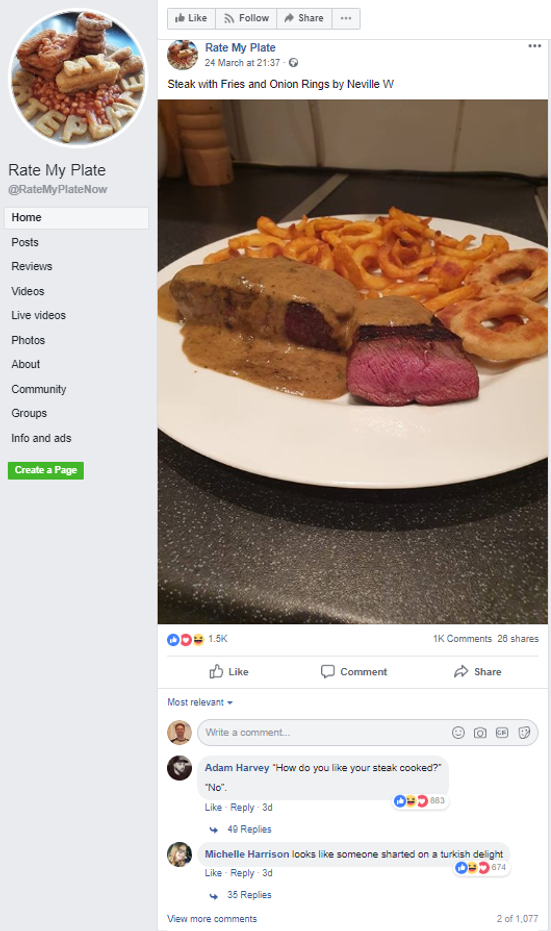
I remembered seeing a Facebook group called “Rate my plate”, where members post pictures of what they are about to eat, for other members to judge and comment on, largely with derogatory, but playful, humour.

This group has a following of close to 2 million, which indicates that there are plenty of people that enjoy having their efforts judged (and even overtly ridiculed!) and plenty of people that are more than happy to oblige.

I suspect that this group (and other similar groups) grew out of the “Nailed it!” phenomenon that swept the internet, where people posted the amusing comparative results of their efforts to emulate culinary creations that they found in the internet:

With the current health-driven push for people to cook more fresh food at home (rather than rely on takeaway and convenience meals) and considering the popularity of recipe apps, and communal food judging, I believe that there is a strong USP to be found with a fusion of the 2 concepts. This is the concept that I will pursue.

Evaluating My Strategic Options

The course videos provided a good starting point for investigating the wealth of development strategies that I could adopt. It is clear to me that my choice of strategy is a key decision at this point and I need to take the time to make the right decision.

My priority, when considering my options, is that I need to be confident that I am able to achieve my objective of developing mobile apps that are accessible for at least the majority of the market. So, my first step is to get a feel for the state of the market for operating system platforms to see who’s currently buying what:

The Mobile Device Market By Platform

I looked at the Statcounter website to get the latest available data. To start with, I pulled up the market share at a global level:


Worldwide: Android 75.4%, iOS 20.8%, other 3.2%

I was already aware that the market for mobile devices is essentially a duopolistic situation. However, I was surprised to learn that, globally, Android is the clear dominant force, claiming an average market share over the past year of 75.4% compared to that of iOS at 20.8%, and together, claim almost all of the market between them. All other operating systems combined make up only around 3.8% of the global market for mobile devices over that period.

So I thought it would be interesting to drill down to see how the market looks at a continent level:

Africa: Android 79.6%, iOS 7.5%, other 12.9%

Asia: Android 83.2%, iOS 11.8%, other 5.0%

Europe: Android 71.0%, iOS 27.3%, other 1.7%

North America: Android 49.3%, iOS 50.1%, other 0.6%
Oceania: Android 44.1%, iOS 54.6%, other 1.3%
South America: Android 86.8%, iOS 10.3%, other 2.9%

It’s interesting to see the differences between the continents. I would assume that the factors behind this largely revolve around price sensitivity, technological capability, and the breadth of app availability. Android is an open source platform, with many contributors to it’s development, whereas iOS has Apple in control. Android is therefore a far more flexible platform than iOS. The Open Handset Alliance is a group of 84 technology and mobile companies who have come together to accelerate innovation in mobile and offer consumers a richer, less expensive, and better overall mobile experience through the Android platform. This enables a broader range of device options across a much wider spectrum of price points, opening up the possibility of mobile device ownership, particularly so in the more price sensitive markets. The network effects of this, coupled with the relatively uncomplicated app market (compared to iOS) make it a more attractive platform for many 3rd party developers, which in turn leads to a greater breadth of app choice for Android consumers. Loyalty for both platforms is high, although slightly higher for Android.

I then went on to examine the data for several country level markets. I wont include them all here, but as the UK and the USA are probably my most relevant markets, here are the relative market share for these countries:


UK: Android 47.4%, iOS 50.9%, other 1.3%

USA: Android 44.4%, iOS 55.1%, other 0.5%

Even though I was certain that I need to develop for Android and iOS platforms, examining market data was a worthwhile exercise for 2 reasons: firstly, I have now confirmed that my assumptions were sound, and secondly, I had no idea whether or not I should also consider the need to develop for other platforms (I had Windows in mind in particular). The conclusion I draw from the market share data is that I definitely need to develop for both Android and iOS platforms in order to reach almost the entire market, but I don’t consider the other mobile platforms as being particularly significant for me. At least, not sufficiently significant to allow it to influence my choice of development strategy.

Strategic Options

Now that I know that I am targeting Android and iOS platforms, I need to consider the 3 high level routes :

  1. Native Development
  2. Progressive Web Apps
  3. Cross-Platform Development

Native Development

Built specifically for a single platform, native apps are written languages that the operating system is specifically designed to accept (Java or Kotlin for Android, and Objective-C or Swift for iOS. Native apps tend to offer a better user experience, superiority in terms of performance and they don’t necessarily require an internet connection (unless remote data storage reading/writing is required). The major setback is the need to develop a completely separate code base for each platform, which has a big impact on resource requirements (time, expertise, cost) across the entire development lifecycle.

Whilst it would be essential to be essential for me to develop an expertise in two languages and build and maintain two separate code bases, I do already have a certain amount of experience with Java for Android and so I consider native development to be a viable option for me.

Progressive Web Apps

Effectively, a mobile website built with JavaScript frameworks, designed to look, feel and work like a native app. This route provides a number of benefits, including
a single code source accessible to any platform with a browser, a fast responsive user interface and no need to go through an app store (this has it’s pros and cons). However, there are some drawbacks, which include: limitations on the accessibility of device hardware accessories (particularly on iOS), increased battery power requirement and limited access to plugins (such as Facebook login & verification facilities). Furthermore, from a personal point of view, I have no web development experience whatsoever and so I would be starting from scratch.

I feel that, for my purposes, the downsides outweigh the benefits, and so I’m dismissing progressive web apps as a viable way forward for me.

Cross-Platform Development

There is a mind-boggling wealth of framework tools that provide the capability of developing apps that run on both Android and iOS (and other operating systems in some cases). A single code base is written and maintained in language(s) specific to the chosen framework, which then employs a translation process (compiler, interpreter, virtual machine) to create compatibility with the target operating system.

The major benefit of adopting a cross-platform strategy is the efficiency of one code base serving both platforms is common to all of the framework tools. The common disadvantage is that they tend not to achieve the performance metrics that native apps do. Each framework has arguments for and against it’s adoption, which makes for an overwhelming compare and contrast exercise.

I have done a lot of reading around cross-platform frameworks this week, assessing the relative advantages and disadvantages of many of the more popular options (such as Reactive Native, Xamarin, Ionic and Apache Cordova, to name but a few). It’s not feasible for me to go into any depth of analysis, comparing and contrasting each against the others here, but I did find it difficult to find any one framework that offered a clear advantage for me.

Up until last week, I had no appreciation for the number of cross-platform tools that are available. However, I had come across Flutter, which I find to be an attractive proposition, and so I have been using this as a yardstick against which to compare the various framework options.

Flutter is Google’s free, open source mobile app SDK for crafting high-quality native experiences on iOS and Android in record time, using a single codebase .

Flutter uses Dart, a modern and concise, object-oriented language , which is compiled “ahead of time” (AOT) into native code for multiple platforms. This allows Flutter to communicate with the platform without going through a JavaScript bridge that does a context switch, achieving excellent app performance, and near instant app startup times, that outshine all other cross platform development methods. Additionally, the hot reload functionality (which uses a just in Time compilation model to compile in real-time) makes for a far more efficient development experience as there is no need to rebuild the entire code base every time – it just implement the changes. Dart being a relatively straightforward language to learn is also a big draw for me, as I still currently consider myself to be little more than a coding novice.

All things considered, Flutter remains a favourite option for me. However, I’m not without my reservations, chiefly due to it’s lack of maturity as a framework. That said, the risks are somewhat mitigated by the fact that Google is investing heavily in the development of Flutter (including compatibility with the web, as well as Google’s currently in development operating system, Fuschia), and it is currently widely considered to be the fastest growing SDK, with the fastest developing community (which appear to be incredibly enthusiastic, altruistic and loyal ).

In conclusion

I have decided to give Flutter a test drive to get a hands dirty insight into it’s potential. If that doesn’t work out for me, then I will revert to plan B, which is the native approach, where I pick up where I left off with Java for Android, and, then learn Swift for iOS, once my Java capabilities have been sufficiently developed.

I have identified a number of sources of tutorials, which I will engage with, in order to test my theory that Flutter is the future, and best choice of app development strategy for me.

Design a site like this with WordPress.com
Get started