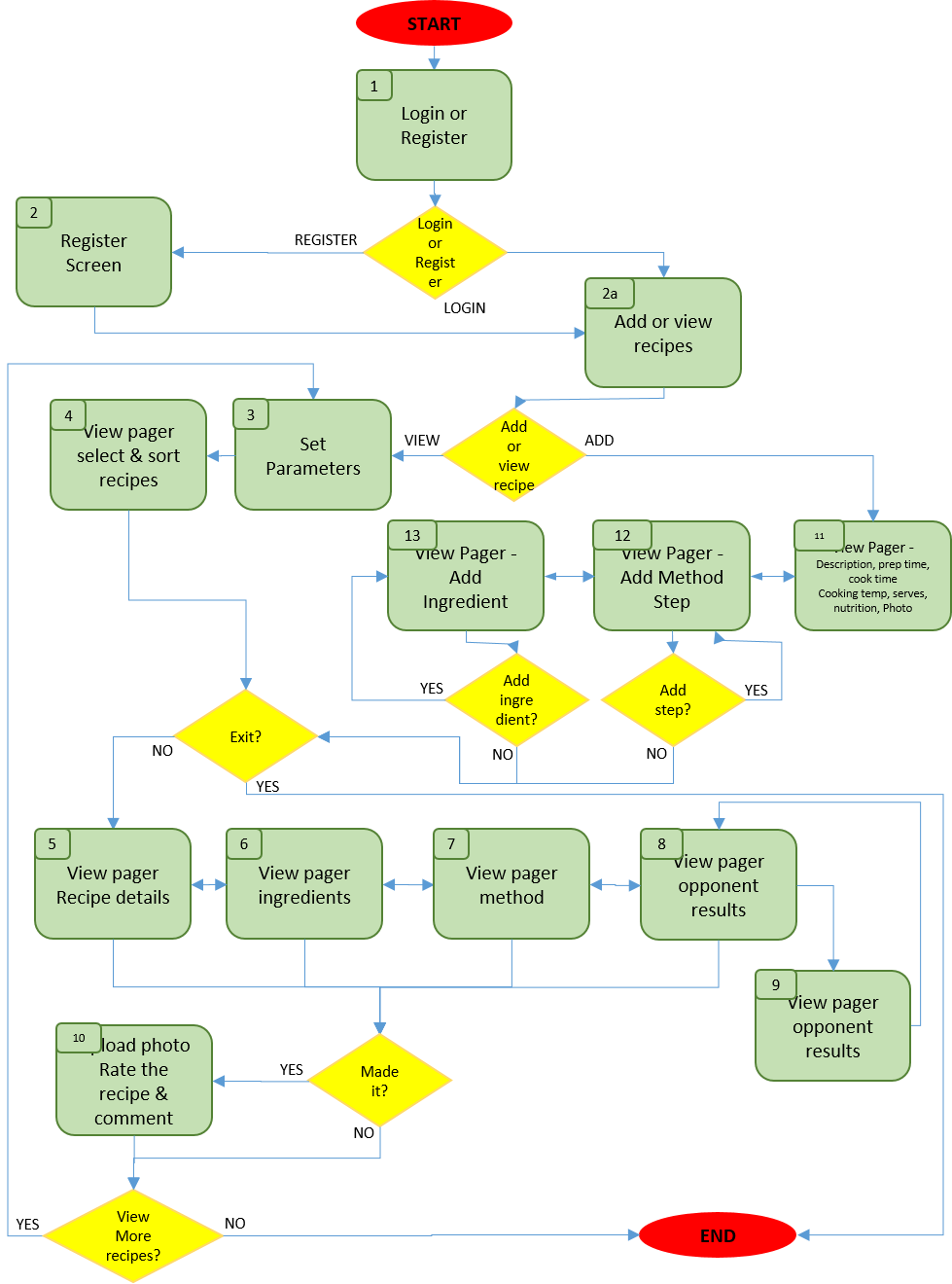
Having established the concept for my app, I set to work mapping out the process flow, in order to build up a picture of what screens are required, and how they should interact with each other to provide the user with logical paths, and decision points, from start to finish. Green boxes represent a screen and yellow diamonds represent a user decision, leading to alternative paths through the app:
Constructing a process flow diagram like this is very helpful in charting the various paths that must be provided for the user to intuitively move through the app, and the purpose of each screen that needs to be presented along the way.
Having learned from my experience in the creative piece from week 1, I constructed an initial version of this process flow diagram, and amended it when I identified any anomalies as I worked my way through the process of building screen layout prototypes. The final version is presented above.
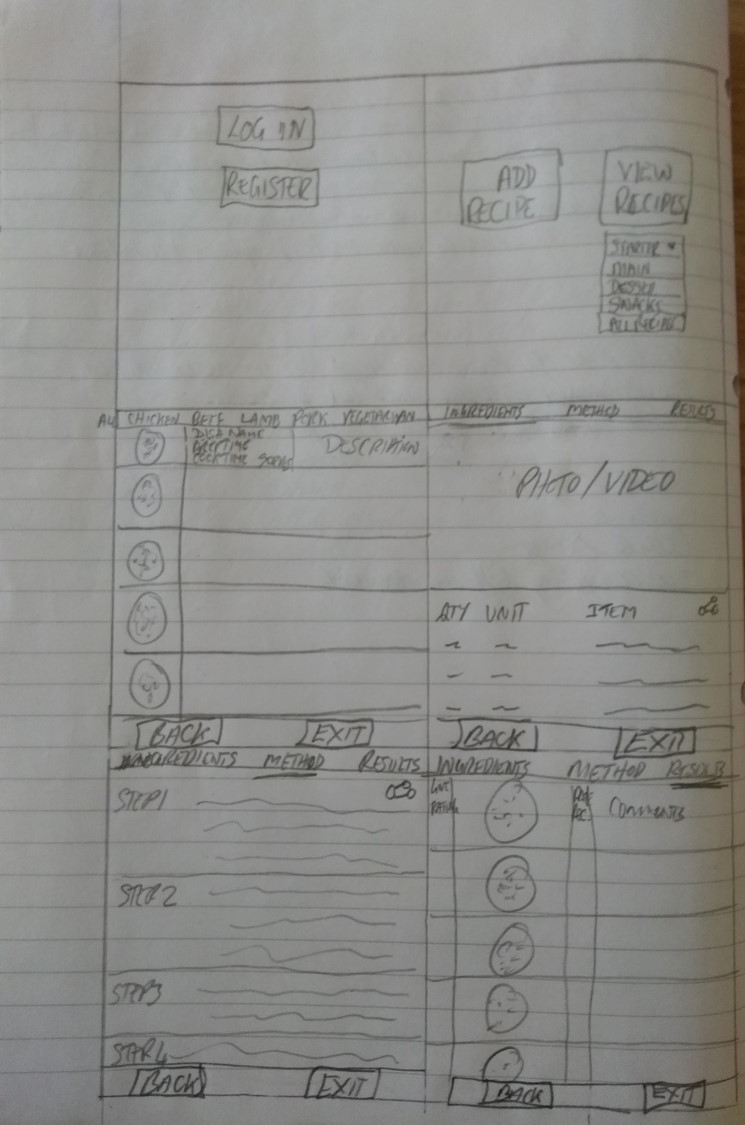
As a starting point for prototyping, I spent some time roughly sketching screen layouts, which helped to clarify the purpose and features of each of the screens, and to refine the process flow diagram.
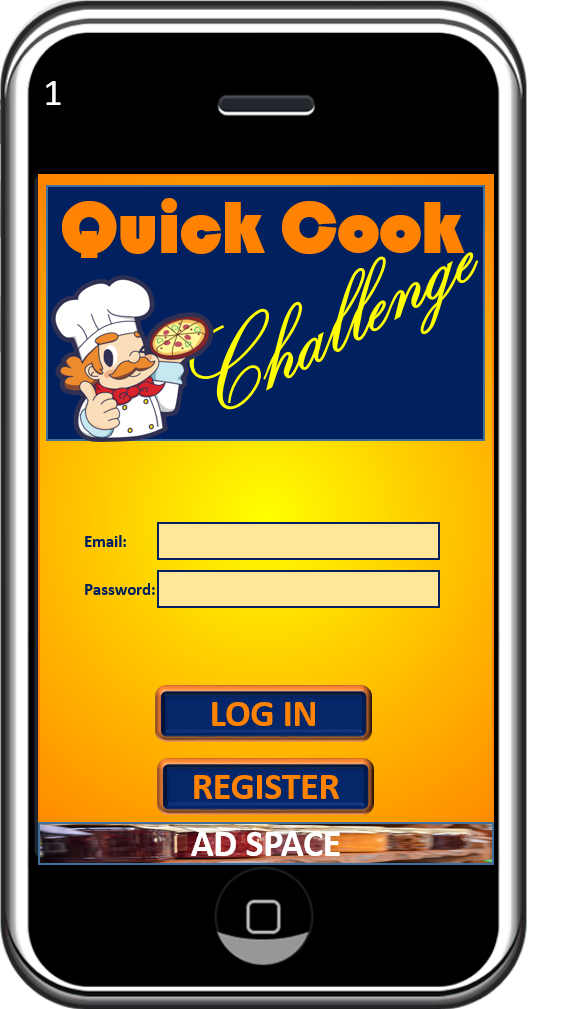
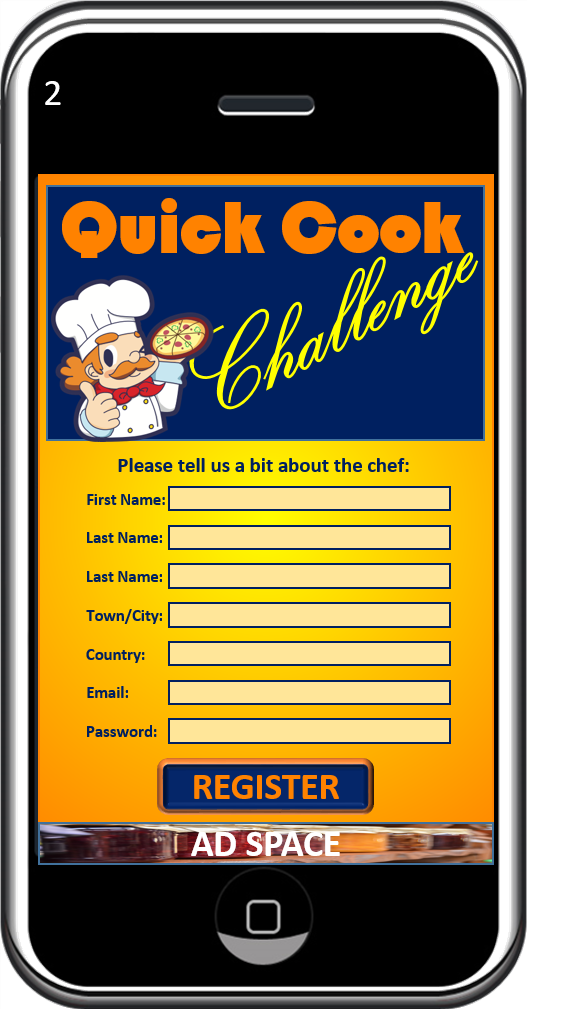
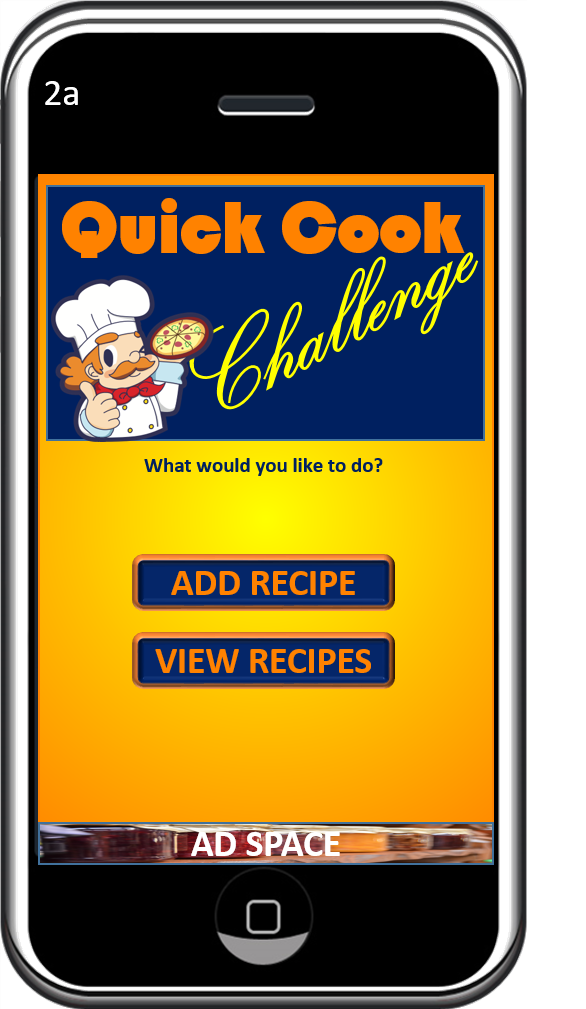
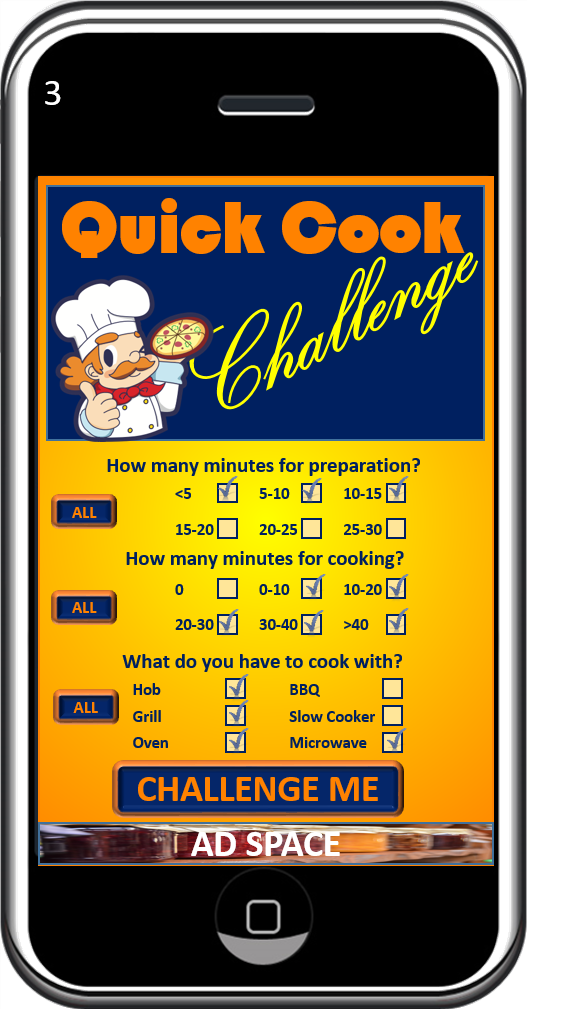
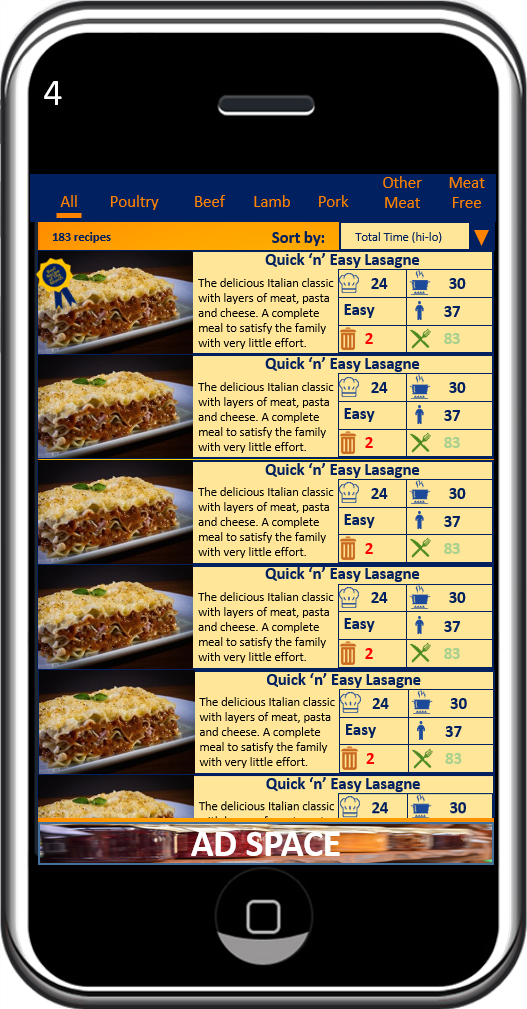
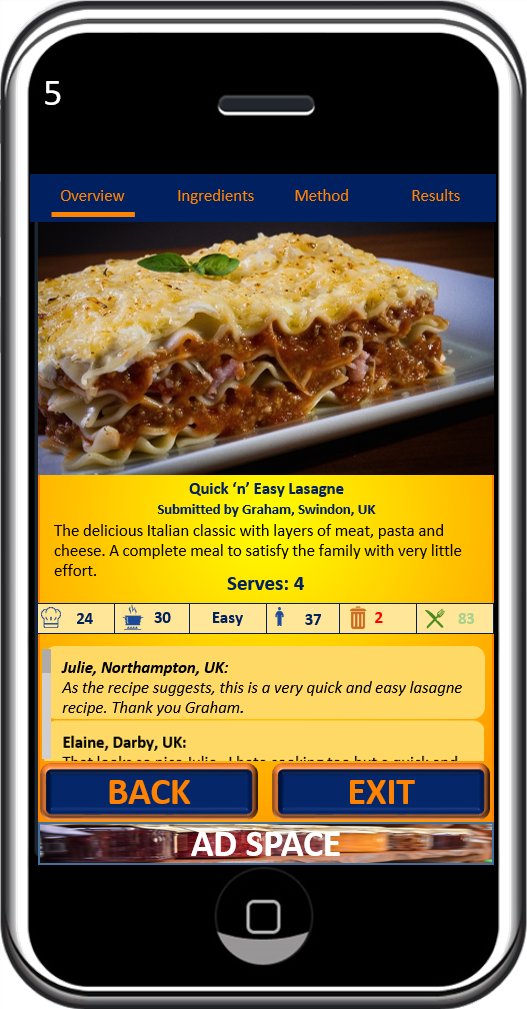
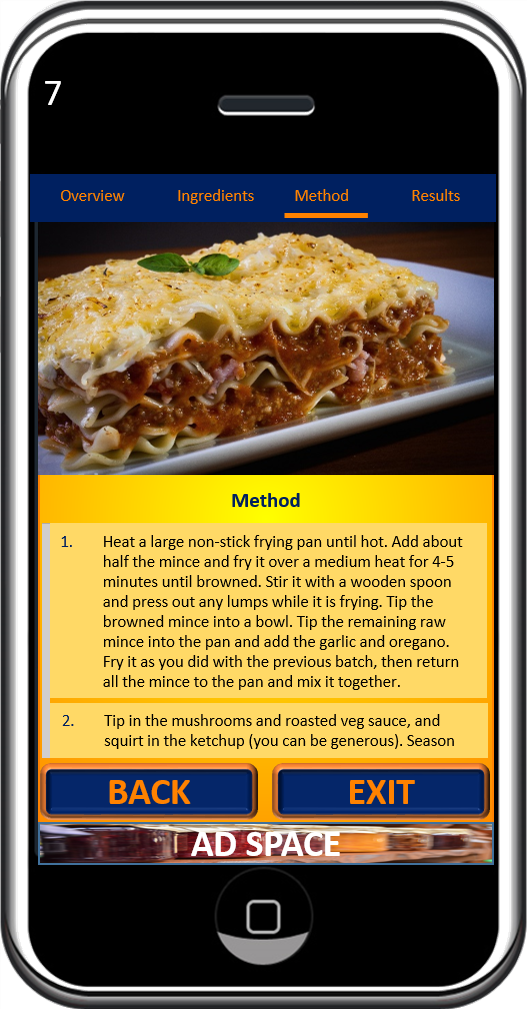
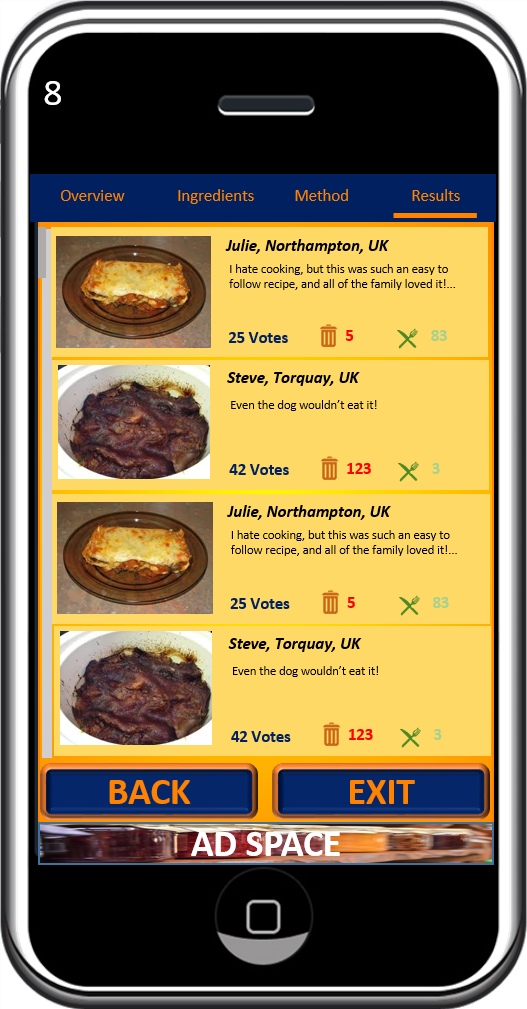
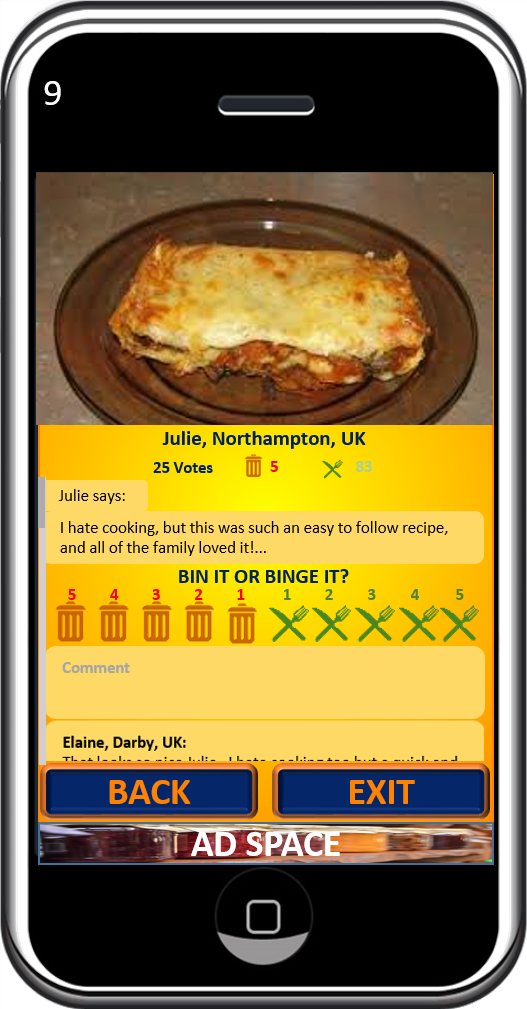
I then went on to convert those sketches into an increased fidelity (albeit still static) prototype . And here is the result of the prototyping exercise. Screen numbers correspond to the numbered boxes in the process flow diagram above:
Now that I’ve decided to pursue the cooking challenge , I need to further develop the concept to design an app product that will stand out from the crowd.
Time prevents me from delving into the much deeper market research exercise that I would undertake, if this were a product that I intended to actually launch. Without this constraint, I would have spent a lot more time analysing the market for the existence of cooking challenge apps, and gaining a more thorough understanding of what the market wants and needs, and what it doesn’t. However, the research that I have done indicates a gap in the market, and so I aim to exploit that gap with a concept that encapsulates the following elements:
Government agencies are pushing for people to reduce their consumption of takeaway and convenience meals
There is a general upward trend toward wanting to adopt and maintain a healthier diet
The most popular reasons for not cooking at home include:
people are busy and don’t have the (perceived?) time to cook at home as frequently as they should (and could)
a perception that convenience foods are much cheaper than fresh foods
People like recipe apps and “food porn”
People enjoy communal food judgement
So I came up with the concept of “The Quick Cook Challenge” – The only app where you can find or share the recipes that suit your lifestyle, and celebrate your culinary successes, and disasters, with the community.
The app will provide a double hook, encouraging users to the platform who:
want to share their recipes and try new recipes posted by other community members
seek the entertainment value of judging the efforts of the community.
Next, I will look at the flow of the app, and design screen layout prototypes to deliver the features of the concept…
I employed some rudimentary market research to compare the validity of the remaining two app concepts. I explored possible gaps in the market, with a view to identifying who is already doing something similar, pinpointing an untapped niche opportunity and the associated target market and formulate some semblance of a unique selling point to satisfy the needs and wants of that target market .
I looked at the mentor platform theme first and found that there are already quite a few platforms for matching mentors with mentees. Some are focused on a particular niche area, such as Mentor, for professional women, and iMentor for US students, but others, such as FindAMentor and Mentor City are more general, covering a wide range of mentoring opportunity.
I could have spent more time researching the market for mentoring, with the aim of identifying a niche to serve with a unique selling point, but decided to look at my cookery competition theme to see if I could spot any obvious opportunity there.
There are a LOT of recipe apps and websites. Too many to count. One of the most popular being “Yummly“, which carries more than 2 million recipes, and boasts a worldwide membership base of over 30 million subscribers. There is clearly a huge appetite (pardon the pun) for recipe apps, which indicates that opportunity could well be present, if only I can find a fresh and unique angle that appeals to the market, whilst fulfilling the jam theme of “Guide”, “Restricted” and “Opponent”.
I then focused on cooking apps with a competitive/challenge element, and found surprisingly few. There is “Food Fu” and “Come Dine With Me”, which have (iOS only) apps that provide for holding a competition among your friends. And then there’s Reddit’s “52 weeks of cooking” challenge, which provides a theme each Monday, and encourages over 38 thousand subscribers to “cook something new”. There are also some small niche offerings, like “meatless Monday”.
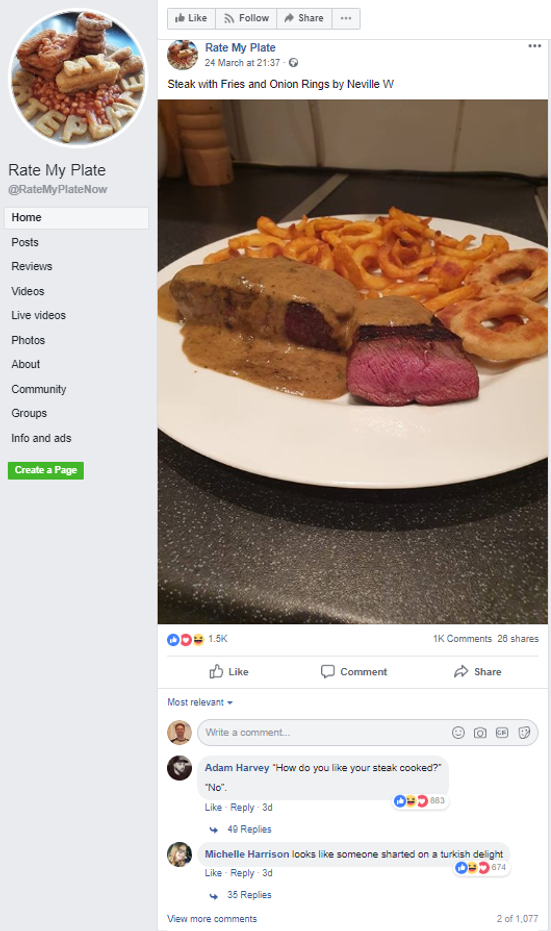
I remembered seeing a Facebook group called “Rate my plate”, where members post pictures of what they are about to eat, for other members to judge and comment on, largely with derogatory, but playful, humour.
This group has a following of close to 2 million, which indicates that there are plenty of people that enjoy having their efforts judged (and even overtly ridiculed!) and plenty of people that are more than happy to oblige.
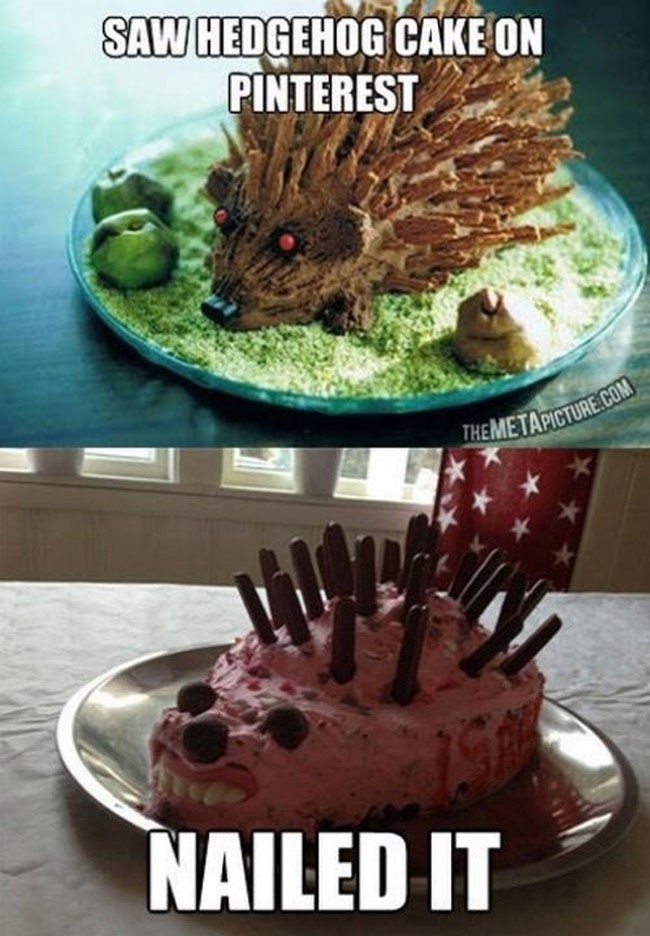
I suspect that this group (and other similar groups) grew out of the “Nailed it!” phenomenon that swept the internet, where people posted the amusing comparative results of their efforts to emulate culinary creations that they found in the internet:
With the current health-driven push for people to cook more fresh food at home (rather than rely on takeaway and convenience meals) and considering the popularity of recipe apps, and communal food judging, I believe that there is a strong USP to be found with a fusion of the 2 concepts. This is the concept that I will pursue.
I need to cut my list of possibilities down to just 2 to move forward with. I was expecting to have to spend some time deliberating this, but I arrived at my conclusion after asking just 2 questions:
1. Would I use it?
It’s so much easier to develop an app concept for which you consider yourself to fit the profile of the target market. Therefore, it was easy for me to eliminate the trades person’s work management tool and the children’s treasure hunt concepts.
2. Do I know enough about the subject area?
As time is a limiting factor here, it is wise to discard any concept that would require extensive research in order to generate authentic and meaningful content. I eliminated the habit breaker concept on this grounds. Although it is something that I think I might really enjoy bringing to life, I don’t know nearly enough about Neural Linguistic Programming, Cognitive Behavioural Therapy, or any of the necessary psychological techniques required to effectively make a difference. Extensive research time and collaboration with experts in the field would be essential and these are resources that I just don’t have at my disposal.
So that leaves me with two concepts to delve a little deeper into, to explore the possibilities:
The point of this stage is to analyse the result of the brainstorm, compare and contrast the lists that were generated, and start to consider the patterns, concepts and themes that emerge from that.
The Result
I took the full 20 minutes to came up with a list of general themes that could potentially lend themselves to solid app concepts, and satisfy the requirements of the jam theme. It then only took me a further 22.5 minutes to put a little flesh on the bones for each of the the top 5 themes to turn them into high level concepts (in no particular order):
A treasure hunt style game for children, to guide them around an attraction or location e.g. a zoo or maybe a city centre, imposing restrictions, such as road blocks, along the way, They could be collecting tokens as they go, which generates a score, dictating their position on a leader board, where they can see how they performed, relative to their opponents (all other users).
A cookery competition where opponents are guided by a recipe, with ingredient and time restrictions, with the video/ photo results uploaded to compete for likes.
A habit breaker, that guides the user from their nemesis (opponent) ingrained habit, to freedom from the restricted lifestyle that the habit causes.
A mentoring platform that matches those seeking guidance through a project, due to their restricted experience and/or ability. The user will then compete against opponent mentees to be selected by the mentor.
A CRM and work management tool for independent tradespeople, guiding them through an efficient process from initial customer contact, through quoting, invoicing and building an ongoing relationship with the customer. Many Independent tradespeople are restricted by time and know how when it comes to administration and establishing an effective process. Using this app will help them to win jobs over opponent tradespeople.
I have managed to bank almost an hour of allotted time for this stage. The ideas flowed faster than I had expected them to, but, I do put some of this gain down to an overestimation of the time required to achieve this.
I now need to apply some evaluation criteria to whittle this list down to just 2 contenders…
The purpose of this stage is to build upon the dictionary definitions of “GUIDE”, “OPPONENT” and “RESTRICTED” in a free flowing, unfiltered brain dump of word associations, synonyms, antonyms and anything else that might come to mind.
For the sake of clawing back the time lost during the dictionary definitions stage, I restricted my time on each of the words, and used good old pen and paper as my tools for the job, rather than employing digital methods. The benefit being that it is far quicker to scribble down the ideas as they come into your head, but this comes with the cost of presentation. In reality, this is not a problem as the true purpose is to generate ideas for yourself,. however, in this instance, the outcome will be shared in this blog post, so all I can do is apologise to the reader for my very untidy handwriting, which you will probably find illegible. I can read it, and that’s all that really matters.
The Result
I found that once I got started, the ideas flowed fairly quickly and effortlessly, up to a point, and then a more conscious thought process engaged as the speed of idea generation reduced. 15 minutes was adequate time for each of these words and so I called a halt early, which creates 5.5 minutes of extra time for the rest of my plan, which I’m sure I will be thankful for at some point.
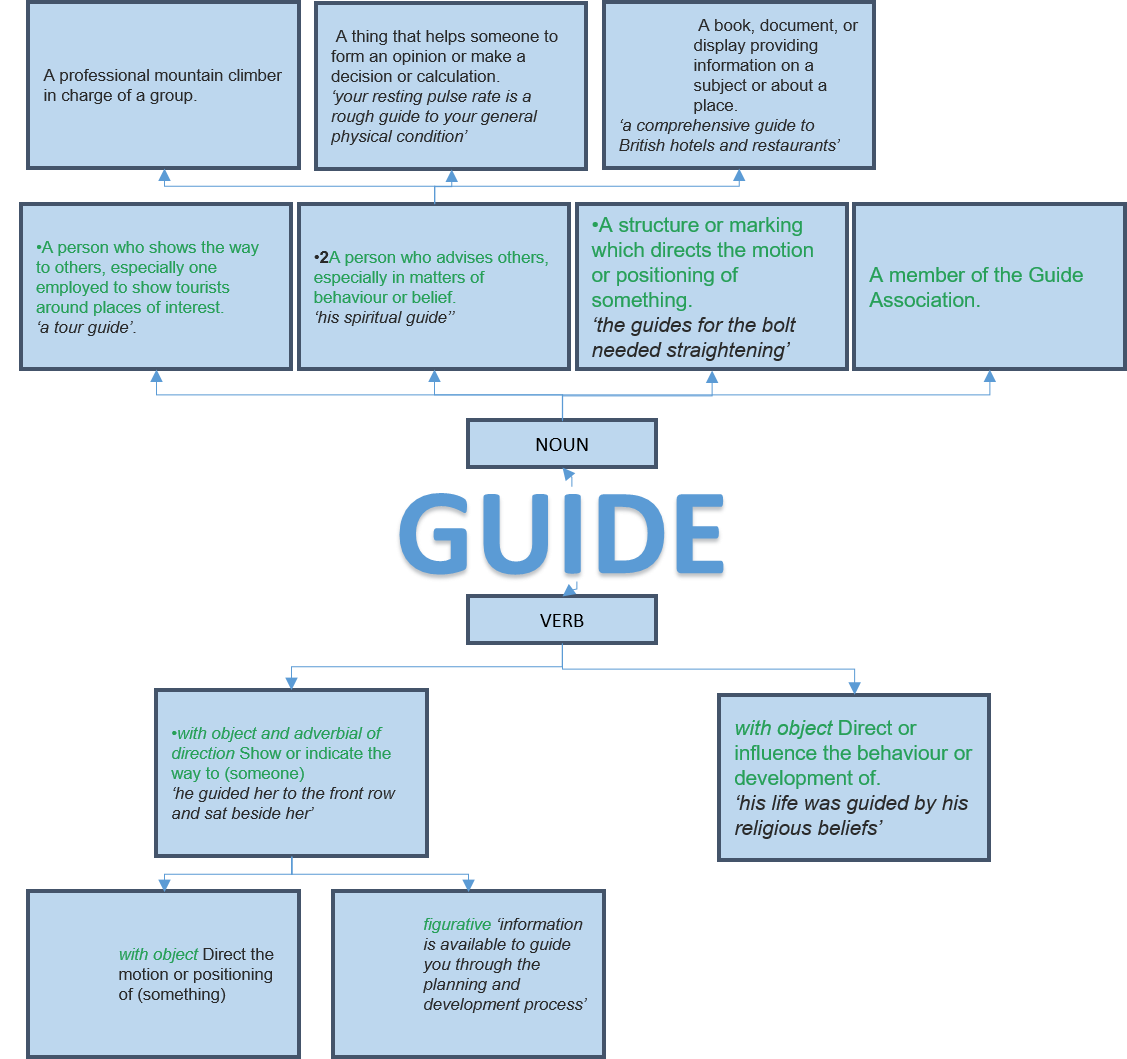
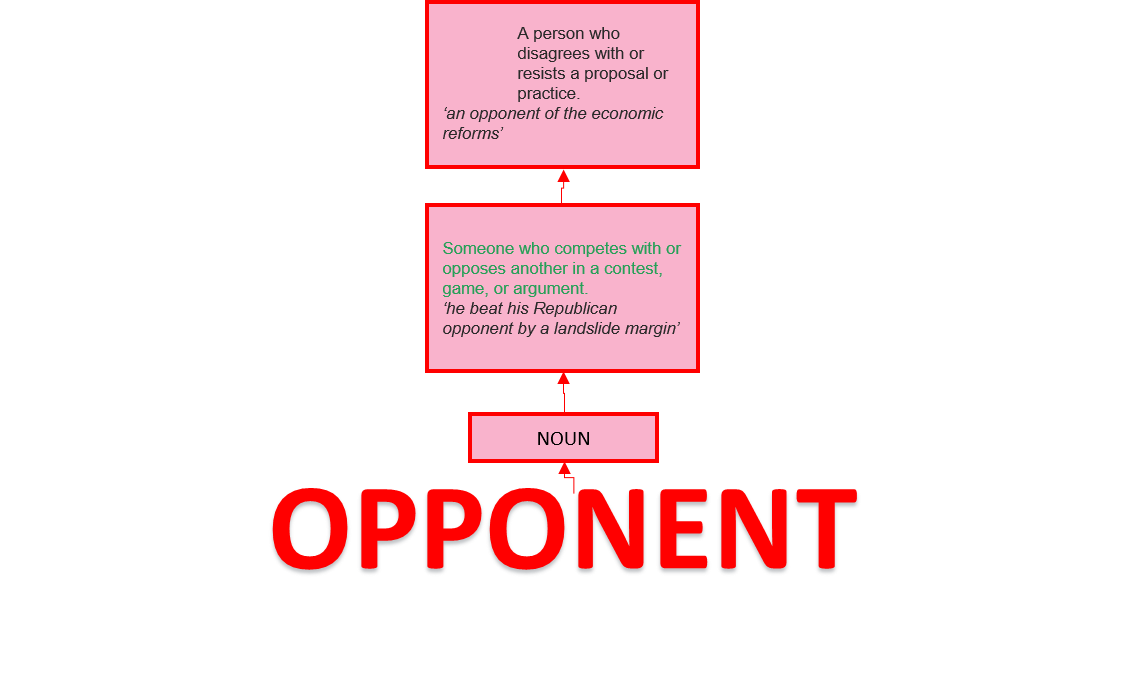
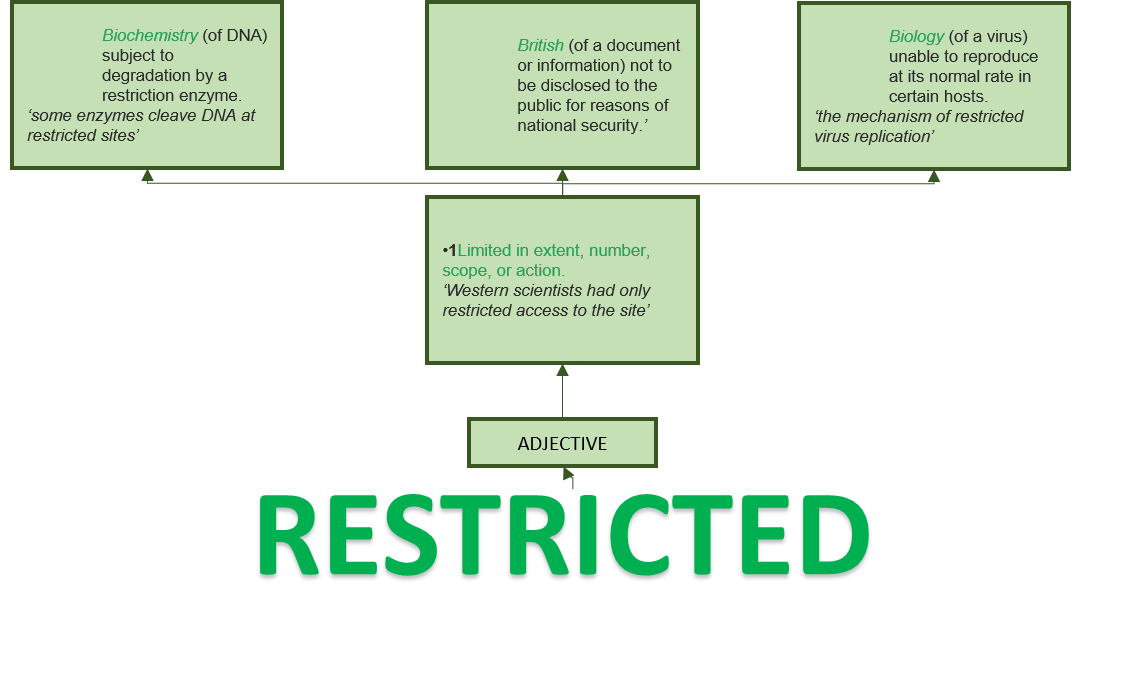
So the first step was to get a definition for each word from the Oxford English Dictionary online, and to then break each one down into appropriate chunks . The purpose of this is to provide a foundation for the creative process of exploring the possibilities that the theme affords. I used Powerpoint to do this as it is easy to rearrange the chunks as necessary.
The result:
Right off the bat, I’ve experienced slippage on the first task. This is down to a combination of factors:
The original estimate of time required for this task was a little on the optimistic side.
Breaking the definitions down into boxes in Powerpoint was a little more fiddly than I had anticipated.
I had watched the theme revelation video before tackling this stage, but I hadn’t noticed the attached papers that explained the use of VNA (Verb, Non, Adjective) cards. I have since read them (but not until after I had completed the Associations and Links stage) and I now realise that “GUIDE” must be used as a verb, and so I might have wasted some time arranging and considering the definitions and examples of “Guide” used as a noun. I could have saved some, if not all of the excess time by ignoring them. Looking at it from a different angle though, a guide, is used to guide. The two are practically interchangeable, and so, it could be argued that exploring “GUIDE” as a noun was time well spent.
I will compensate for this slippage, and bring the critical path back into line, by restricting my Brainstorm stage to 16 minutes and 50 seconds per word, instead of the planned 20 minutes, making up the 9.5 minutes overshot on this phase. To help with this, I will abandon any digital tools in favour of a fast and furious pen and paper brainstorming session.
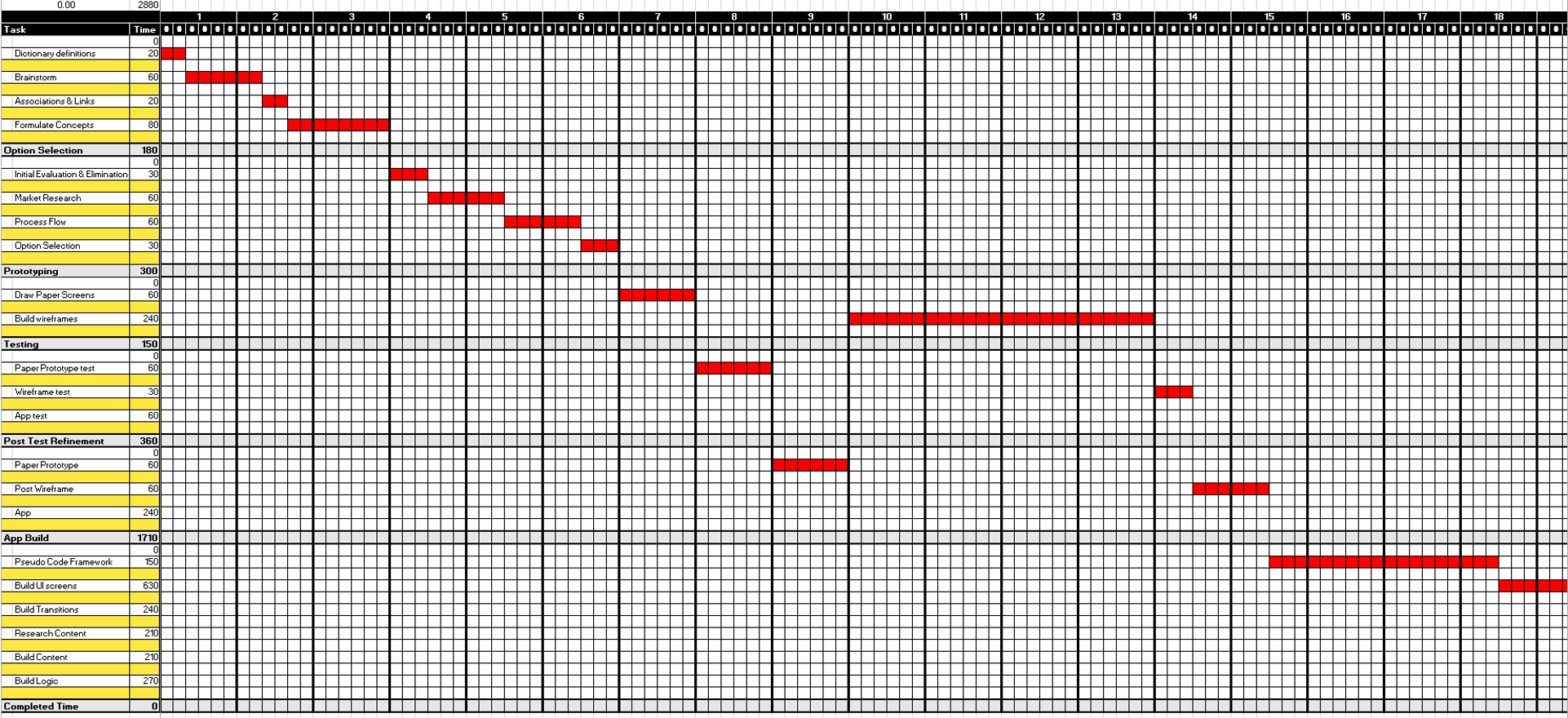
In preparation for the app jam, I have pulled together a Gantt chart on Excel, breaking down the task into the following categories, and sub-categories (with time allocations, in minutes, in brackets):
Ideation (180)
Dictionary definitions (20)
Brainstorm (60)
Associations & Links (20)
Formulate Concepts (80)
Option Selection (180)
Initial Evaluation & Elimination (30)
Market Research (60)
Process Flow (60)
Option Selection (30)
Prototyping (300)
Draw Paper Screens (60)
Build wireframes (240)
Testing (150)
Paper prototype test (60)
Wireframe test (30)
App test (60)
Post Test Refinement (360)
Paper Prototype (60)
Wireframe (60)
App (240)
App Build (1710)
Pseudo Code Framework (150)
Build UI screens (630)
Build Transitions (240)
Research Content (210)
Build Content (210)
Build Logic (270)
I have allocated the available time (48 hours, or 2880 minutes) as I currently feel is appropriate. I am backloading the plan, affording more than half of the available time to the build process, as I know that my current coding capabilities are very low and slow, so I will need to seek regular guidance from online sources throughout the build phase.
I will manage the project timings tightly, using a countdown timer app on an old Samsung Galaxy S5 device that I use for development and testing (so that I don’t have to root my own phone). I am, however, prepared to allow for some flexibility if and when I feel that my predicted time requirement was unrealistic, or if the nature of the app selected justifies deviation from the plan. For example, if I were to generate a great concept that would require more time to research the content, then I would consider pulling back the allocation for other sub-categories to compensate, as long as I feel that this will not have an adverse effect on the overall 48 hour deadline. I will pause the clock while I am not working on the jam and record the actual time taken for each sub-category on the Gantt chart as I finish them, which will be used in a post-jam variance analysis exercise.
This week is all about the app jam. This is my first experience of a jam and so it is a little daunting. But, in essence, it’s a very similar exercise to the creative piece in week 1. That went OK, and I learned a few lessons from it, so what’s the worst that can happen?
I do feel that this jam has come a little early for me though. As much as I would like to finish the 48 hour stint with a fully working app, I am currently but a few hours into my Flutter test drive, and so the hope of achieving a fully working app within 48 hours is somewhat optimistic, if not unrealistic.
Therefore, my plan for the jam will make allowances for this, and afford as much of the allotted time as possible to the building of the app. Will this be at the expense of the other phases of the process? Possibly, but I will just have to sharpen my focus throughout the earlier stages, making sure that I use my time as efficiently as possible, minimise wasted time, and reach decisions swiftly.
I am fully aware that I have a tendency to over analyse situations in the pursuit of an optimal outcome. This is not necessarily a bad thing in many circumstances, but time is of the essence here, and so I need to make a conscious effort to keep to milestone deadlines wherever possible, and to trust my intuition, if and when necessary, rather than spending too much time gathering supporting evidence.
If I should finish up with a fully working app within 48 hours, that’ll be great. However, that is a secondary concern for me. I am primarily focusing on what I can learn from the process of this jam, which will, in itself, reap rewards during subsequent similar circumstances.












 My Journey to App Success