
The brief:
We have been tasked with presenting a concept for an app that will create value and enrich communities. The primary purpose of this task is to experience the process of rapid ideation – an exercise to help nurture creativity. The app concept must also comply with the constraining theme provided:
“AS LONG AS WE HAVE EACH OTHER, WE WILL NEVER RUN OUT OF PROBLEMS“
My thought process:
I allowed the theme to stew in the back of my mind for a few days before actually doing anything with it. Although the theme is intended to provide a constraint, it is wide open to interpretation, with a plethora of choice of avenues to pursue. I found myself identifying numerous divergent paths relating to the theme without conscious effort over those few days. Then came the time to brainstorm. I firstly identified the 2 key elements of the theme:
1. Having each other:
The first synonym that came to mind was ‘together’. I then looked for the Oxford English Dictionary definition of together:
- ADVERB
- With or in proximity to another person or people.
- ‘together they climbed the dark stairs’
- they stood together in the kitchen’
- So as to touch or combine.
- So as to touch or combine.
- mix together the soya sauce and sesame oil’
- In combination; collectively.
- taken together, these measures would significantly improve people’s chances of surviving a coach crash’
- Into companionship or close association.
- ‘the experience has brought us together’
- (of a couple) married or in a sexual relationship.
- they split up after ten years together’
- So as to be in agreement.
- ‘he won the confidence of the government and the rebels, but could not bring the two sides together’
- At the same time.
- they both spoke together’
- Without interruption; continuously.
- ‘she sits for hours together in the lotus position’
- With or in proximity to another person or people.
- ADJECTIVE
- informal
- Self-confident, level-headed, or well organized.
- ‘she looks a very together young woman’
- informal
2. No end of problems
I then looked for the Oxford English Dictionary definition of problem:
- NOUN
- A matter or situation regarded as unwelcome or harmful and needing to be dealt with and overcome.
- ‘they have financial problems’
- the problem of ageism in Hollywood’
- A thing that is difficult to achieve.
- ‘motivation of staff can also be a problem’
- as modifier Denoting or relating to people whose behaviour causes difficulties to themselves and others.
- ‘practitioners help families develop strategies for managing problem behaviour in teens’
- ‘a problem family’
- Mathematics Physics
An inquiry starting from given conditions to investigate or demonstrate a fact, result, or law. - Geometry A proposition in which something has to be constructed.
- Compare with theorem (in chess) an arrangement of pieces in which the solver has to achieve a specified result.
- A matter or situation regarded as unwelcome or harmful and needing to be dealt with and overcome.
I then went on to randomly and rapidly generate unfiltered word associations for ‘together’ (represented in orange boxes, below) and types of ‘problems’ (represented in blue boxes, below) as two completely separate exercises.
Next, I carefully considered the possible links between the 2 key elements of ‘having each other’ and ‘no end of problems’ (represented in yellow boxes, below). There is a cause and effect relationship between the two, and so I deduced that a dilemma is presented, the options being:
- Remain together
- Through choice – the perceived benefits of remaining together outweigh the burden of dealing with the consequent persistent problems
- By force – the entities are together against their will and gain very little or no benefit, while facing endless problems
- Separation
- To bring the problems to an end (or at least reduce them) as it is perceived to be of greater benefit to those offered by having each other
- To escape the force that is keeping them together against their will and end (or at least reduce) the endless problems.
This is my 1 page brainstorm:
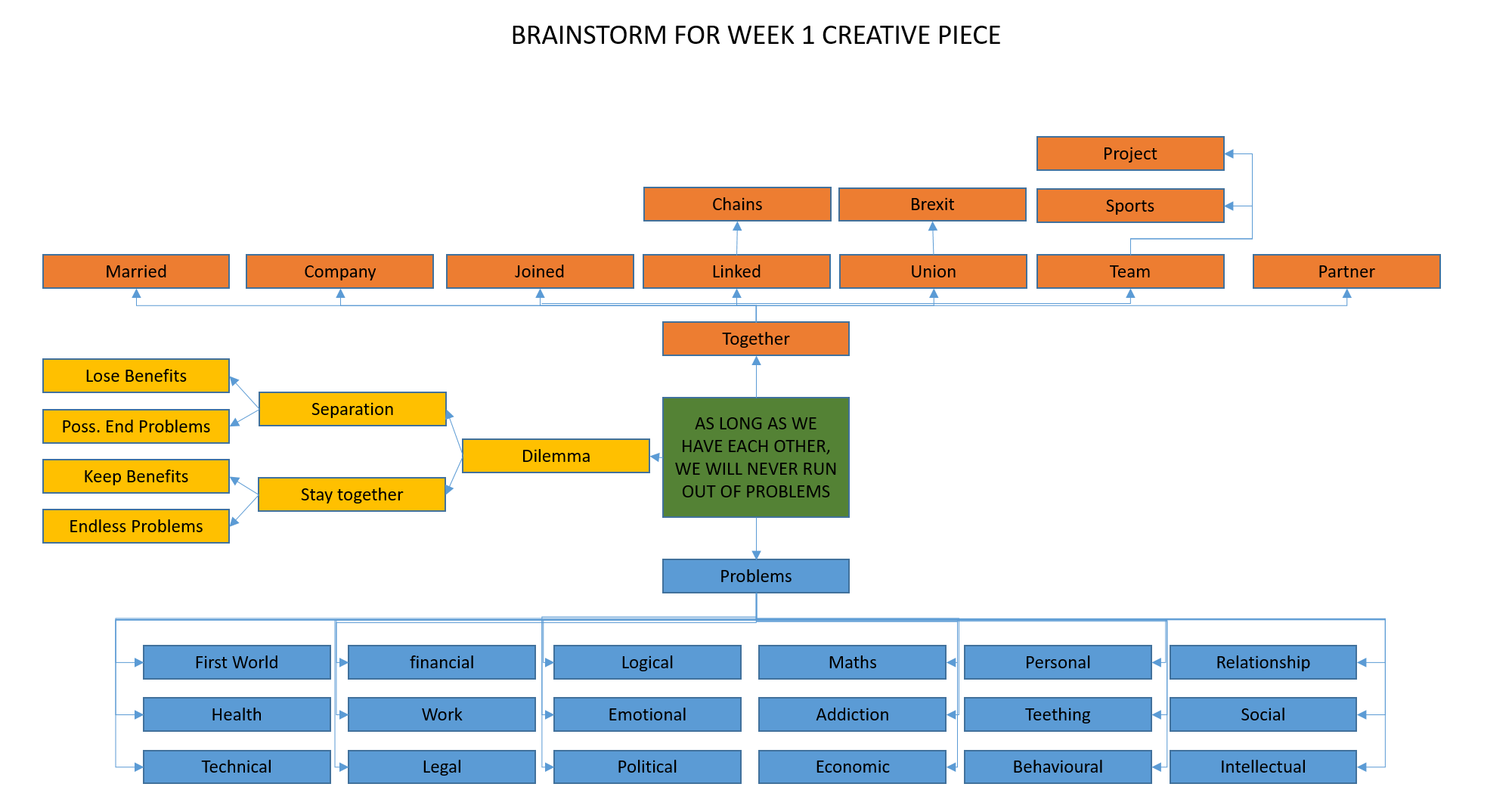
I then used all of these ideas to think of situations that lend themselves to the scenario. Although the theme offers itself to a whole world of possibilities for games nicely, this is not an area that interests me as a developer and so I dismissed those thoughts immediately. Following this, the most obvious option to me was a dating app. So many people seem hell bent on finding a life partner, in spite of the inevitable problems that manifest as a result (call me cynical!). However, I wasn’t totally sold on this way forward as it’s not something that particularly interests me, and I’m aware that the market is very well, if not overly, catered for, which would make it very difficult to identify a niche that isn’t already satisfied, or present originality to the saturated market.
I also liked the idea of pursuing ‘maths problems’ and ‘logic problems’, as I like numbers and logic puzzles (simple example – Tim is twice the age of Tom, who is 6, so how old will Tim be when Tom is 8?). Coming up with a concept to fit the theme was the next challenge. During this week’s tutorial, we were urged to consider a game concept, if we are not gamers (which I’m not). This led me to thinking about how the gamification of end-of-topic testing for school children might help with their enjoyment of the subject and further their learning.
Apart from my own education, I have no experience of the school system (which I’m sure has moved on considerably since I left in 1988). Had there been a requirement to pursue this concept further, I would have spent time researching the market beforehand. But, for the purposes of the exercise, I have developed my concept based largely on my own assumptions. I did, however, confirm with a primary school Head Teacher friend that children do use tablet devices as part of their maths lessons.
Results:
I decided on the concept of “BREAKOUT!” – a database driven Android & iOS mobile/tablet app that enables the teacher to test student understanding of an area of study in a way that is far more fun and challenging for them than answering questions read out by the teacher, with a pen and paper in silence.
The premise of the game is that (avatars of) the students are chained together in a circle, with padlocks, each with a (teacher determined) number of locks. Whilst they are chained together, they will be presented with ‘no end of problems’. Alternate problems will reward a correct answer with a key to a lock to their left and right. Each time a student correctly solves a problem, they will unlock one of their locks. The aim of the game is for the student to free themselves from the chains, so that they no longer have each other, and put an end to the problems they face.
Once I felt that the concept was sufficiently developed in my head, I drew up a process flow diagram to help me to determine the screens that were needed, and how they need to interact. Numbers in the top left corner of each box (mostly) correspond with the screen numbers:
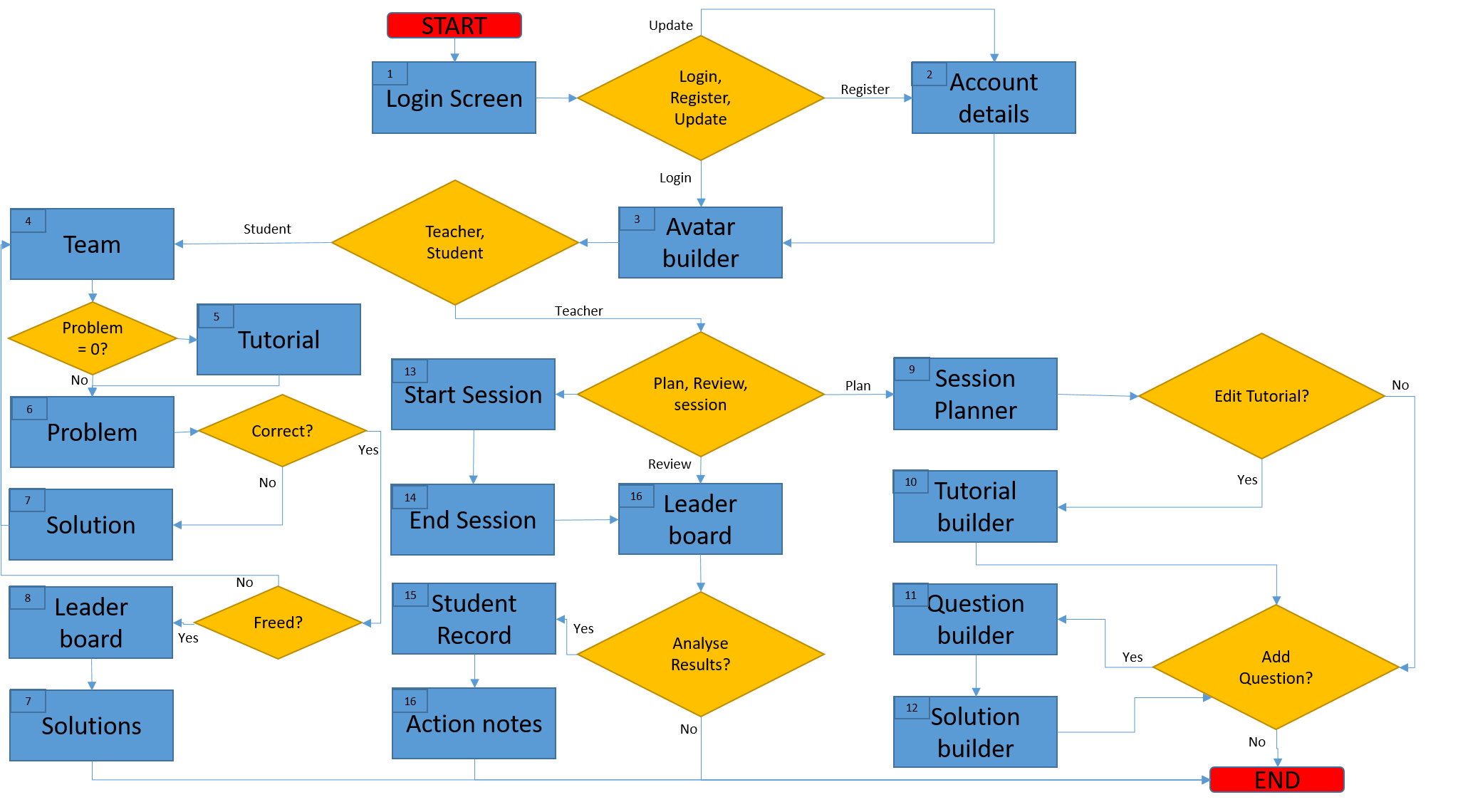
I wasn’t aiming for perfection with this process flow diagram, and I know that there are some shortcomings here, but it gave me direction and served its purpose throughout the process of designing screen content. I actually deviated from the plan on several occasions. As I moved from designing one screen to the next, my thoughts developed, and further consideration as to the practicalities of using the app inspired some alterations to the flow. I didn’t retrospectively update the process flow diagram to reflect those deviations. What you see here is my original plan.
Screen 1 – Log In
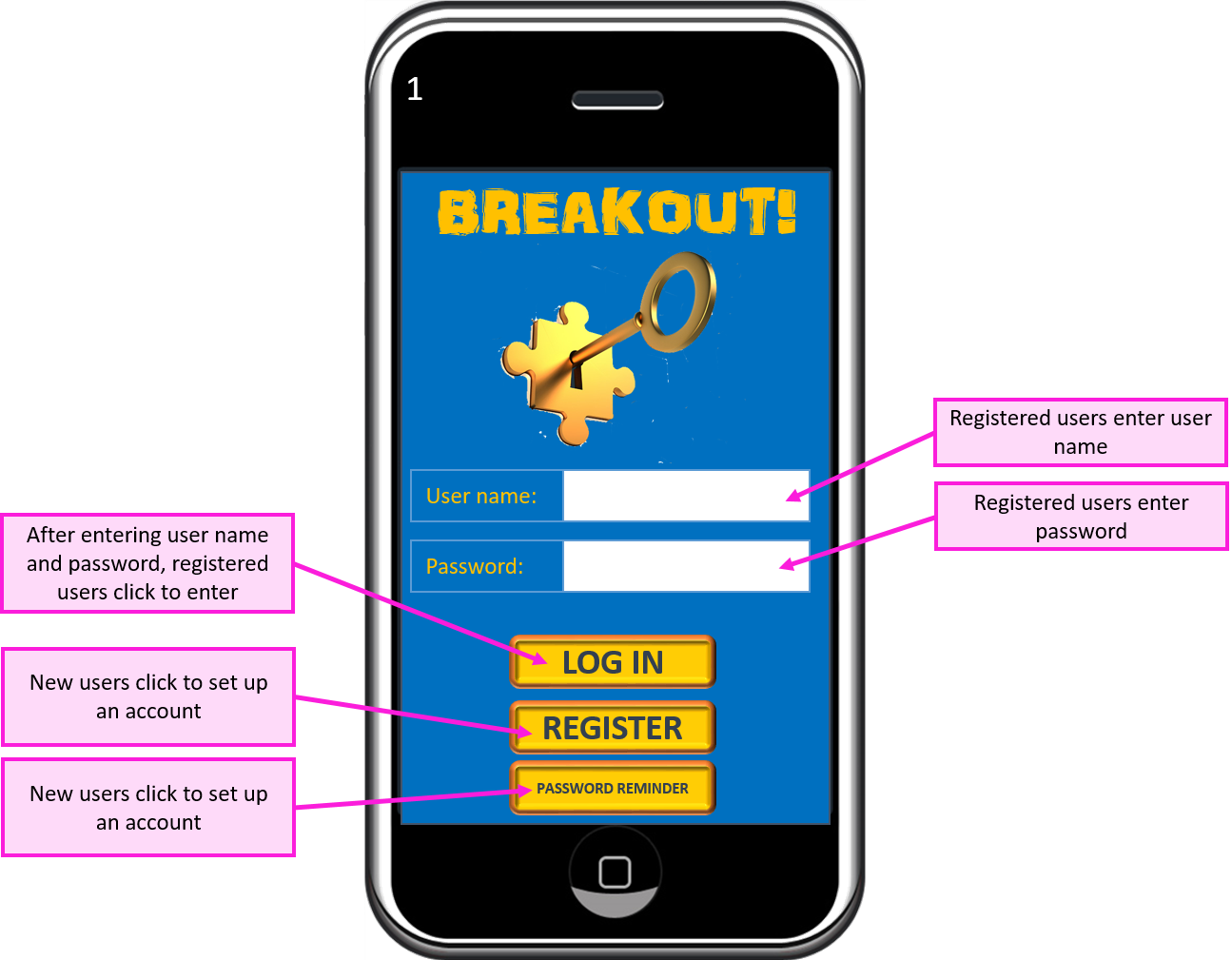
The teacher will have access to student log in details to deal with the issue of students forgetting passwords.
Screen 2 – Account Details
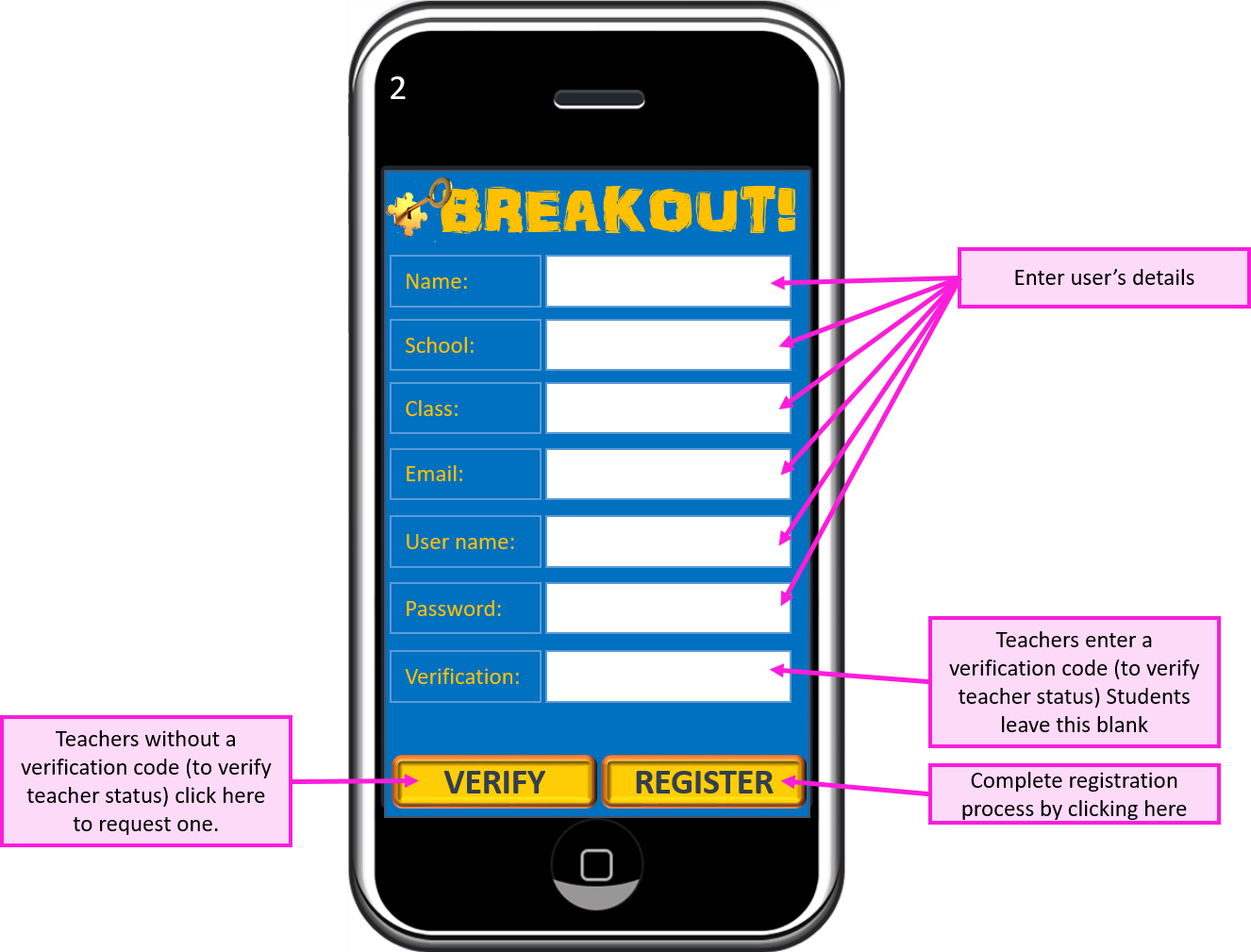
Teachers will be issued with a verification code to enable them to set up a teacher account.
Screen 3 – Avatar Builder
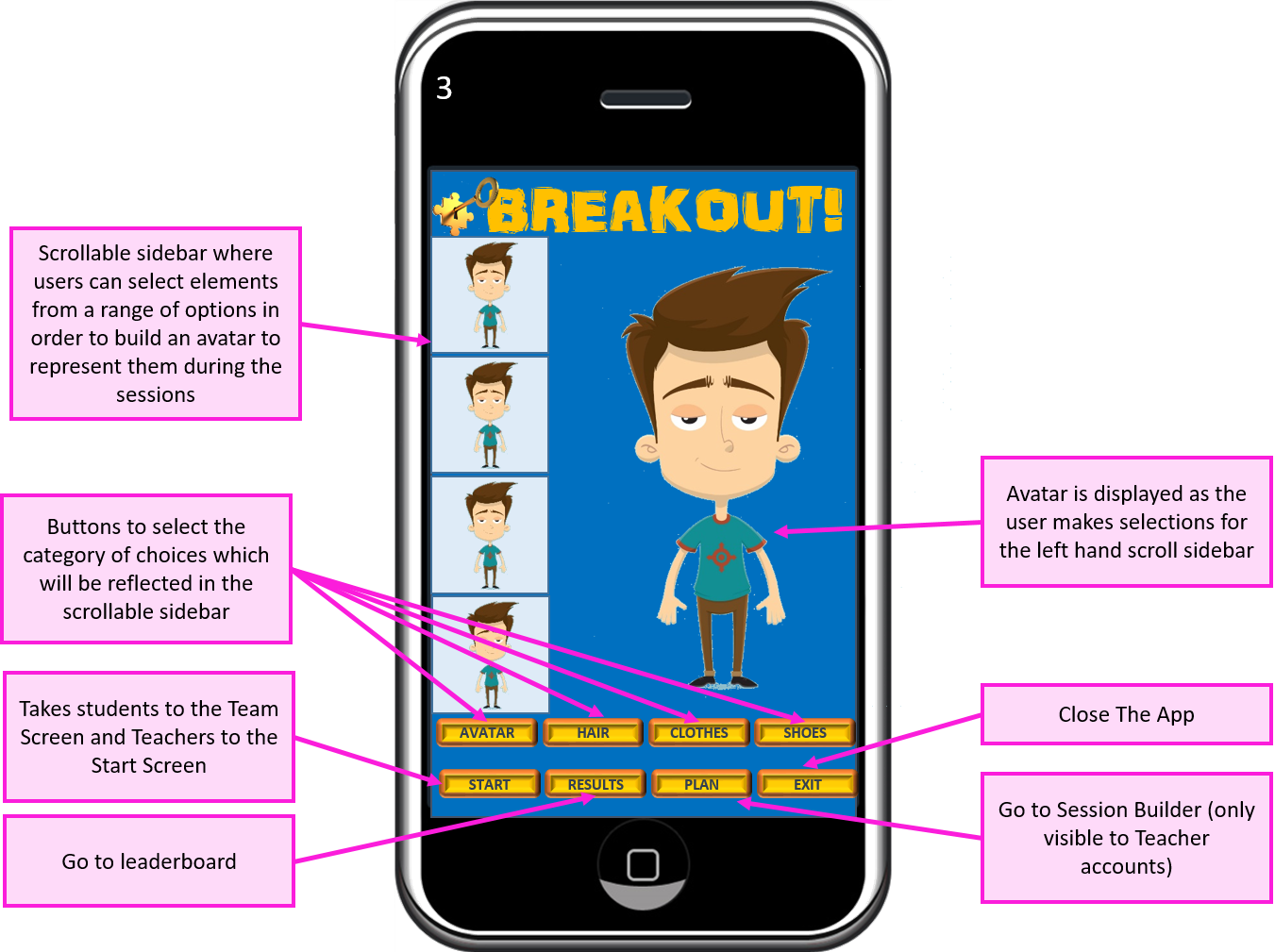
Students will be able to build and edit an avatar that represents them during the game. A selection of boy, girl and other (animals, aliens etc.) choices will be made available. They will be able to go on to further customise their avatar’s hair style and colour, clothing and shoes, to inspire fun and creativity.
Screen 4 – Team Screen
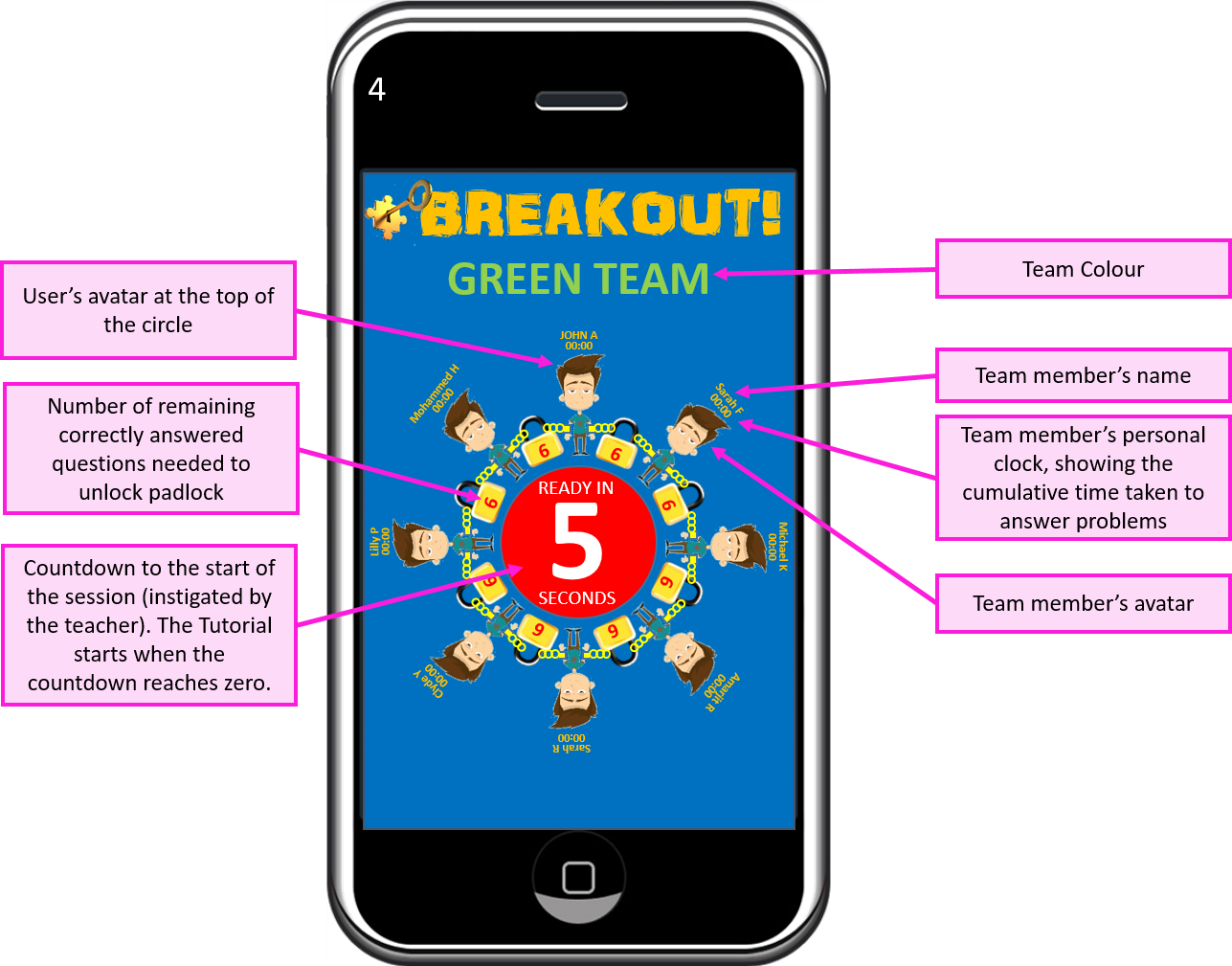
From the student user’s perspective, the team screen acts as the home screen. They will be returned here between problems where their progress will be updated and they can compare their status with that of other team members.
Screen 5 – Tutorial
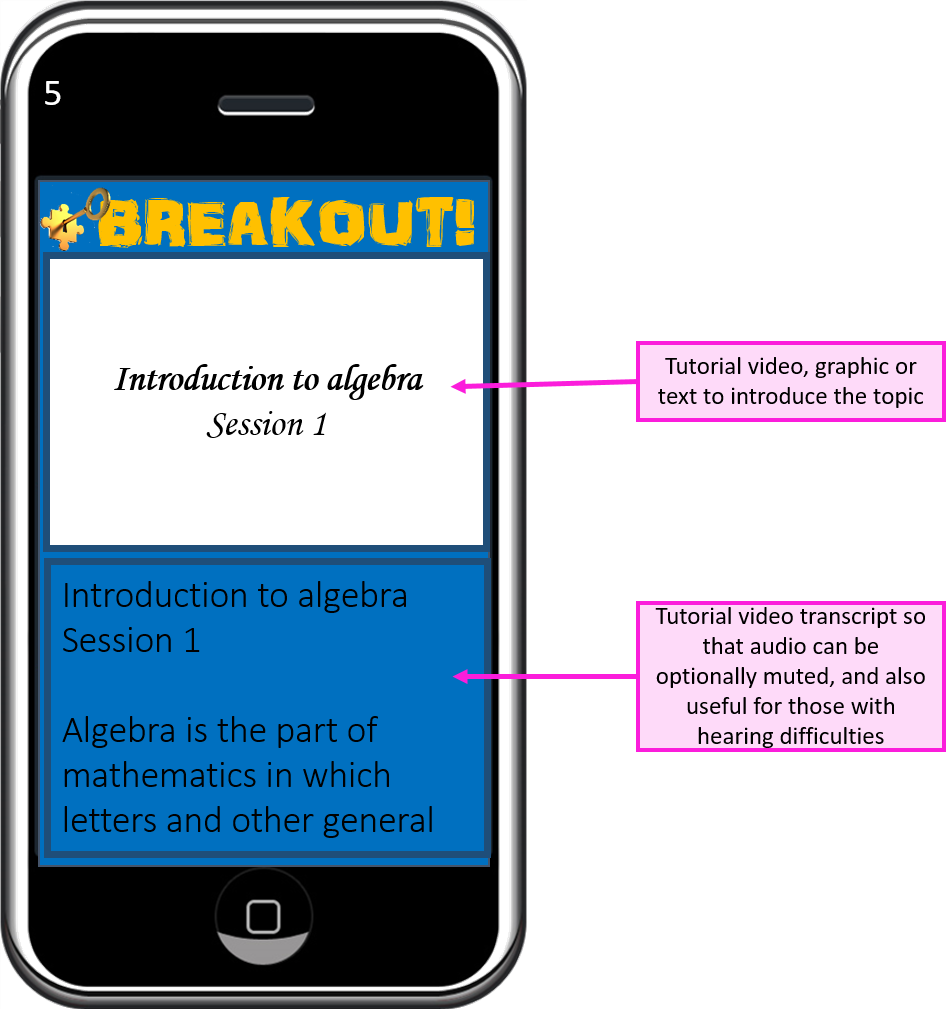
Teacher can opt to provide a tutorial to refresh the subject matter for the students. This can consist of a mixture of uploaded video, graphics and text, and will be shown to the students before the first problem is presented.
Screen 6 – Problem Screen
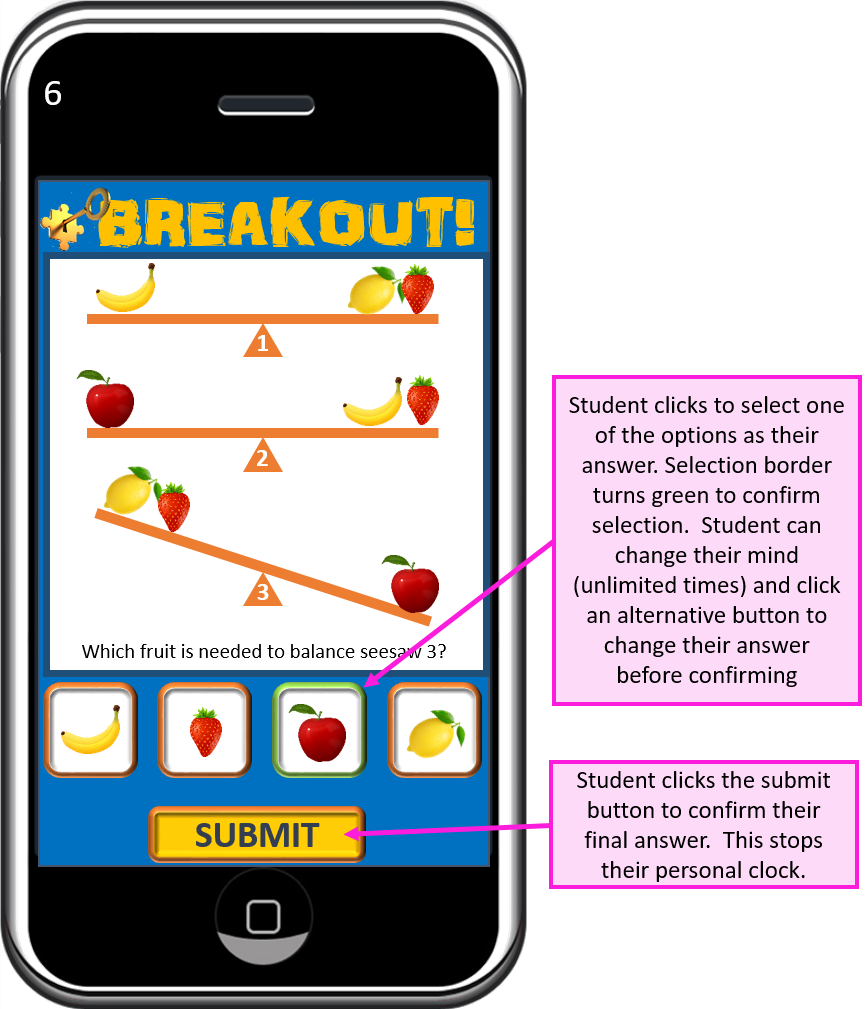
The student’s stopwatch is started when the problem screen is presented, and stopped when they submit an answer.
Screen 6a – Marking
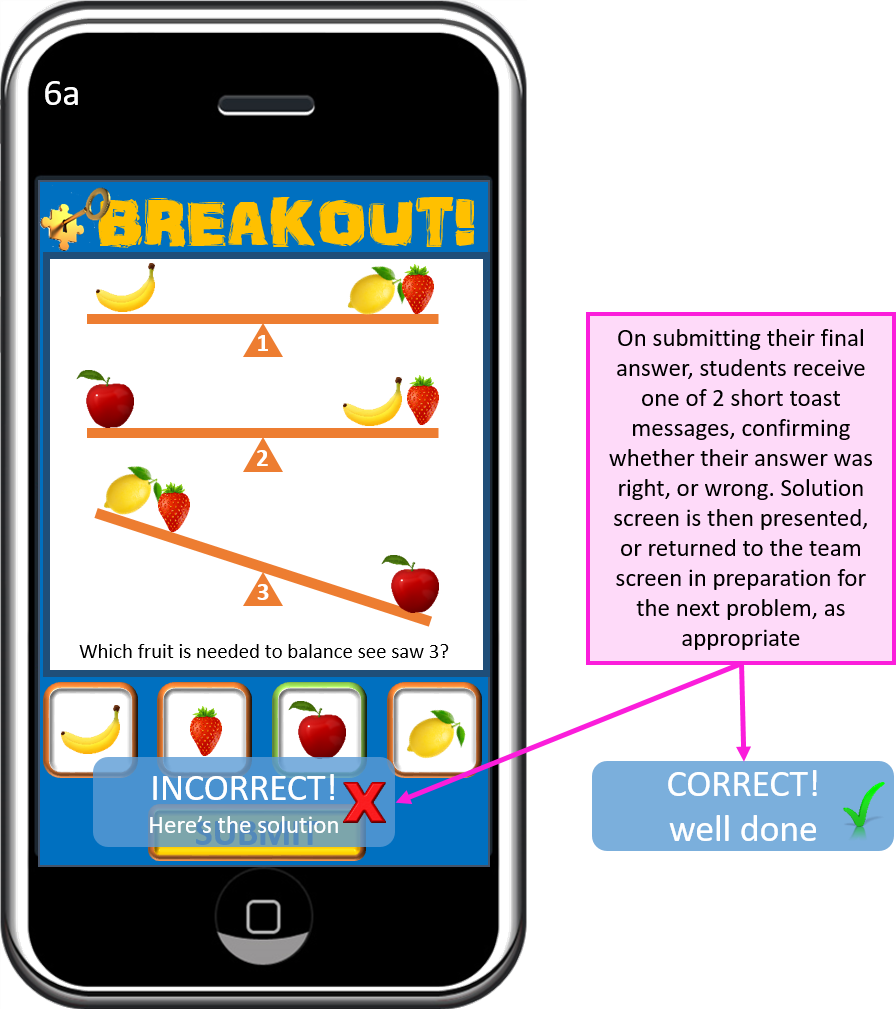
The student is informed whether their answer was correct, or not.
Screen 7 – Solution Screen
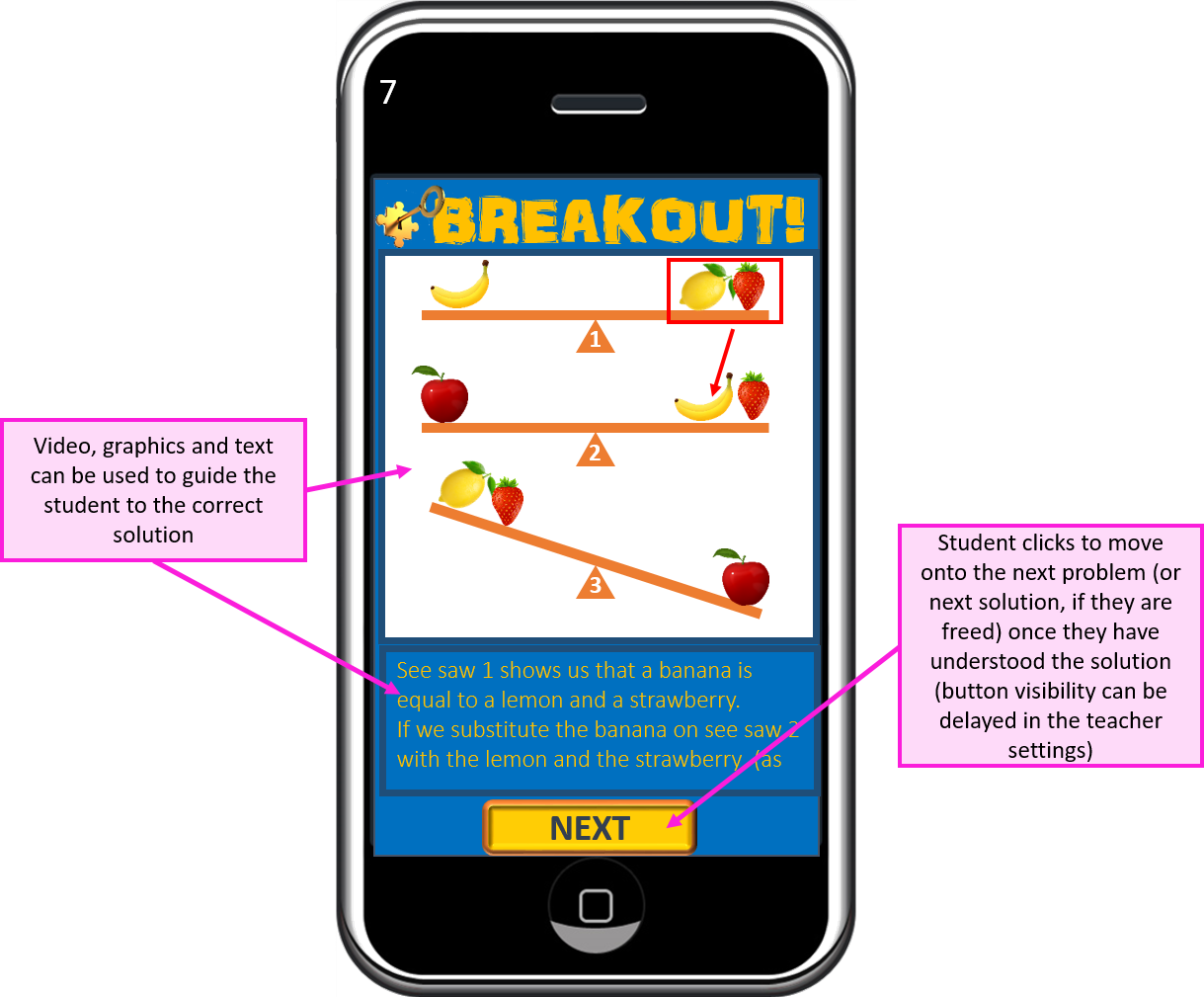
If the student has answered a problem incorrectly, they will be shown the solution immediately afterwards. The time taken with the solution will act as a penalty and be added to their score. The teacher has some control over the magnitude of the penalty when setting the question.
Screen 8 – Leader Board
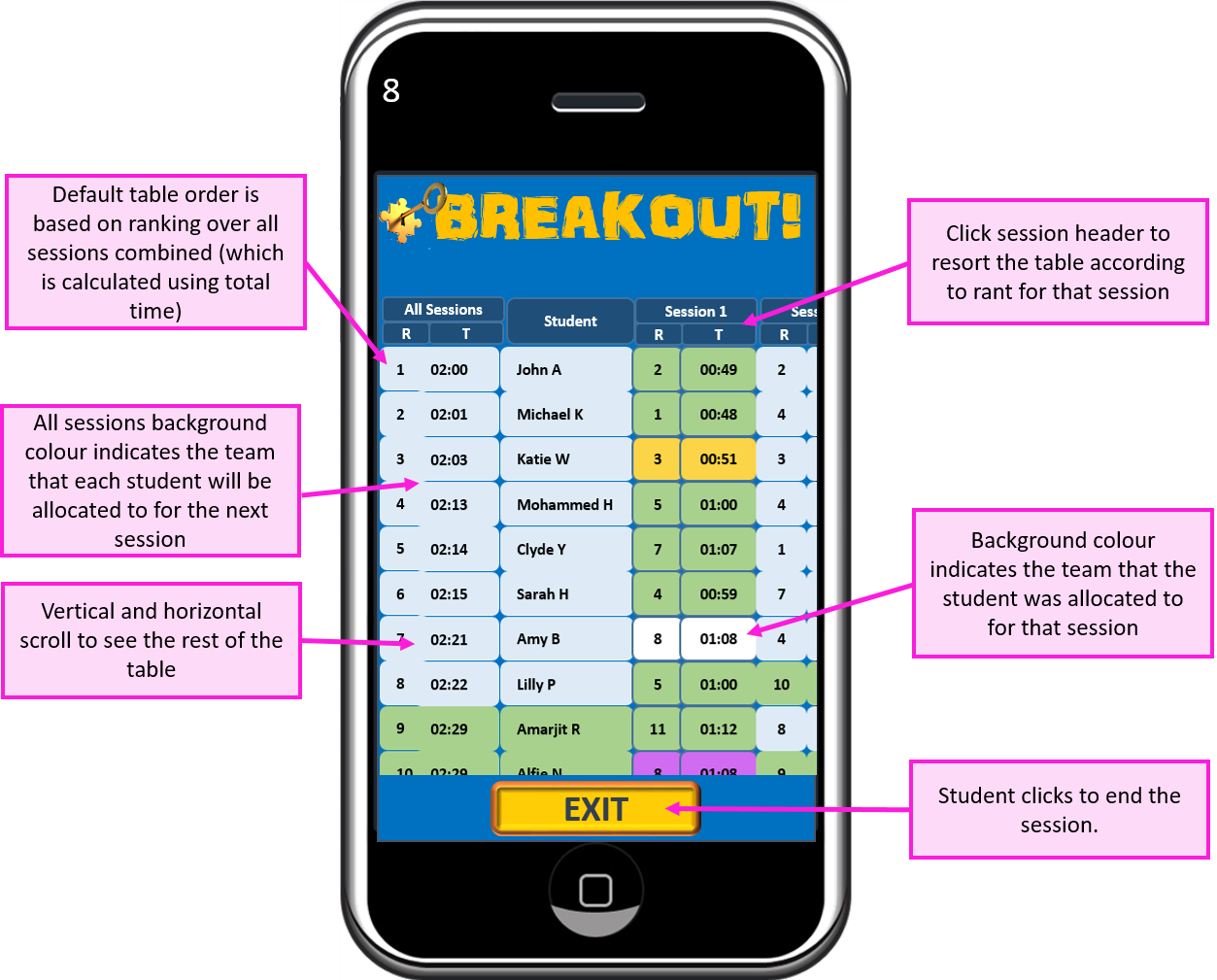
Students can see how they performed in comparison with other students in their team, and in their class, for each session, and cumulatively over all sessions to date.
Screen 9 – Session Builder
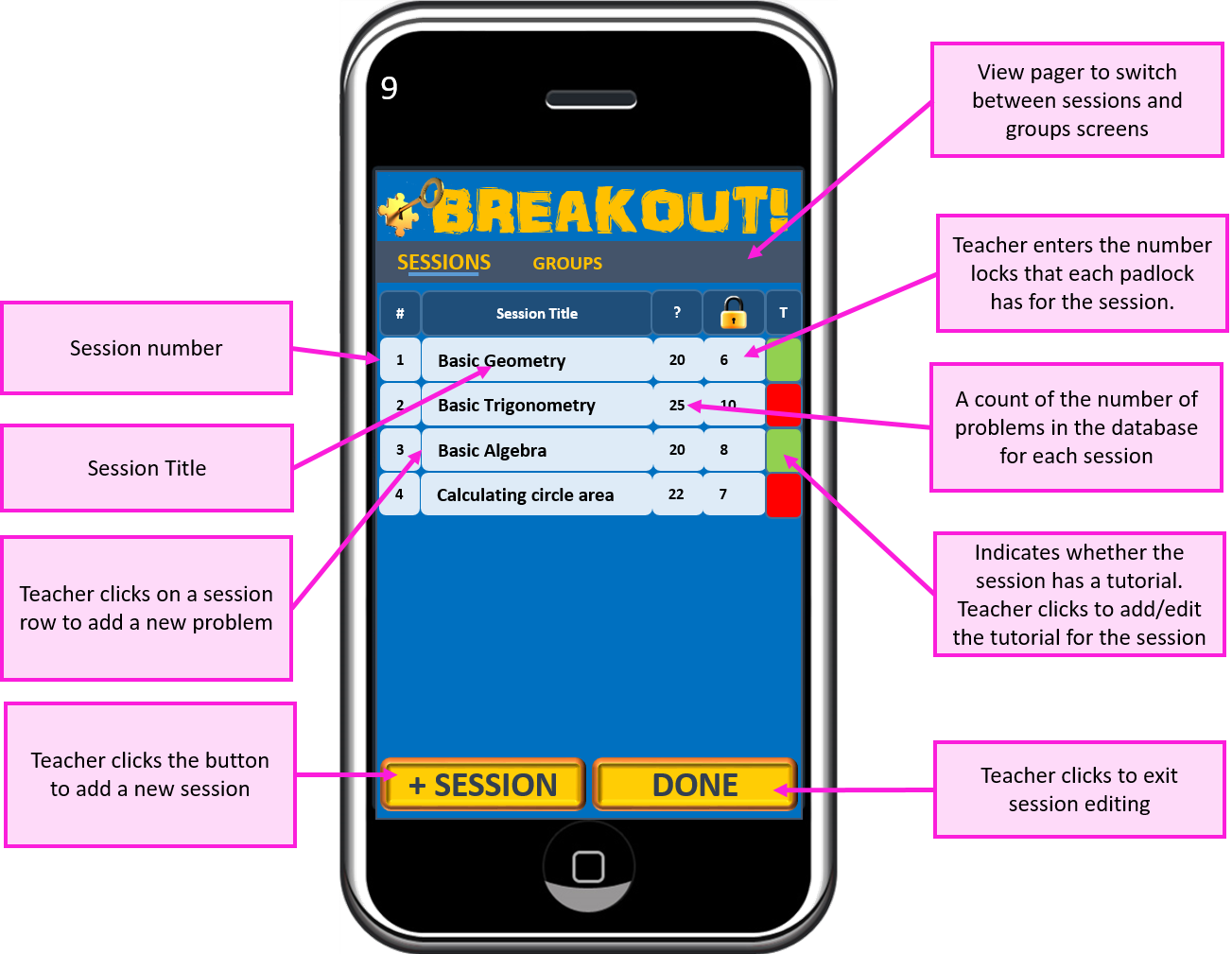
The teacher can build sessions to cover each of the topics on the syllabus.
Screen 10 – Tutorial builder
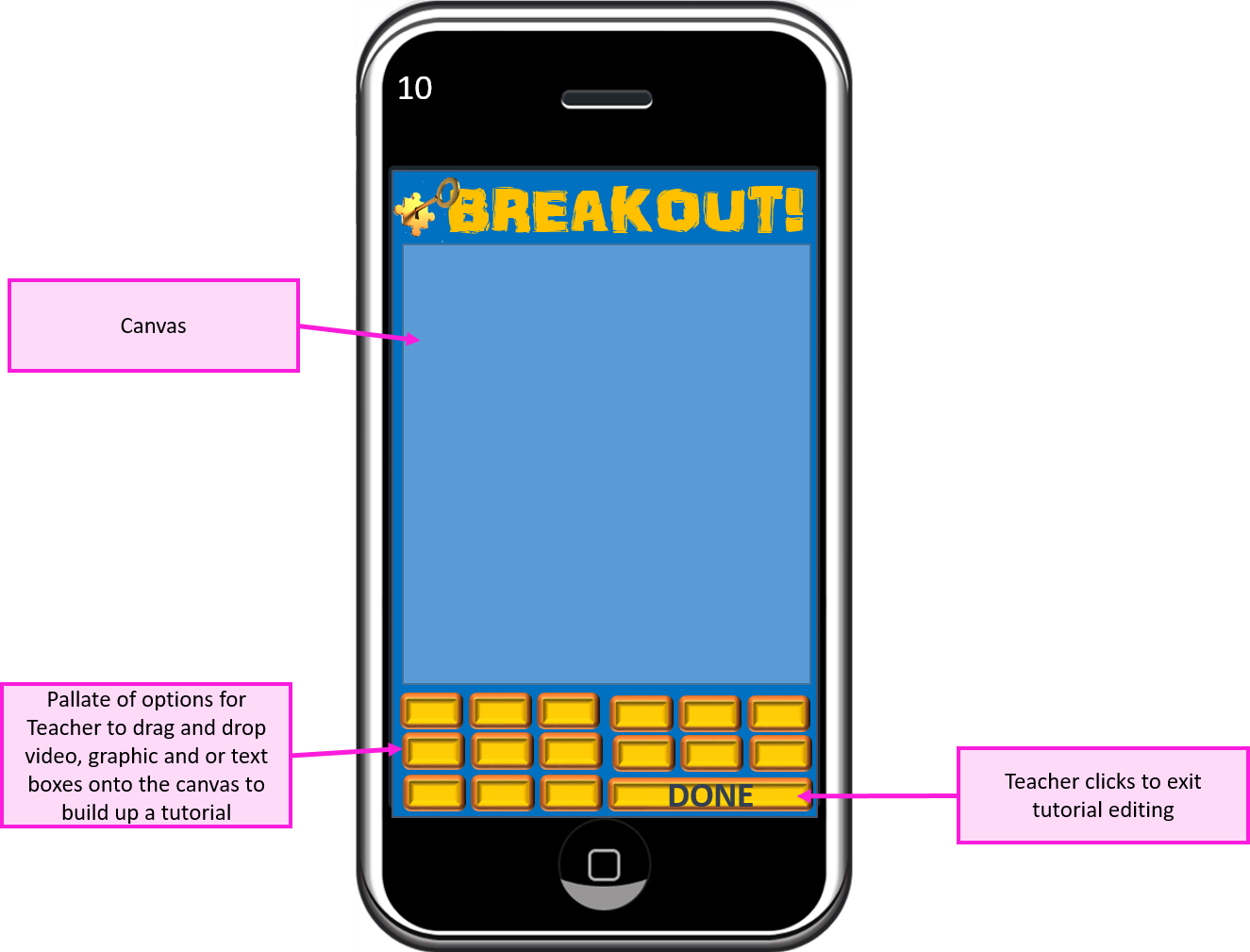
This is where the teacher builds the (optional) tutorial that acts as a brief refresher for students before starting the first problem of the game. I have not gone into too much detail here as far as the controls are concerned, but I anticipate a drag and drop capability, with uploaded video and graphics files.
Screen 9a – Problem Builder
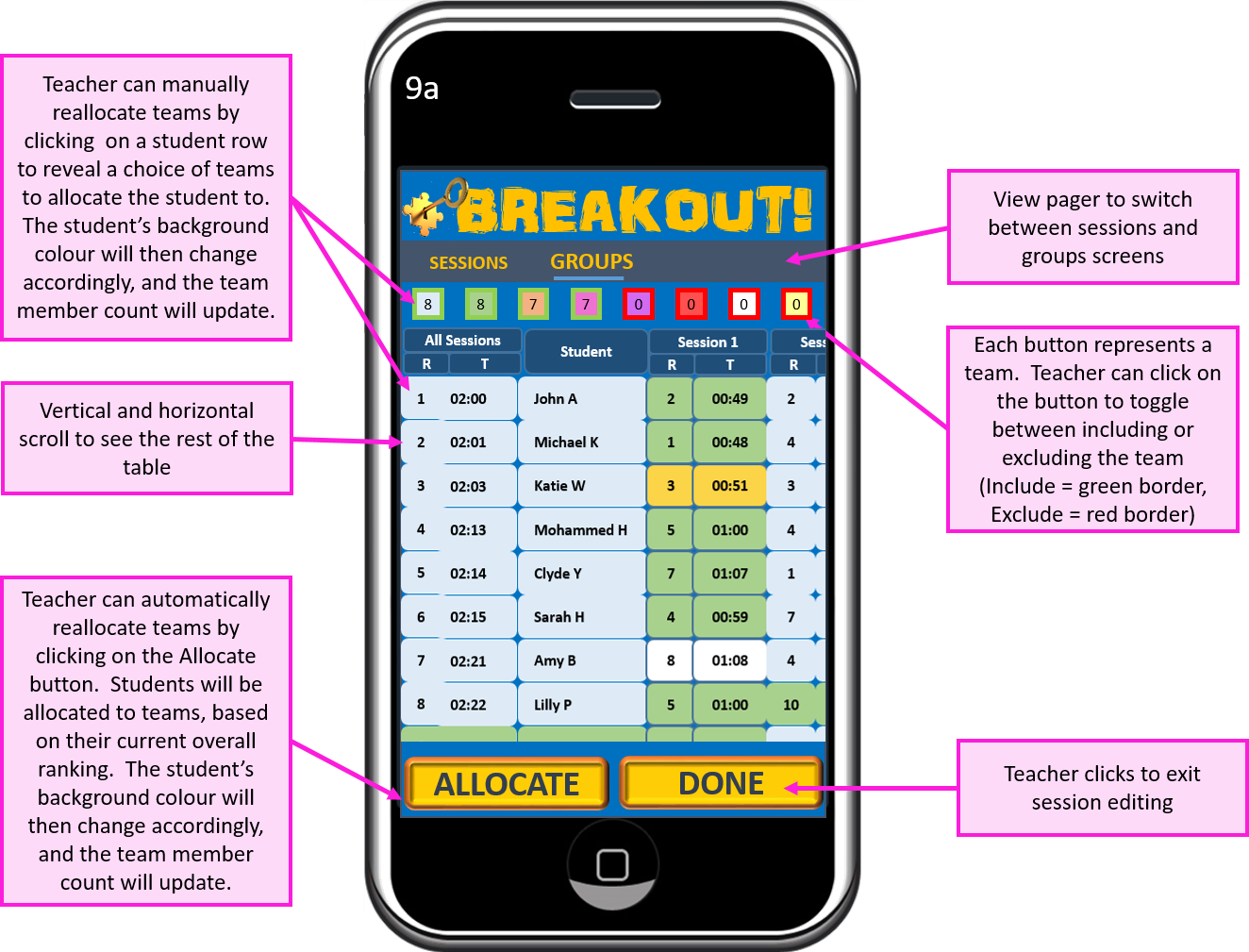
The system automatically reports the leader board after each session is complete, and allocates the students to groups according to their overall ranking and an optimised number of groups. The teacher is able to override these allocations if they feel that students could benefit from being in another group.
Screen 11 – Problem List

The teacher is able to see the full list of problems in the database relating to the session, add new problems, or edit existing ones.
The teacher needs to build up a number of problems (all at a similar level of difficulty and complexity) well beyond the number of locks set on 2 padlocks. This will allow for incorrect answers. Students will be presented with problems in a random order, so that they are unable to collaborate.
11a – Problem Builder
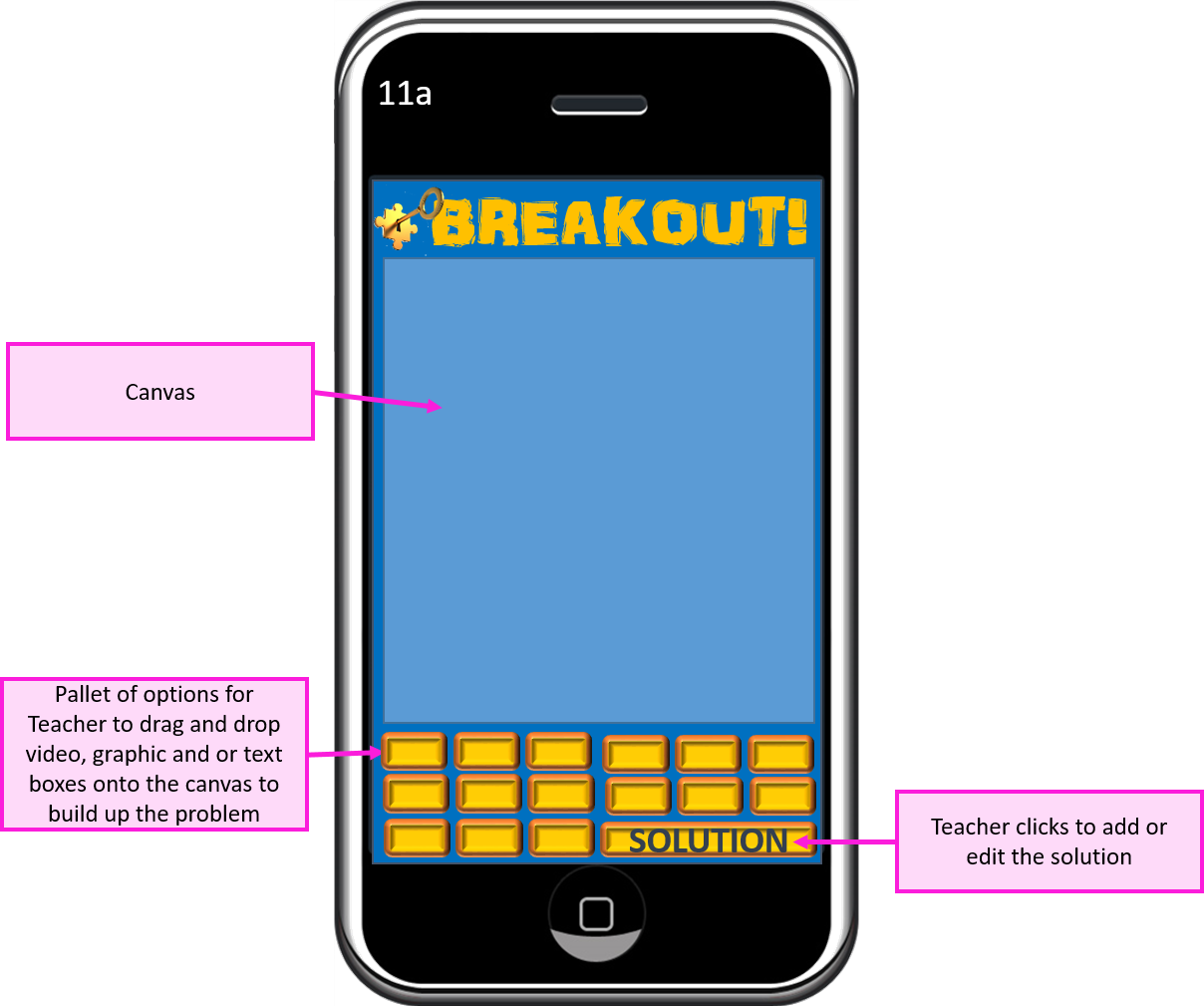
This is where the teacher builds the problem screen. I have not gone into too much detail, as far as the controls are concerned, but I anticipate a drag and drop capability, with uploaded video and graphics files
12 – Solution Builder
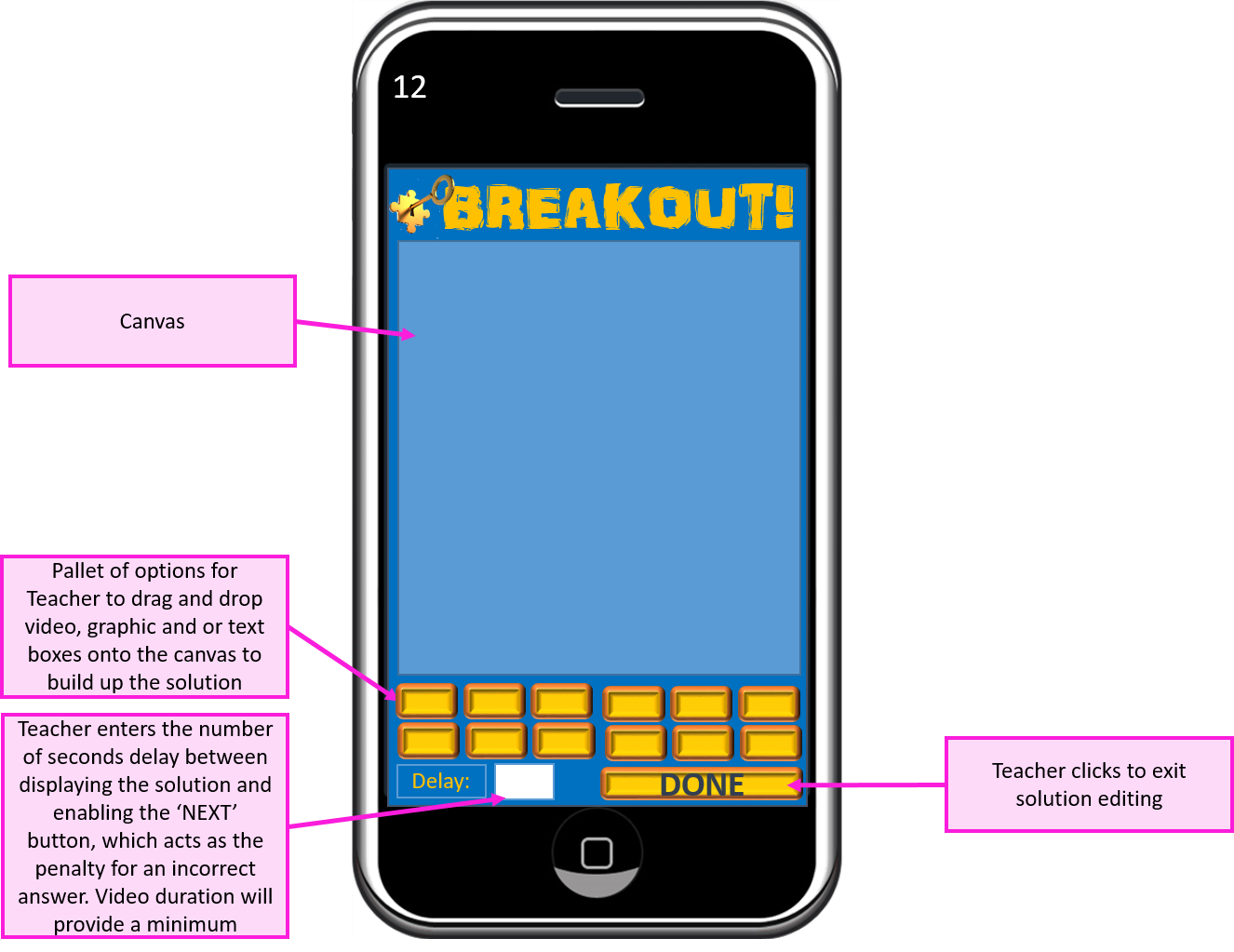
This is where the teacher builds the solution screen. I have not gone into too much detail, as far as the controls are concerned, but I anticipate a drag and drop capability, with uploaded video and graphics files
13 – Start Session

This is the teacher’s control panel for running a game session. The teacher can see when all the students are ready to commence (and which students aren’t), start the session, and see when students (and full teams) are freed
14 – Teacher Leader Board

This is where the teacher can analyse results of the session and the overall leader board standings. From here, the teacher can drill down to analyse the performance of each student.
15 – Student Record
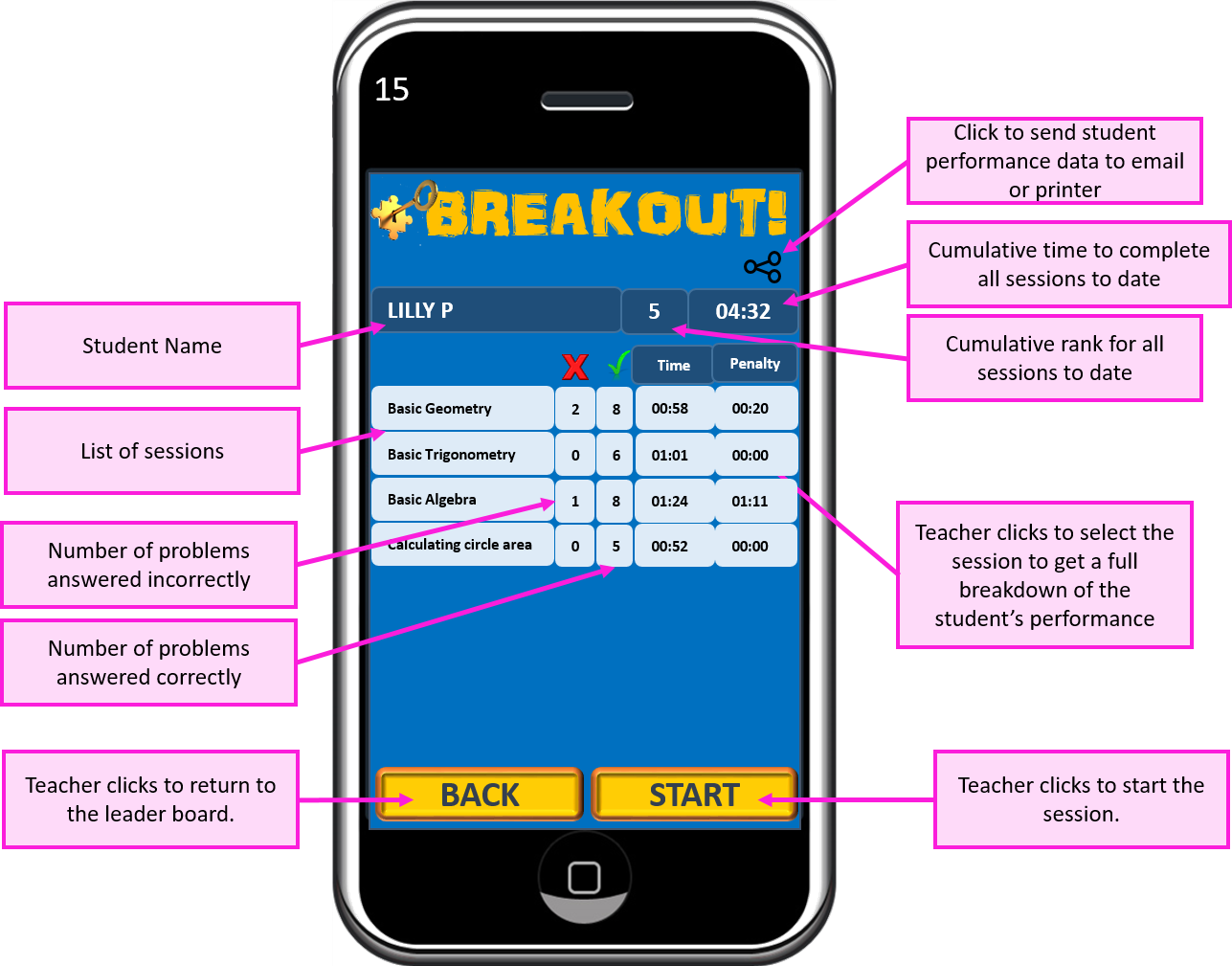
This screen shows the student’s overall performance at a session level. The teacher can then click a session row within the table to view the student’s performance for each question within that session.
15a – Detailed Student Record

The teacher can get an insight into how the student performed within each problem that they were presented with.
- Credits (in line with graphic usage licence requirements):
- Boy avatar: <a href=”https://www.freepik.com/free-photos-vectors/people”>People vector created by smithytomy – http://www.freepik.com</a>
- Mute icon – <div>Icons made by <a href=”https://www.freepik.com/” title=”Freepik”>Freepik</a> from <a href=”https://www.flaticon.com/” title=”Flaticon”>www.flaticon.com</a> is licensed by <a href=”http://creativecommons.org/licenses/by/3.0/” title=”Creative Commons BY 3.0″ target=”_blank”>CC 3.0 BY</a></div>
Opportunities for further development:
- Animation could improve the user experience, particularly where younger children are concerned.
- The analytical tools could be enhanced to provide more useful reports for teachers, containing charts to aid performance comparison and progress monitoring.
- Different games could be added in order to provide some variation for the students.
- If I were to pursue this concept any further, I would invest significant time in market research and concept testing before taking it any further. I did do a search for ‘algebra’ on Google Play, which indicated that there might be a gap in the market for the concept. However, to minimise startup risk and maximise the potential for this concept to become a successful product, Among other things, I would need to know a lot more about:
- how subject testing is performed in schools now (and the pros and cons of these methods)
- what teachers and students (perhaps further segmented by age) want from a new product
- what competitive offerings are currently available (I have since been informed of the existence of kahoot.com, which appears to have similarities with my concept)
- Education Board approval process
- A centralised database (Firebase, for example) would enable results and progress to be compared against other classes and even other schools or countries, providing far greater opportunity for analysis.
- The app could be monetized with a structured subscription model. Market research would be required in order to get this right). A payments screen will need to be added.
- Teachers could buy and sell the tutorials, individual problems (with solutions) and even entire sessions that they have built. This could be done with subscription credits, or money.
- Using Google Analytics would provide useful user data that would contribute to the future evolution of the app.
- The concept of the game could be used for testing in subjects other than maths.
- The concept lends itself well to a platform situation, where a community of teachers interact to generate value for that community, with network effects providing feedback that will positively impact the product lifecycle.
What went well:
- Overall, I was happy with my thought process and how it helped in achieving the results that it did.
- I feel that I have achieved a fairly robust first draft concept that fulfils the requirements of the brief and has plenty of scope for further development.
- With market research driven refinement, I believe that this concept could possibly have the potential to be moulded into a marketable product.
Lessons learned:
- I spent far too long on this exercise. While the ideation phase was completed fairly swiftly, I have probably gone into far too much detail for concept testing purposes.
- Building screen mock ups was a very long process. I might have gone into too much detail for each screen, but it is largely down to my choice to use Powerpoint. As I have no manual drawing ability whatsoever, Powerpoint seemed to be a good idea at the time, as I am quite familiar with it and I thought I would save some time over learning a new program for the task.
- While Powerpoint is an adequate (if not the best) tool for brainstorming exercises, it is definitely not the best tool for process flow diagramming or for designing screen mock ups, as it is far too fiddly, slow and can get quite messy (particularly where process flow diagrams are concerned). I will spend some time searching out and testing more appropriate tools for these jobs next week.
 My Journey to App Success