In all honesty, I’ve struggled with reflective practice. I’m more comfortable facing questions requiring convergent thinking, with a definitive correct answer to strive for, than those requiring divergent thinking to reach an outcome judged with subjectivity. I’m somewhat uncomfortable with the uncertainty of whether I’m meeting expectations, and, being an analytical thinker, I find it difficult to know when to stop. I do proactively seek frequent feedback, which helps.
Until very recently, I’ve
viewed reflective practice as an inconvenience – a distraction to my learning
progress. This attitude, along with my focus on developing my Flutter
capability, is largely responsible for my falling behind with my critical reflection
journal. While I’ve recognised the value
in understanding what went well (and should be applied again) and what didn’t
(so do something different) in a given context, I’ve been puzzled by the apparent
heavy emphasis for this module.
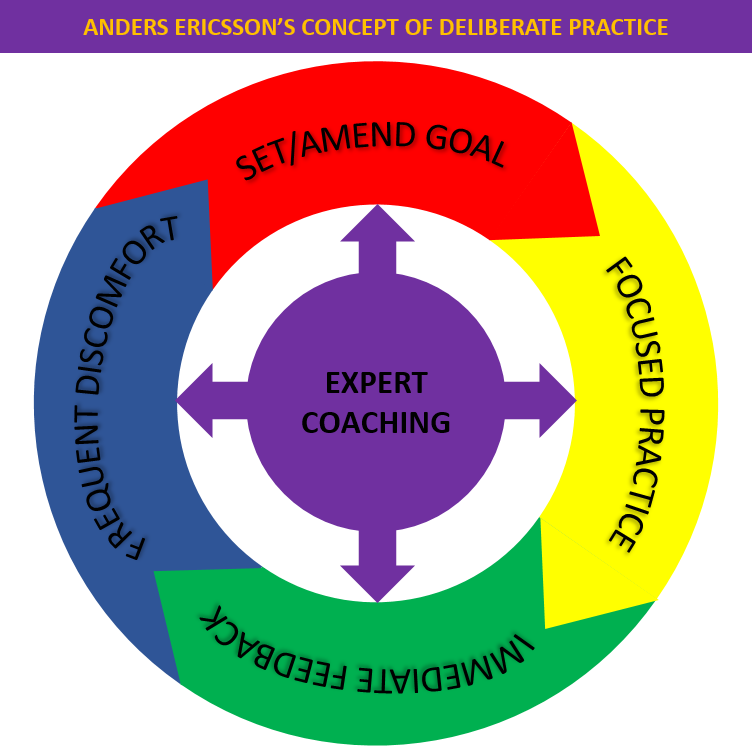
However, I’ve recently engaged with Anders Ericsson’s work on Deliberate Practice. It provoked a turning point for my perception. Building the following representation of Ericson’s cyclical process for incremental development of expertise helped me to see that the structured proactive approach to reflection stimulates creative insight and mental adaptation. This encourages elaboration, and the formation of associations between known and new concepts, to form alternative representations, and view situations from different perspectives to expedite learning.
I’m beginning to recognise
that I should embrace reflective practice, as it could actually be my passport
to app development mastery.
My Critical Reflective Journal
will be brought up to date by 29th April
Deliberate practice expedites learning. Active retrieval provides a self-assessment of my comprehension, which is fundamental in identifying improvement opportunity, enabling me to effectively plan future activity for efficient progress.
I have 3 weeks to post blog entries for weeks 5 to 11. Using my notes, I will dedicate 6-8 hours per week to achieving this.
Regular requests for Tutor/study
group feedback, will help me continue to achieve incremental quality improvement.
Specific
I will post journal entries reflecting on the work that I have covered in weeks 5 to 11.
Measurable
I will use my Trello board to plan and implement weekly sprints, to include journal entries covering 2-3 weeks coursework, and chart my progress.
Achievable
Time is my key constraint, but I can afford to allocate 6-8 hours per week to achieve this. I’ve kept notes on everything that I’ve worked on.
Relevant
This module requires submission of a complete journal, and it’s a skill that I will use to assess and drive the progress of my continuing professional development.
Time-Bound
This will be done by 29th April. I will complete entries covering 2 weeks coursework, each week, over the next 3 weeks
Keen to get a good handle on what reflective practice can do for me, I’ve been exploring the work of Anders Ericsson, and his concept of Deliberate Practice.
This has been a pivotal step in changing my perception and comprehension of the potential value that can be delivered by investing time in reflective practice. I think I’m beginning to properly get it.
While much of the material relating to reflective practice that I have previously consumed has helped me to form some level of understanding, I’ve found it to be a bit woolly, and difficult to draw solid conclusions that I can confidently apply to my own performance improvement efforts. However, I connected with Ericsson’s work on achieving expertise through the application of Deliberate Practice. he outlines a cyclical structure of definitive iterative steps that I can take in order to realise incremental progress toward mastery in any field, including my chosen field of app development:
Have a well defined specific goal.
Practice with intense focus – no distractions.
Seek immediate feedback on your practice.
Frequent discomfort – adjust your goal to push you slightly beyond your capability.
Quality mentoring to oversee this process will further expedite learning.
Ericsson dismisses the commonly held belief that an innate talent is the primary factor that dictates success (which gives me hope!), and offers the alternative theory that the key requirement is adaptability – a ‘gift’ which we all possess. He goes on to say that we are all ‘Homo Exercens’ – the practising man, committed to self-improvement.
He also clarifies that while practice is an integral part of improvement strategy, it is not an effective stand-alone strategy. He labels this approach “Naive Practice” and describes how spending hours repeating the same actions over and over again, will only deliver limited improvement, and never achieve expertise.
I have a commercial background, but I’m on the MA Creative App Development course because I want to be well equipped to create my own startup venture, with a mobile app sitting at the core of the business and I want to feel confident that I can launch and grow that business into a success story. So, I’m using the course to develop the full range of skills and competencies that I need to become a developer of great mobile apps.
Skills & Competencies
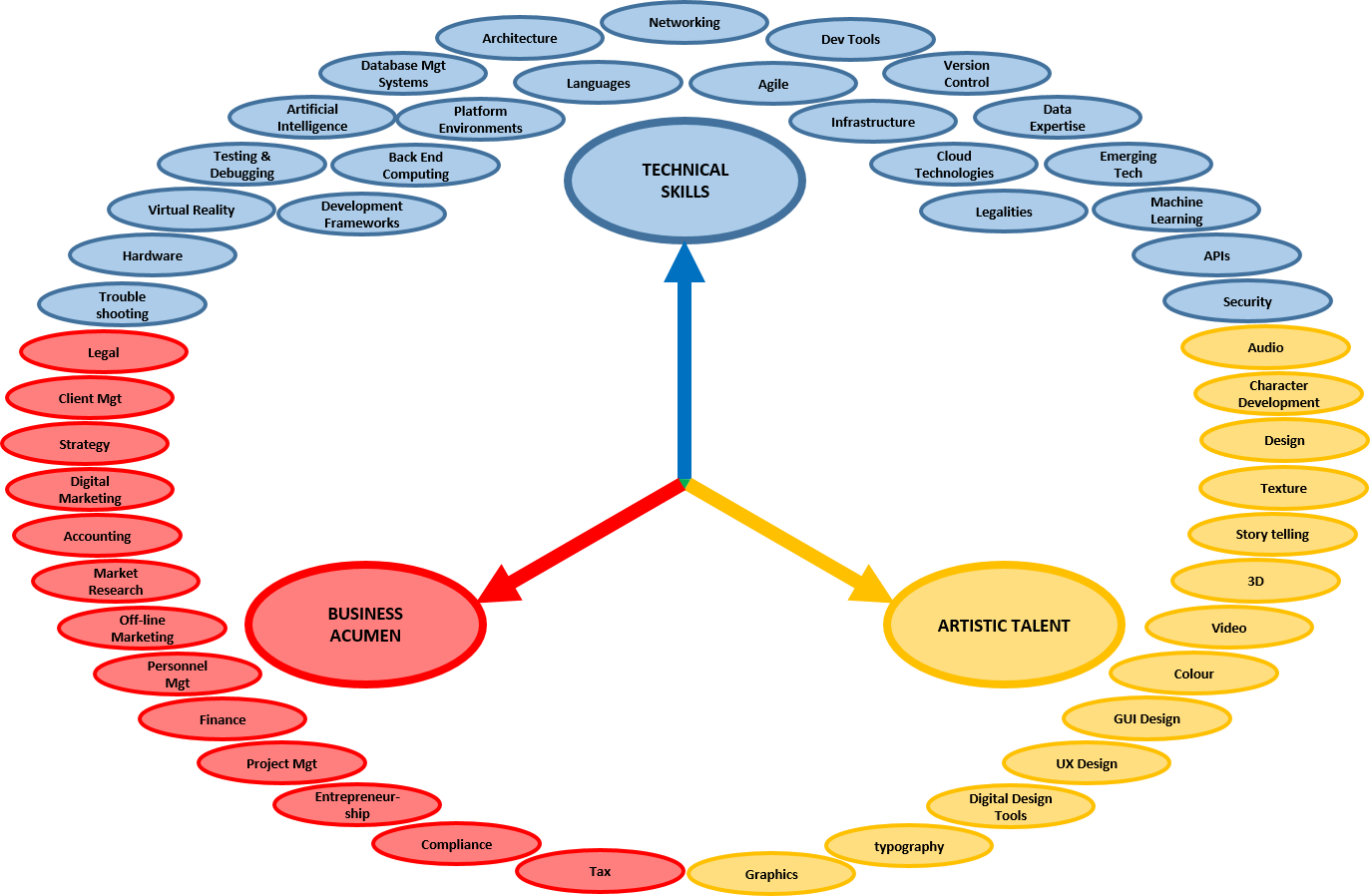
I started by looking at the key skills and competencies that
a great app developer needs, and through brainstorming, with some internet
research, I found myself developing a model to help me to see where I need to
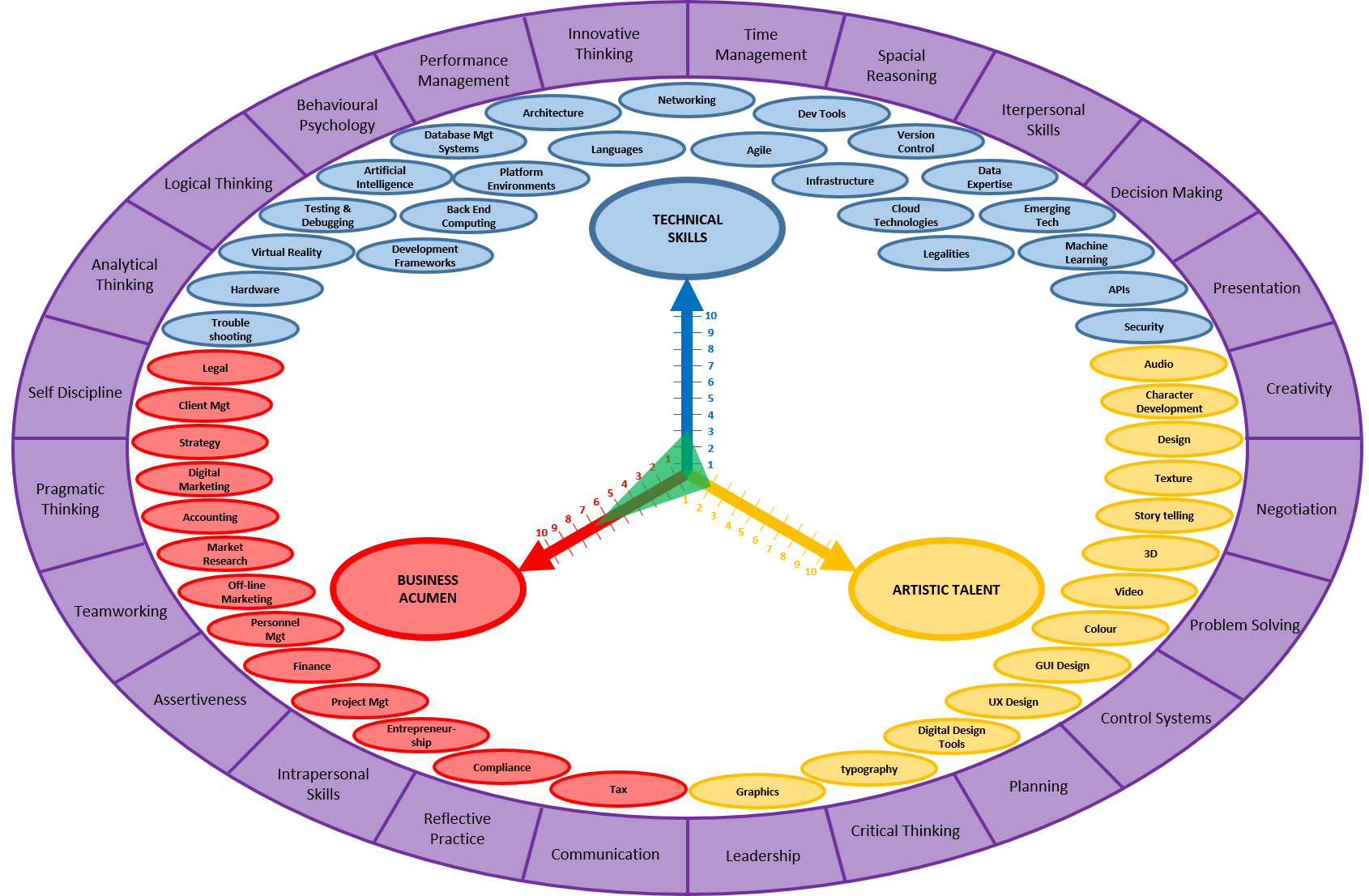
be. This is how I see it:
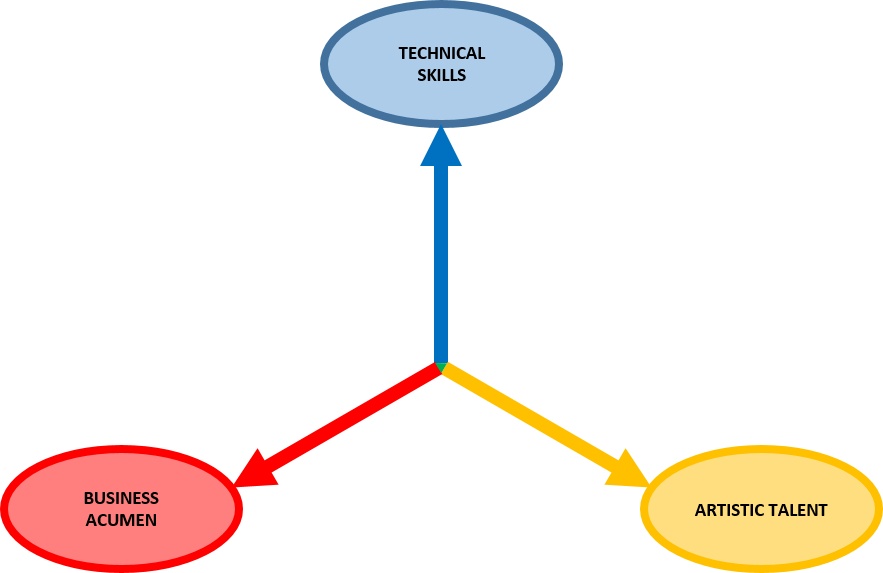
The skills, group nicely into a trinity of families:
Technical skills – so that I can create and build an excellent product
Business acumen – so that I can identify market needs and create a business model that successfully delivers a financially viable solution.
And artistic talent – so that I can deliver a user experience that supports the brand, creates another competitive selling point, and nurtures adoption and loyalty.
And I rank them in that order of importance for me.
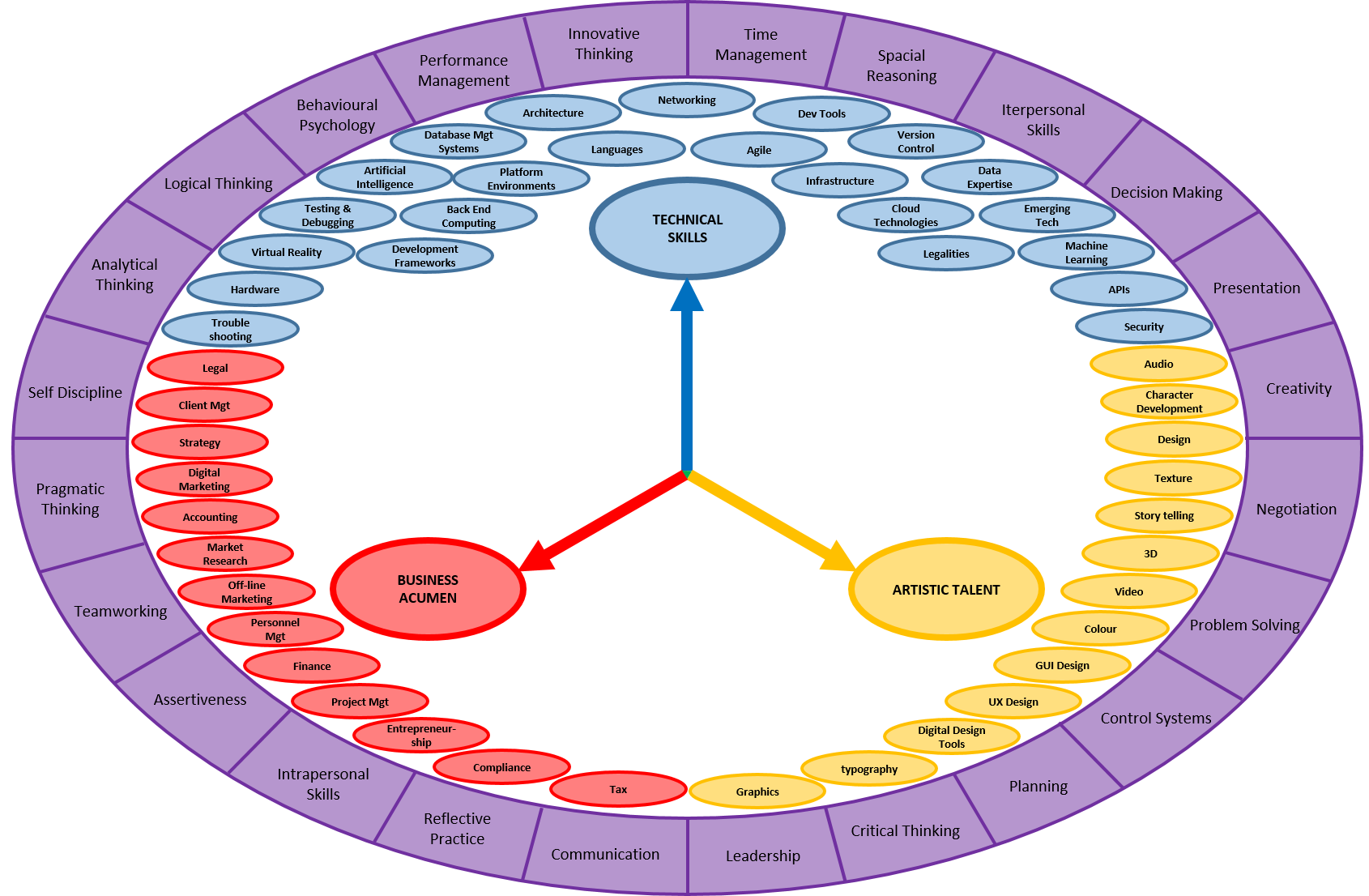
Each of the skills families is an umbrella for an array of hard skills, each with its own level of relevance and priority in terms of how it impacts my own short, medium and long-term objectives.
And all of this is supported by a range of soft skills.
I conducted a subjective self-assessment of my starting
point, based on my achievement to date and peer comparison, and the green
triangle represents my perceived current capability as an app developer.
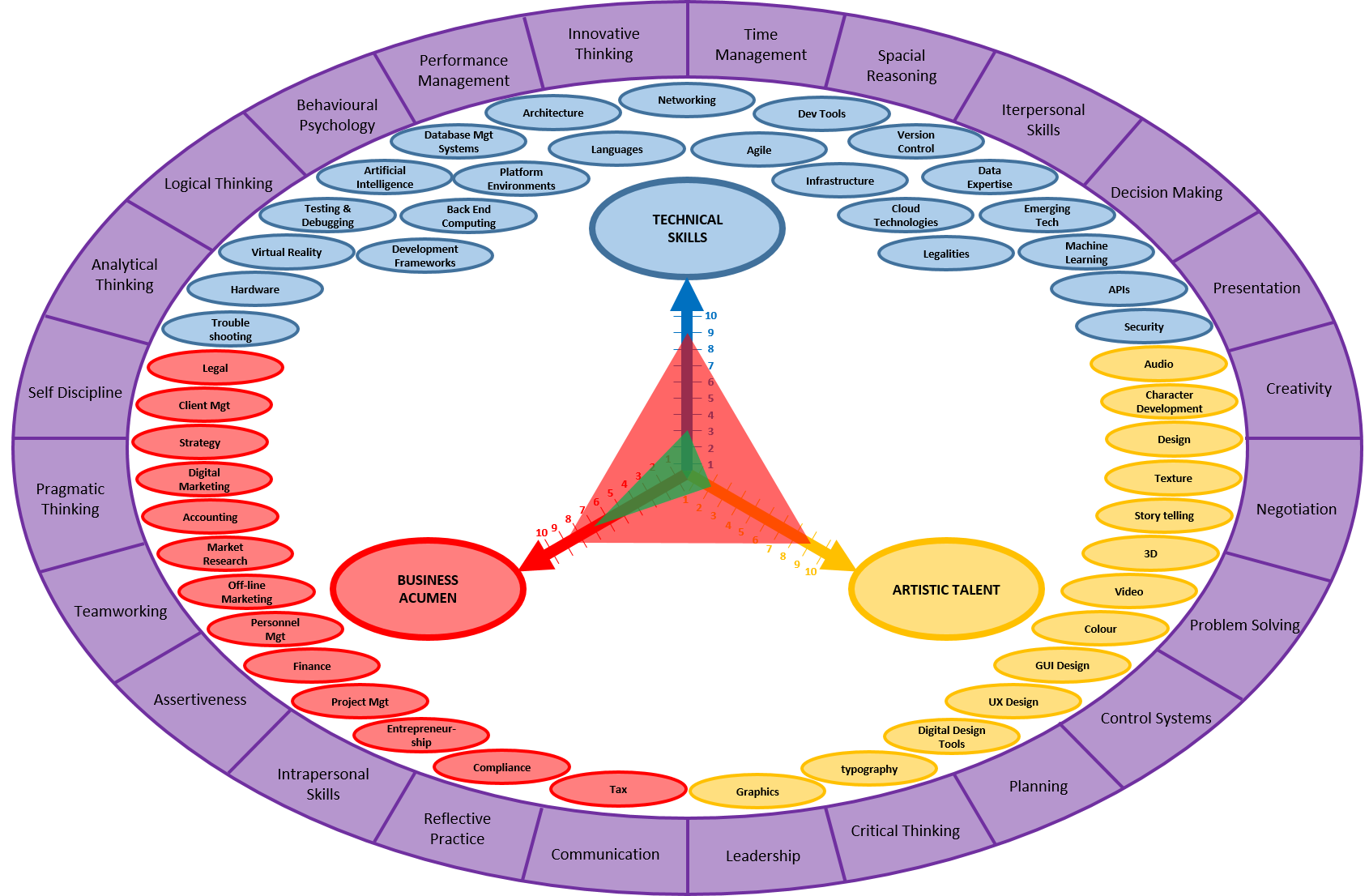
I intend to get my business venture off the ground on my own,
initially, and gradually build my team of specialists around me, as and when
necessary, and so I need to spend the next 2 years bringing my score for each
of the skills families to at least a 9.
The red area represents my currently perceived skills gap.
The arrows at the end of each scale, point toward infinity, representing
my appreciation for endless learning opportunity, in order to exploit new
technologies, rapid adaptation of developing industry trends, and satisfy
ever-changing consumer demands.
My priorities for the course lie with the development of my technical
skills. It’s imperative that I bring
those up to speed as quickly as possible, so that I have a solid foundation for
the rest of the course.
I may not have an IT background, but I do bring some solid
transferrable skills. I’m very
analytical and pragmatic, with a good balance of both logical and creative thinking
for problem solving. However, building this
model brought a realisation that I hadn’t fully appreciated the enormity of the
task ahead, and just how much of it is completely new to me. I’m viewing this as a stretching, but
achievable challenge that I’m fully committed to, but, at times, I’ve felt a
little overwhelmed by the size of the skills gap, and there is a degree of
imposter syndrome that I’m currently wrestling with.
I just need to keep a calm head, eat this
elephant one bite at a time, and trust in the support network and resources that
the course provides, to help get me there.
The App Jam
The week 3 app jam was an end-to-end development exercise, with a theme based on the words “guide”, “opponent” and “restricted”, which were generated using VNA cards. This was an opportunity for me to draw on everything I’d learned, and assess my strengths and weaknesses within that context. I knew from the outset that the jam had come far too early in the process for me, as I lacked the necessary technical skills. Although, I hadn’t discounted the possibility at that point, I knew that building a fully working app wasn’t a realistic goal for me. So, I primarily focused on what I could learn from the process of the jam, with the aim of creating a paper prototype and then building a fully working app if I could improve my skills sufficiently in time, but this became a secondary concern for me.
As expected, I didn’t get to build the app. But I did get a good experience of the
process, taking away some key lessons:
The right tools for the job
I need experience with the best tools for the job.
Flutter
I tried to get some Flutter experience before starting the jam. I’m now content that Flutter is the best development strategy for me, as it allows me to develop for both Android and iOS platforms with a single code base, and it’s reported to be relatively straightforward to learn. However, it’s completely new to me and there just wasn’t enough time to get to grips with it in any real depth.
Dart
Flutter uses the Dart language, and so a solid general understanding of that will also be highly beneficial for me.
Process flow tool
During the creative piece from week 1, I had identified a need to find a more appropriate tool than PowerPoint to draw up process flow diagrams, but I hadn’t managed to do this in time
Wireframing tool
and it’s a similar situation with wireframing. I did look at InVision as a possible tool, to help planning screen layouts, but learning how to use it was time that I couldn’t afford if I wanted to achieve anything else before the deadline. So I reverted to PowerPoint. It does deliver aesthetically pleasing results, but it’s time consuming and becomes fiddly when working with small detail. Maybe I should have settled for hand drawn sketches? I’ll explore this further.
Time estimation
I based my plan for the jam on what I’d learnt from the week
1 creative piece. While the structure was, on the whole, fairly sound, my time
estimations for each phase weren’t always very accurate. I compensated for slippage by adjusting and
capping subsequent tasks to stay on track.
Experience will help with this, but I’ll also look to adopt some Agile
principles to improve my project management skills.
Select projects that inspire me
I generated a list of theme ideas, and decided to pursue my “Quick
Cook Challenge” app idea, as it was something that I thought I might use
myself, and some rudimentary research identified that there might be an
opportunity in the market for it. But,
after working on this for a few days, I noticed myself beginning to
procrastinate, which told me that I wasn’t as invested in the concept as I’d first
thought, and I had to be quite disciplined to make progress with it. I might have avoided this by generating a
theme that I could really get excited about, had I afforded more time for the
theme generation phase, and applied a more strategic concept assessment and selection
criteria.
Subconscious thinking is valuable
Many of my better creative ideas happened while I was doing
something completely unrelated, with thoughts just popping into my head from
nowhere. I need to capitalise on this
and build purposeful breaks into my plan at the appropriate times, to allow for
this subconscious ideation to happen.
Taking all of this into account, my main objectives for the
remainder of the module are:
Objectives for the rest of module 1
Programming
Before the next Module starts, I will use Flutter to build a working prototype for the “Quick Cook Challenge” app, from the jam. I will apply the principles learned as I go through 6 Flutter and Dart tutorial courses, to create a fully working prototype. I will dedicate 18 hours per week to this, as it is essential that I can comfortably build an app of a decent standard, for the rest of the course. To further improve my capability, I will also read “Think Like a Programmer”, and engage with the Flutter community, by connecting with relevant individuals and groups on social media platforms, as well as sharing ideas with others within the study group who also have an interest in Flutter.
2. Version Control
By 26/04/19 I will be comfortable using Git and GitHub for version control, both from the command prompt, and through Android Studio, so that I am well prepared to work on collaborative projects. I will spend 2-3 hours per week taking 2 video tutorial courses.
3. Development tools
Before the next Module starts, I will select and learn how to use:
A process flow diagramming tool to draw process flow diagrams more easily
A wireframing tool to create medium fidelity screen plans more quickly
I will assess 2 or 3 of each type, analysing the benefits over using pencil and paper, and select the ones that I feel most comfortable with, if any. These tools could prove very useful during future app development projects.
4. Better time management
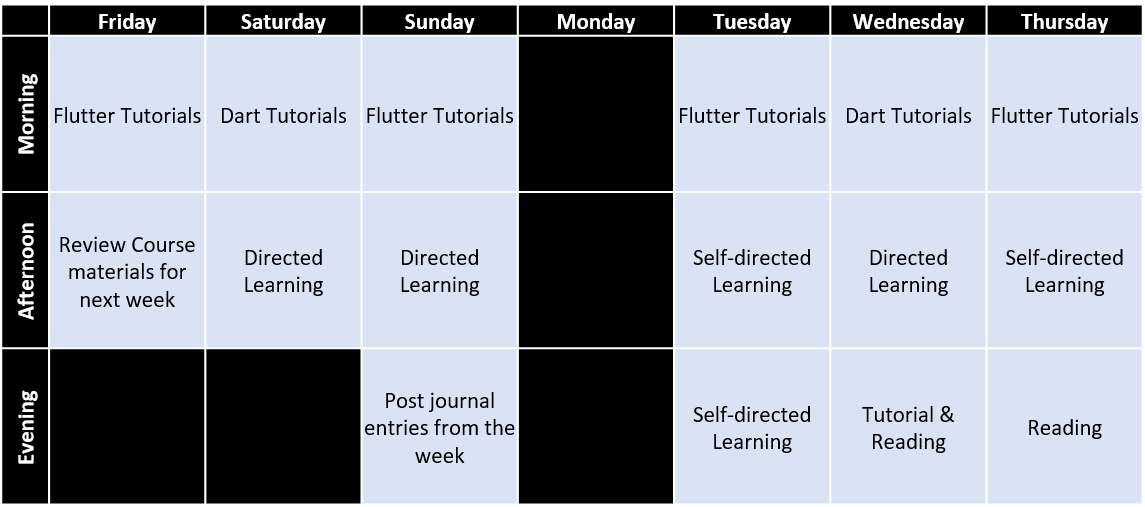
Feedback has, so far, been largely positive, and encouraging, but I’m finding myself falling behind the pace of the course, a little. I need to adopt a more structured, but flexible, approach to managing my week, to help me to achieve a good balance of technical skills and coursework. I’ll spend the next 2 weeks catching up, and then work to keep pace going forward, using this weekly plan, of 3 hour periods:
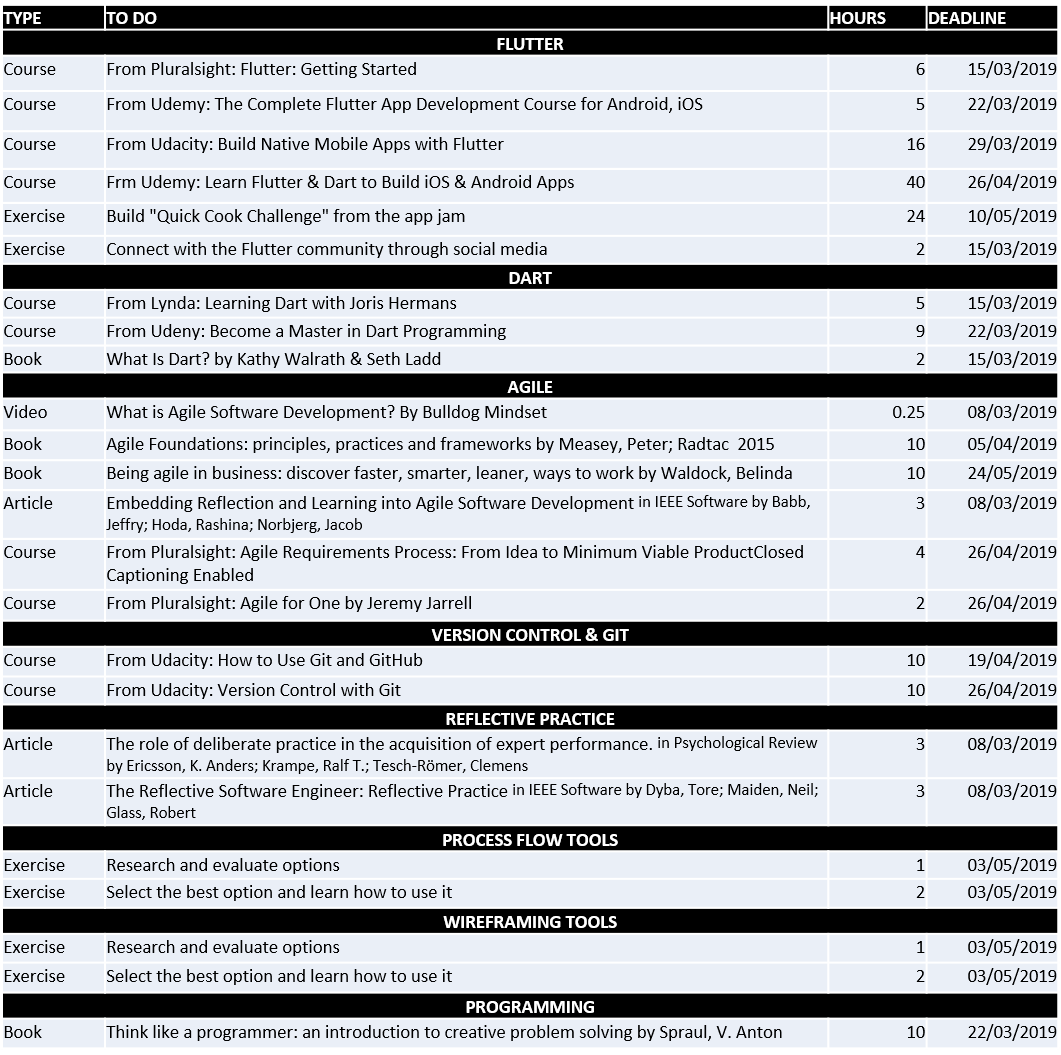
And this is how it all fits into my plan for the rest of the
module.
I found the paper “Using Journal Writing to Enhance Reflective Practice”, by David Boud,, helped me to develop my understanding of the importance of engaging in reflective practices
For my own sake, I will outline here the key points that I took from reading this paper, which defines reflection in the following way:
Reflection has been described as a process of turning experience into learning. That is, of exploring experience in order to learn new things from it. Reflection has been described as ‘those intellectual and affective activities in which individuals engage to explore their experiences in order to lead to new understandings and appreciations.
Boud, Keogh and Walker 1985: 19
The following points are made to elaborate on the the ways in which reflection is an effective learning aid:
Reflection is about taking the raw, unprocessed material of experience and engaging with it to make sense of what has occurred
Exploring often messy and confused events and focusing on the thoughts and emotions that accompany them.
Events and experiences are recorded, processed and performed.
The basic assumption is that learning is always grounded in prior experience, and that any attempt to promote new learning must take account of this learning.
All learning builds on existing perceptions and frameworks for understanding, and links must be made between what is new and what already exists.
Past experiences profoundly affect perceptions of what is and what isn’t important.
Much of the benefit of participating in any event derives from how it can shape our participation to suit our goals.
This paper has helped me to secure at least an overview of the main purposes of engaging in reflective practice through journaling.
While the Johari Window model has been a useful aid in getting to grips with critical reflective journaling, and feedback received to date indicates that I am moving closer toward satisfying the requirements of the assessment criteria, I am still not completely confident that I am getting this right. However, this week’s course material (which I think I might have found very useful in week 1) and the relevant recommendations on the reading list, are helping me with this, along with learning from continued feedback.
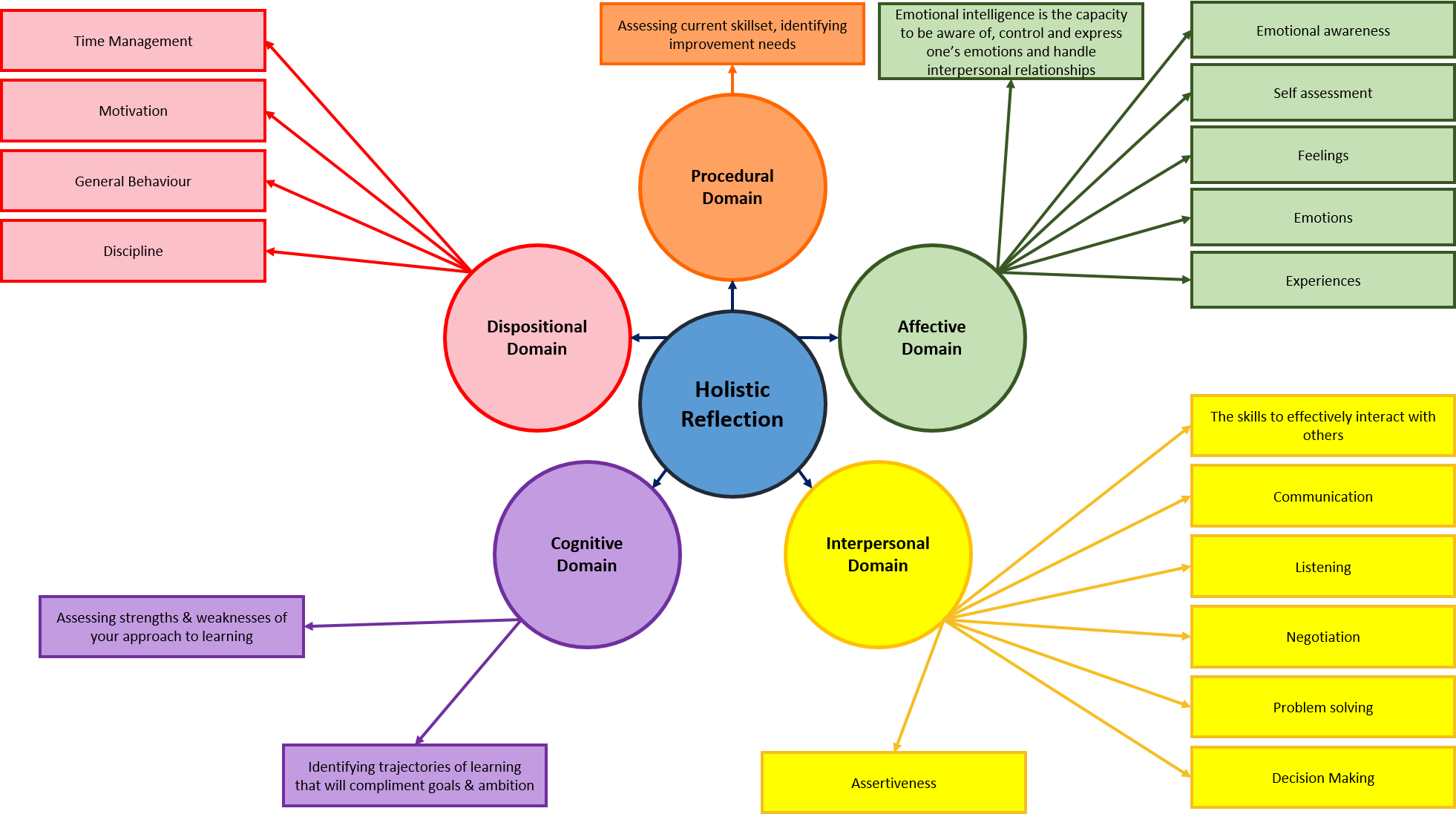
I found it helpful to interpret the video on the holistic reflection and the reflective domains into a model (above) which maps out what a holistic reflection needs to look like. I will attempt to use this in my reflective practice on order to find the right balance across all five domains. While each domain needs careful consideration when reflecting on any topic, I can see that the relative weights might vary, depending upon the nature of the subject matter in question. The skill to be mastered here is the ability to recognise where the emphasis needs to lie, in order to get the correct balance within any given context.
The focus for this week is on critical reflection and journaling.
I hesitate to be so candid here, and I have no intention to offend, but I understand that this is a space where I am required to say what I feel, so here goes…
If I’m totally honest, my initial instincts tell me that critical reflection and journaling are a bit of a waste of my time. At this point, it feels like an academic exercise that is a distracting nuisance, robbing me of a considerable amount of time. Time that could be better spent developing critical skills.
My objectives for this course primarily lie in gaining a good range of skills that will enable me to develop well received, commercially lucrative apps. I therefore want to spend the vast majority of my time focusing on achieving coding expertise and development best practice, as well as improving my business and design capabilities.
Considering the marking schemes for this module, I notice the emphasis on reflective practices and self-analysis. I’m sure that is by design, rather than by accident, or purely for the box-ticking sake of it, and so, I am prepared to suspend my judgement, and approach creative reflection and journaling with an open mind. I will trust the process, actively strive to discover the value in it, and see if I can make critical reflection and journaling beneficial for me. I’m not saying that I’m right to feel the way I currently do – I’m merely saying this is how it is at leas at this point, but I am open to having my opinion changed.
I am new to critical reflection journaling, and for the past 3 weeks, I have struggled with it. Knowing what to share, and how to share it within this arena is not something that has come naturally to me, and I think that I have found it difficult to strike the right balance.
This situation has brought to mind the Johari Window model ( Joseph Luft and Harrington Ingham, 1955 ), that I was introduced to many years ago during a training course. The concept resonated with me at the time, and has stuck with me ever since. The model is used as a basis upon which to examine interpersonal and intrapersonal communication, and how relationships can be effected by the appropriateness (or otherwise) of what information is and isn’t shared between relevant parties.
The model provides a simple framework for us to think through the consequences, and decide which box is most appropriate for a piece of information, within a specific context. A lot of social media users would do well to consider the Johari Window model before posting!
I’m still not entirely convinced that much of the content of this post shouldn’t have remained in the ‘Hidden’ box (i.e. kept to myself), but, if nothing else, I can always learn from the reception it gets.
Being the first book on the reading list, I thought this might be a good starting point. I read the preface and first two chapters. It makes for a very dry read. Social work is used as a context for much of the illustrative examples.
I do intend to revisit this book and read the rest of it. However, there are nine other books for me to get through on the resource list and I feel that this one deserves a place nearer bottom of the priority list.







 My Journey to App Success