
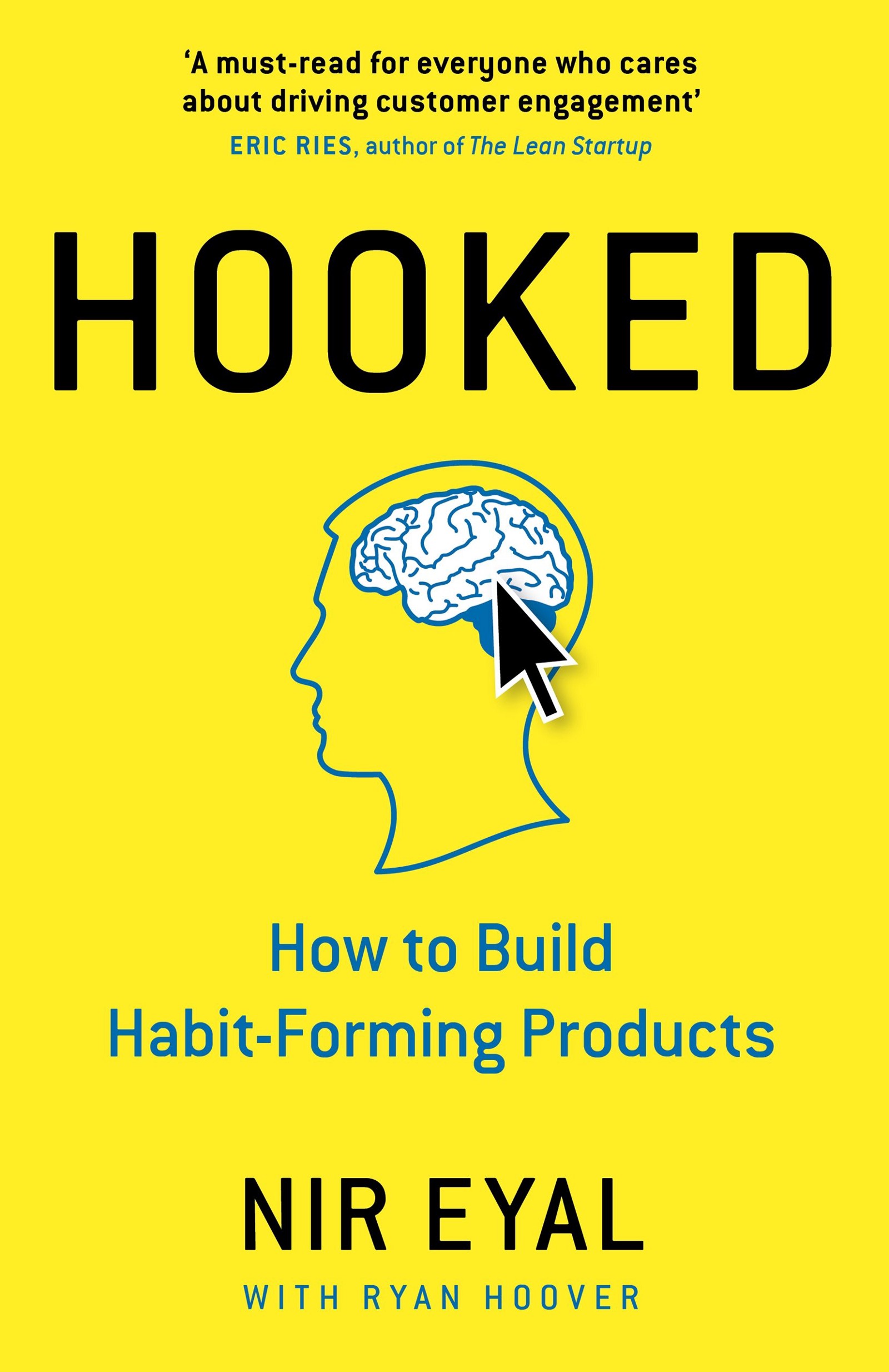
My week 8 SMART goal was to read “Hooked: How to Build Habit Forming Products” by Nir Eyal. And what a fascinating read it was!
Hooks and stickiness were raised in the course materials in week 8 and I thought it would be an interesting and valuable area for further research, and I wasn’t wrong.
Nir Eyal is a Behavioural Psychologist with a particular interest in consumer behaviour within a technology context. His book, “Hooked” sets out to explore why some apps capture the attention of the market, while others just don’t.
Based on years of research, Eyal has identified the four elements that must be integrated into a product’s design in order to attract users, maintain engagement, create a desire within the user to use the app repeatedly, and even establish this behaviour as a habit. The book discusses the application of the Hook Model that he developed:
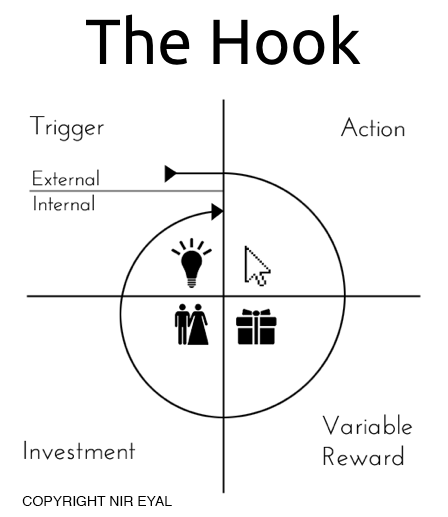
The Hook Model represents a 4 stage process that an app designer should lead their user through in order to create a stickiness and elicit habitual engagement. The 4 stages are:
1. Trigger
A trigger is something that prompts the user to take action of some kind. Initially, external triggers must be provided (for example, a notification with button to be clicked) in order to guide the user into your app. Eventually, this should cultivate an association between visiting your app and the rewards that this action brings for the user, and so internal triggers will take over as the impetus. Internal triggers are (mostly negative) emotional cues, such as boredom or hunger, that your user learns to satisfy by using your app. Internal triggers are critical to habit formation.
My “Quick Cook Challenge” app concept could provide an external trigger in the form of a strategically timed (maybe 3pm as it tends to be a low point in the day and people start to think about what they will have for dinner) notification which, when clicked, provides a randomly selected recipe. Hopefully, over time, the user will build an association between their feelings of hunger and the rewards (recipes) that the app provides, and so this internal trigger will be the foundation upon which a new habit will develop for them.
2. Action
The action is a simple behaviour that is carried out by the user with the expectation of a resultant reward. For example, entering keywords and clicking the search button in Google with the expectation of receiving answers to questions.
My “Quick Cook Challenge” app concept will provide lists of recipes to choose from, prompting the user to scroll to see what is available, and what’s new.
3. Reward
The reward is the reason for visiting the app. It is the value that the user receives from the app. The nucleus accumbens is the area of the brain that is activated by desires and cravings, and it is most active when a reward is anticipated. The brain is fascinated by the unknown, and so the nucleus accumbens can be further stimulated with the added suspense of an unknown or unexpected reward (for example, the content is different each time a user logs into Facebook). This is the reason why apps that provide variable rewards tend to become habitual far more quickly than those offering a predictable reward, with the habit lasting longer before the user begins to lose interest.
There are 3 categories of reward:
- Rewards of the tribe
- Value derived from other people that makes the user feel good, for example, replies and likes on Facebook or retweets on Twitter.
- Rewards of the hunt
- Value derived from the user’s own efforts, for example finding interesting articles from scrolling through Pinterest.
- Rewards of the self
- An intrinsic pleasure, with an element of variability, such as a feeling of accomplishment, achievement or completion, for example, levelling up on Candy Crush.
The more types of reward that an app offers, the better the chances of establishing a user habit.
My “Quick Cook Challenge” app concept will provide rewards of the tribe in the form of feedback and ratings on their own posted recipes and culinary attempts. Rewards of the hunt will be provided when they find recipes from other people that interest them, and reading feedback that has been left for other people’s recipes and results (which can be entertaining). Rewards of the self should be realised when the user has followed a recipe, enjoyed a meal, and satisfied their hunger because of it. if sponsorship could be secured, physical rewards and prizes could also be earned for the best and worst rated recipes and results, which would further encourage usage of the app.
4. Investment
The investment phase is where the user is encouraged to provide value to the app, for the purpose of increasing the likelihood of their next pass through the Hook Model process. This investment could be monetary (for example purchasing extra lives in a game) but other examples might include increasing their reputation through contributing to group discussion, gaining followers or generating and sharing content. All of these investments build to create a barrier to exit for the user, which might be a considerable factor in retaining their loyalty, should the user ever be faced with the decision to stick with your app or ditch it in favour of direct competitor.
My “Quick Cook Challenge” app concept provides many opportunities for user investment. They can upload their own recipes, provide feedback and ratings for recipes that other users have uploaded, share the results of their culinary efforts in anticipation of comments and ratings, and provide comments and ratings for the culinary results of other users.
While my “Quick Cook Challenge” app concept already incorporated many of the elements of Nir Eyal’s Hook Model, this was more by accident than by intentional design. I think the Hooked Model is an incredibly valuable find, and I fully intend to purposely incorporate what I’ve learned from this book in all future app designs.
 My Journey to App Success