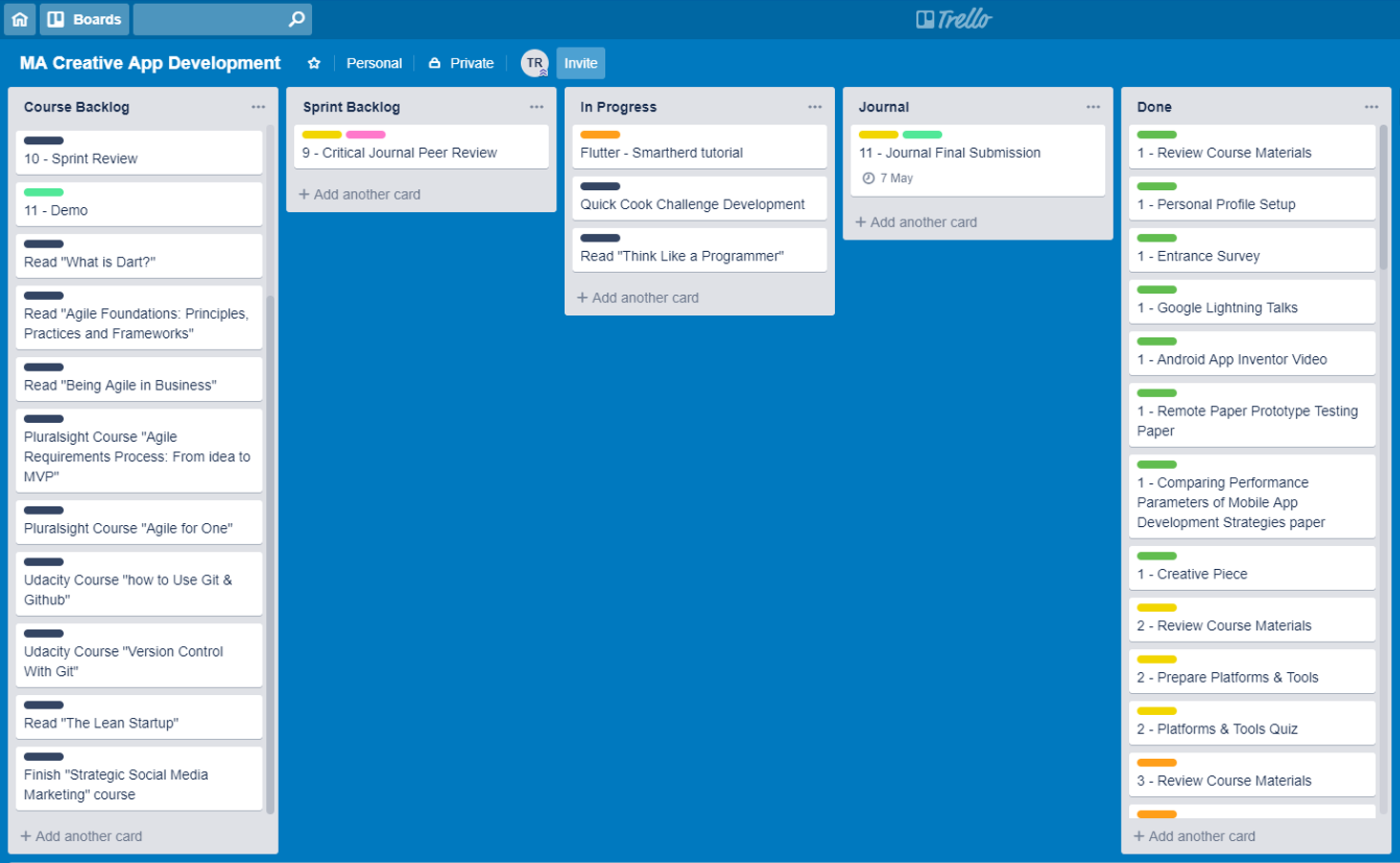
Now that I have visibility of each task (rather than at a weekly topic level) I can see exactly where I am.
I can now use this board to properly plan and review my weekly sprints, and organise myself more efficiently, and so I consider my SMART goal from week 9 to be achieved.
It’s also quite nice to be able to slide each card to the right, as it helps to garner a satisfying feeling of accomplishment.
In all honesty, I’ve struggled with reflective practice. I’m more comfortable facing questions requiring convergent thinking, with a definitive correct answer to strive for, than those requiring divergent thinking to reach an outcome judged with subjectivity. I’m somewhat uncomfortable with the uncertainty of whether I’m meeting expectations, and, being an analytical thinker, I find it difficult to know when to stop. I do proactively seek frequent feedback, which helps.
Until very recently, I’ve
viewed reflective practice as an inconvenience – a distraction to my learning
progress. This attitude, along with my focus on developing my Flutter
capability, is largely responsible for my falling behind with my critical reflection
journal. While I’ve recognised the value
in understanding what went well (and should be applied again) and what didn’t
(so do something different) in a given context, I’ve been puzzled by the apparent
heavy emphasis for this module.
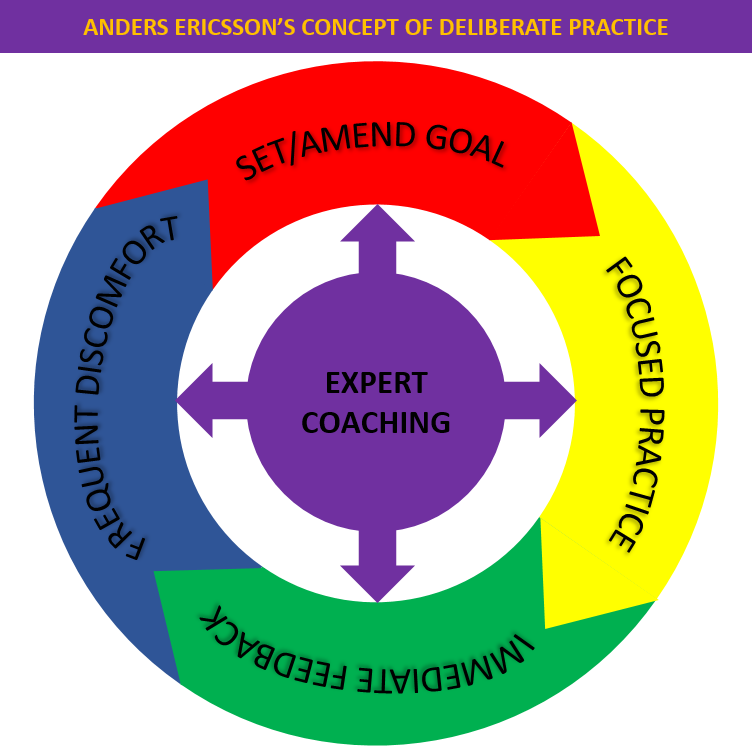
However, I’ve recently engaged with Anders Ericsson’s work on Deliberate Practice. It provoked a turning point for my perception. Building the following representation of Ericson’s cyclical process for incremental development of expertise helped me to see that the structured proactive approach to reflection stimulates creative insight and mental adaptation. This encourages elaboration, and the formation of associations between known and new concepts, to form alternative representations, and view situations from different perspectives to expedite learning.
I’m beginning to recognise
that I should embrace reflective practice, as it could actually be my passport
to app development mastery.
My Critical Reflective Journal
will be brought up to date by 29th April
Deliberate practice expedites learning. Active retrieval provides a self-assessment of my comprehension, which is fundamental in identifying improvement opportunity, enabling me to effectively plan future activity for efficient progress.
I have 3 weeks to post blog entries for weeks 5 to 11. Using my notes, I will dedicate 6-8 hours per week to achieving this.
Regular requests for Tutor/study
group feedback, will help me continue to achieve incremental quality improvement.
Specific
I will post journal entries reflecting on the work that I have covered in weeks 5 to 11.
Measurable
I will use my Trello board to plan and implement weekly sprints, to include journal entries covering 2-3 weeks coursework, and chart my progress.
Achievable
Time is my key constraint, but I can afford to allocate 6-8 hours per week to achieve this. I’ve kept notes on everything that I’ve worked on.
Relevant
This module requires submission of a complete journal, and it’s a skill that I will use to assess and drive the progress of my continuing professional development.
Time-Bound
This will be done by 29th April. I will complete entries covering 2 weeks coursework, each week, over the next 3 weeks
This week’s materials cover some aspects of managing large scale projects. There was a comparison of the (considered somewhat outdated) waterfall approach and the Agile approach.
I spent the last 17 years as an independent Excel/VBA Development Consultant, and my approach to each project was very much in line with the waterfall approach, as the video demonstrated. I can see many advantages to be gained from taking an Agile approach instead, but within a consulting context, I suspect that it would be very much dependant upon the culture of the client organisation as to whether they would be willing to accommodate that. In my experience, clients want to hold the consultant to a clearly defined set of objectives and a predetermined budget, and I’m fairly certain that the clients that I have worked with would never have achieved sign-off for a business case that didn’t explicitly dictate these things. That said, it was very often the case that once the client began to learn of the potential for additional functionality for the model or system that I was building, they would then set to battle for sign-off on an amended and extended business case. This process often makes for a less than efficient development process, but at the end of the day, the client gets what the client wants.
Having done a significant amount of self-directed investigation into the mechanics of an Agile approach in week 4, I won’t go back over the ins-and-outs of an Agile process with this post. However, as I’ve said previously, Agile was not something that I had come up against prior to this course, and while I’m confident that I understand the theoretical process, I’m keen to become a part of an Agile run project as I don’t believe that you can fully appreciate the practicalities of such a situation until you have been a part of it in operation. I’m sure that I’ll have plenty of questions when the time comes.



 My Journey to App Success